
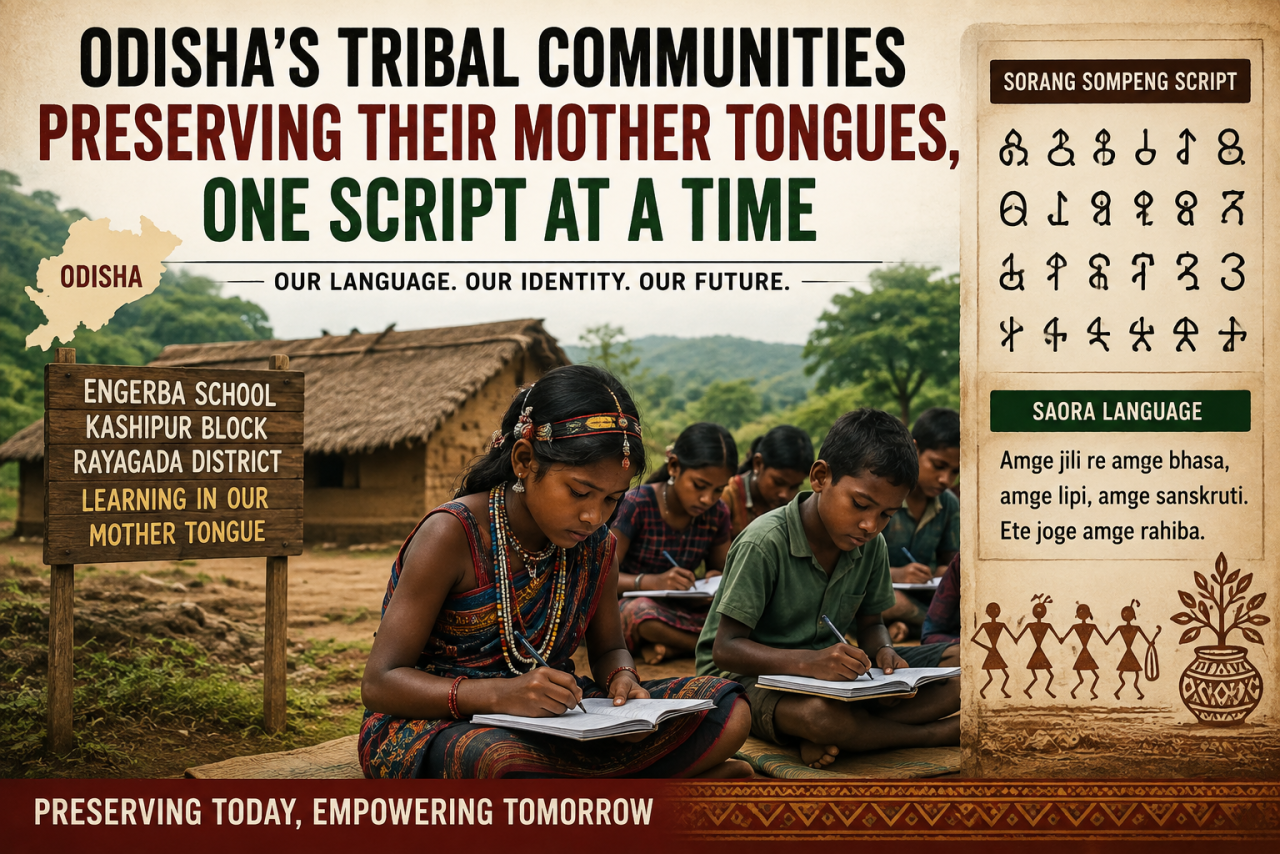
As tribal languages face the threat of extinction, communities in Odisha are creating their own schools, scripts and learning systems to ensure their mother tongues survive for future generations.
In Odisha’s Rayagada district, tribal communities are running a race against time to preserve their mother tongue, something no government scheme can fully protect.
In Engerba village of Kashipur block, the Saora community has spent nearly two decades developing an education system that places the native language at the heart of learning. Children are taught in Saora before gradually being introduced to Odia and English. The approach emerged from a growing concern among tribal families that children were losing fluency in Saora and the Sorang Sompeng script soon after entering formal schools.
The community’s response has been both simple and ambitious for building an education system around the language children already speak at home.
The Engerba school was established more than a decade ago by Giria Sabar. After his death, the community chose to continue the initiative rather than allow it to disappear with its founder. Today, students take examinations in Saora and the Sorang Sompeng script, while tribal teachers develop structured lesson plans and teaching methods themselves.
Textbooks have been translated into Saora, while instructional material that once existed only through oral traditions is being transcribed into Odia and Sorang Sompeng before reaching students. English instruction is deliberately introduced at a later stage, giving children time to establish a strong foundation in their mother tongue.
At Mangali Ashram School in the SP Bhubaneswar cluster, another community-led initiative is following a similar path. Sixty-two students from four villages in Rayagada district study the Sorang Sompeng script under an incentive-based programme. Families contribute food grains, while villagers pool their savings to develop classroom infrastructure.
The initiative survives without state funding. Its strength comes from the community itself.
A Language Crisis Hidden in Plain Sight
The struggle in Rayagada is part of a much wider challenge facing tribal languages across Odisha.
The state is home to numerous tribal communities and dozens of dialects. Researchers have also highlighted the precarious position of languages such as Kurux, which continue to struggle for formal recognition and institutional support.
Language researcher Gobardhan Panda has spent years documenting Kurux and working with communities to encourage younger generations to continue speaking their native language instead of shifting entirely towards Odia or Hindi. His work includes language classes and community meetings conducted without government support.
For communities facing language loss, the problem is not simply the disappearance of words. It is the erosion of a cultural archive.
A language carries memories, traditional knowledge, songs, stories, rituals and ways of understanding the natural world. When younger generations stop speaking it, that knowledge can become increasingly difficult to transmit.
When a Script Becomes a Lifeline
The danger becomes even more visible among languages with limited written traditions.
Santhali, Ho, Sora and Kui are among the tribal languages in the region associated with their own scripts. Others have historically depended much more heavily on oral traditions, with stories, songs and cultural knowledge passed from one generation to another through families and community gatherings.
In Malkangiri district, the situation is particularly serious for Remosam, a language associated with the Bonda community. Only a few thousand fluent speakers are estimated to remain, concentrated largely in the Bonda Hills.
Panda, who has worked with the Remosam-speaking community since the early 1980s, has helped document the language and develop teaching materials with local speakers. Yet the work continues under severe financial constraints, with many contributors receiving little or no remuneration.
Even here, communities have developed their own survival mechanism. Villagers contribute meals and share resources so that students can attend language classes.
It is not a conventional education programme. It is a community deciding that its language is worth sacrificing for.
The Cost of Losing a Mother Tongue
Across Odisha, similar documentation and preservation efforts are being undertaken among communities including the Bonda, Didayi and Oraon.
Weekly meetings, community classes and documentation projects are being used to preserve languages that could otherwise disappear within a few generations.
The urgency comes from a fear that is deeply personal.
For elders, losing a language means losing a part of their identity. A script may appear to be merely a system of symbols, but behind those symbols lie songs, histories, folklore and collective memory. When the language disappears, much of that cultural memory becomes harder to recover.
This is why the efforts in villages such as Engerba deserve attention. They are not merely exercises in linguistic preservation. They represent communities asserting control over their cultural future.
Preservation Without Institutional Protection
What makes these initiatives particularly striking is their grassroots character.
Communities are contributing money, food and labour to establish classrooms, develop teaching material, translate textbooks and sustain teachers. In many cases, institutional support remains limited.
The Constitution’s Eighth Schedule provides formal recognition to a select group of Indian languages, but most tribal languages remain outside that framework. For many communities, therefore, the first line of protection is not an institution but the people who speak the language themselves.
That creates both a powerful example and a troubling question.
Grassroots determination can preserve a language for a time, but can it sustain that language across generations without wider institutional support?
A Model for India’s Multilingual Future
India’s debate over multilingual education has often focused on policy, curriculum and the balance between regional and global languages. The experience of Odisha’s tribal communities adds another dimension to that debate.
The question is not whether children should learn Odia, Hindi or English. It is whether they should have to abandon their mother tongue in order to learn them.
The villages of Rayagada offer a different possibility. Children can learn additional languages without first losing the language of their homes.
The lesson from Engerba is therefore larger than the preservation of Saora or Sorang Sompeng. It is about ownership.
A language survives when its speakers believe that its survival matters. But community determination alone cannot carry the entire burden indefinitely.
If India’s multilingual future is to include its smallest linguistic communities, preservation must move beyond occasional documentation projects and become part of mainstream education and cultural policy.
The people of Engerba have already made their choice. Their mother tongue is not a relic to be archived. It is a living inheritance to be passed on.
And for them, its survival is non-negotiable.
In Odisha’s Rayagada district, tribal communities are running a race against time to preserve their mother tongue, something no government scheme can fully protect.
In Engerba village of Kashipur block, the Saora community has spent nearly two decades developing an education system that places the native language at the heart of learning. Children are taught in Saora before gradually being introduced to Odia and English. The approach emerged from a growing concern among tribal families that children were losing fluency in Saora and the Sorang Sompeng script soon after entering formal schools.
The community’s response has been both simple and ambitious for building an education system around the language children already speak at home.
The Engerba school was established more than a decade ago by Giria Sabar. After his death, the community chose to continue the initiative rather than allow it to disappear with its founder. Today, students take examinations in Saora and the Sorang Sompeng script, while tribal teachers develop structured lesson plans and teaching methods themselves.
Textbooks have been translated into Saora, while instructional material that once existed only through oral traditions is being transcribed into Odia and Sorang Sompeng before reaching students. English instruction is deliberately introduced at a later stage, giving children time to establish a strong foundation in their mother tongue.
At Mangali Ashram School in the SP Bhubaneswar cluster, another community-led initiative is following a similar path. Sixty-two students from four villages in Rayagada district study the Sorang Sompeng script under an incentive-based programme. Families contribute food grains, while villagers pool their savings to develop classroom infrastructure.
The initiative survives without state funding. Its strength comes from the community itself.
A Language Crisis Hidden in Plain Sight
The struggle in Rayagada is part of a much wider challenge facing tribal languages across Odisha.
The state is home to numerous tribal communities and dozens of dialects. Researchers have also highlighted the precarious position of languages such as Kurux, which continue to struggle for formal recognition and institutional support.
Language researcher Gobardhan Panda has spent years documenting Kurux and working with communities to encourage younger generations to continue speaking their native language instead of shifting entirely towards Odia or Hindi. His work includes language classes and community meetings conducted without government support.
For communities facing language loss, the problem is not simply the disappearance of words. It is the erosion of a cultural archive.
A language carries memories, traditional knowledge, songs, stories, rituals and ways of understanding the natural world. When younger generations stop speaking it, that knowledge can become increasingly difficult to transmit.
When a Script Becomes a Lifeline
The danger becomes even more visible among languages with limited written traditions.
Santhali, Ho, Sora and Kui are among the tribal languages in the region associated with their own scripts. Others have historically depended much more heavily on oral traditions, with stories, songs and cultural knowledge passed from one generation to another through families and community gatherings.
In Malkangiri district, the situation is particularly serious for Remosam, a language associated with the Bonda community. Only a few thousand fluent speakers are estimated to remain, concentrated largely in the Bonda Hills.
Panda, who has worked with the Remosam-speaking community since the early 1980s, has helped document the language and develop teaching materials with local speakers. Yet the work continues under severe financial constraints, with many contributors receiving little or no remuneration.
Even here, communities have developed their own survival mechanism. Villagers contribute meals and share resources so that students can attend language classes.
It is not a conventional education programme. It is a community deciding that its language is worth sacrificing for.
The Cost of Losing a Mother Tongue
Across Odisha, similar documentation and preservation efforts are being undertaken among communities including the Bonda, Didayi and Oraon.
Weekly meetings, community classes and documentation projects are being used to preserve languages that could otherwise disappear within a few generations.
The urgency comes from a fear that is deeply personal.
For elders, losing a language means losing a part of their identity. A script may appear to be merely a system of symbols, but behind those symbols lie songs, histories, folklore and collective memory. When the language disappears, much of that cultural memory becomes harder to recover.
This is why the efforts in villages such as Engerba deserve attention. They are not merely exercises in linguistic preservation. They represent communities asserting control over their cultural future.
Preservation Without Institutional Protection
What makes these initiatives particularly striking is their grassroots character.
Communities are contributing money, food and labour to establish classrooms, develop teaching material, translate textbooks and sustain teachers. In many cases, institutional support remains limited.
The Constitution’s Eighth Schedule provides formal recognition to a select group of Indian languages, but most tribal languages remain outside that framework. For many communities, therefore, the first line of protection is not an institution but the people who speak the language themselves.
That creates both a powerful example and a troubling question.
Grassroots determination can preserve a language for a time, but can it sustain that language across generations without wider institutional support?
A Model for India’s Multilingual Future
India’s debate over multilingual education has often focused on policy, curriculum and the balance between regional and global languages. The experience of Odisha’s tribal communities adds another dimension to that debate.
The question is not whether children should learn Odia, Hindi or English. It is whether they should have to abandon their mother tongue in order to learn them.
The villages of Rayagada offer a different possibility. Children can learn additional languages without first losing the language of their homes.
The lesson from Engerba is therefore larger than the preservation of Saora or Sorang Sompeng. It is about ownership.
A language survives when its speakers believe that its survival matters. But community determination alone cannot carry the entire burden indefinitely.
If India’s multilingual future is to include its smallest linguistic communities, preservation must move beyond occasional documentation projects and become part of mainstream education and cultural policy.
The people of Engerba have already made their choice. Their mother tongue is not a relic to be archived. It is a living inheritance to be passed on.
And for them, its survival is non-negotiable.



















Leave a Comment