
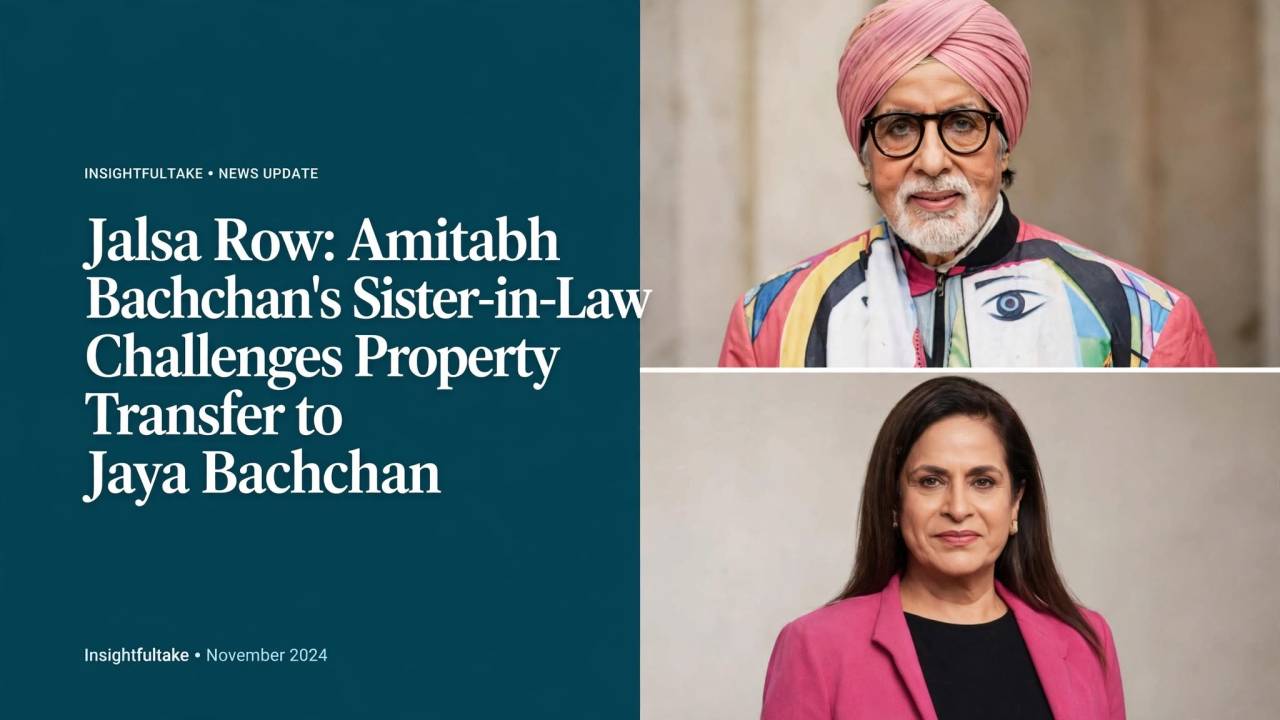
An alleged challenge to a 1993 gift deed has raised questions over the ownership of Amitabh Bachchan’s iconic Juhu bungalow, with conflicting property records now under official scrutiny.
In the leafy lanes of Juhu, where the Arabian Sea breeze carries the scent of old money and older secrets, stands Jalsa. For decades, the bungalow has been more than just a residence. It represents Amitabh Bachchan’s extraordinary journey and his enduring place in an industry that has seen generations of stars rise and disappear.
Every Sunday, fans gather outside its gates for a glimpse of the Bollywood superstar. Inside, three generations of the Bachchan family have shared their lives, celebrations and private moments.
But in the autumn of 2026, an unexpected question has emerged from official property records: Who actually owns Jalsa?
The question has reportedly come from within the extended Bachchan family. Ramola Bachchan, wife of Amitabh Bachchan’s younger brother Ajitabh, has challenged a 1993 gift deed that transferred the bungalow into the name of Jaya Bachchan.
According to reports first published by Mumbai Mirror and subsequently carried by several media outlets, Ramola claims that she neither knew about the transfer nor consented to it. She maintains that the bungalow was originally registered in her name. More importantly, she has pointed to an official government record that continues to carry her name.
Two Property Records, Two Different Owners
The central issue revolves around conflicting ownership records.
The records maintained by the Kapol Co-operative Housing Society reportedly identify Jaya Bachchan as the owner of Jalsa. However, the Maharashtra government's Property Card continues to list Ramola Bachchan.
The discrepancy has reportedly come into focus following alleged attempts to replace Ramola's name with Jaya's on the government document.
Over the past seven months, Ramola has submitted several complaints to registration authorities. The matter has now reached the Deputy Registrar of Co-operative Societies in Andheri.
Deputy Registrar Faiyaz Mulani has confirmed that proceedings have begun and responses have been sought from the parties concerned. However, no final decision has been announced.
The conflicting records have turned what might otherwise have remained a private family disagreement into an official property dispute.
The 1993 Gift Deed Under Scrutiny
At the heart of the controversy is a gift deed dating back to 1993.
As reported, Ramola's representations question the circumstances in which the document was originally prepared and executed. She has allegedly claimed that it was drawn up on plain paper, without payment of stamp duty at the time and without witness signatures.
The document was reportedly registered in 2006 and subsequently regularised under the Maharashtra government's Abhay Yojana, a scheme designed to facilitate the regularisation of certain older property documents and transactions.
Ramola has questioned both the original execution of the deed and the subsequent regularisation process.
These claims, however, remain allegations. No competent authority has yet ruled on the validity of the gift deed or determined the rightful ownership of the property.
The proceedings will therefore need to establish whether the document meets the necessary legal requirements and whether the subsequent registration process was valid.
Jalsa's Bollywood Connection
The bungalow's history is almost as interesting as the controversy surrounding it.
Originally known as Mansa, the property reportedly belonged to film producer N.C. Sippy. According to accounts that have circulated for years, it was given to Amitabh Bachchan as remuneration for his work in the 1982 film Satte Pe Satta.
The family reportedly sold the property at one stage before purchasing it again at a higher price, with Jaya Bachchan said to have played an important role in the decision.
The bungalow was subsequently renovated and renamed Jalsa on the advice of an astrologer.
Over the years, Jalsa became inseparable from Amitabh Bachchan's public identity. Its gates became a familiar landmark for fans, photographers and television crews.
For millions of admirers, there was never much doubt about whose house it was. The emerging dispute, however, suggests that the legal history of the property may be considerably more complicated than its public image.
Who Is Ramola Bachchan?
Ramola Bachchan has largely stayed away from the public spotlight despite her association with one of India's most prominent film families.
She married Ajitabh Bachchan in 1973, the same year Amitabh Bachchan married Jaya Bhaduri. The families have shared social connections dating back to the 1960s, when Amitabh was working in the shipping industry in Kolkata.
A fashion designer and entrepreneur, Ramola has also appeared on television. She and Ajitabh have four children. Their daughter Naina is married to actor Kunal Kapoor.
Unlike several members of the extended Bachchan family, Ramola has generally maintained a relatively low public profile.
Her decision to challenge a three-decade-old property document has therefore attracted considerable attention. Whether the dispute reflects a long-standing grievance or a more recent discovery of the documentary trail remains unknown.
Reports also indicate that her complaints include an RTI application and multiple representations to stamp and registration authorities during 2026.
The Bachchan Family Maintains Silence
The controversy has attracted attention partly because of the family's silence.
When approached by journalists, Ramola Bachchan and her son reportedly declined to comment. The Bachchan family has not issued a public statement addressing the allegations.
Some reports have placed the estimated value of Jalsa at around ₹100 crore, although the actual market valuation has not been independently established here.
For a family accustomed to public attention, the absence of an explanation has left considerable room for speculation. However, the legal proceedings, rather than media conjecture, will ultimately determine the outcome.
Beyond Celebrity Gossip: A Question of Property Rights
Property disputes within Indian families are not unusual. Questions over inheritance, ownership transfers, gift deeds and registration documents frequently lead to prolonged legal battles.
What makes the Jalsa controversy different is the public identity attached to the property.
Jalsa is not simply a valuable piece of real estate. It has become part of the Bachchan family's cultural legacy. Sunday appearances, festival photographs and decades of media coverage have turned the bungalow into a symbol of the family's permanence in Bollywood.
A dispute over its ownership therefore carries significance beyond its financial value.
It also highlights an important legal distinction: possession, society records, government property records and registered transfer documents do not necessarily answer every question in the same way. When records conflict, the underlying documents and the validity of the transaction become crucial.
The Final Word Is Yet to Come
The proceedings before the Deputy Registrar of Co-operative Societies have begun. Notices have reportedly been issued, and responses from the concerned parties are awaited.
Several questions remain unanswered. Will the 1993 gift deed withstand scrutiny? Will the Maharashtra Property Card be amended? Could the dispute eventually move to a civil court?
At present, there is no final determination.
The Jalsa controversy is a reminder that even the most recognisable addresses in India depend on legal documents for their ownership. Celebrity status, public perception and decades of association cannot substitute for a valid property title.
For now, Jalsa continues to stand in Juhu, its gates drawing crowds every Sunday. But behind those familiar walls, a decades-old document has opened a new chapter in the Bachchan family's story.
The house may remain unchanged. The question of who owns it is now before the authorities.


















Leave a Comment