
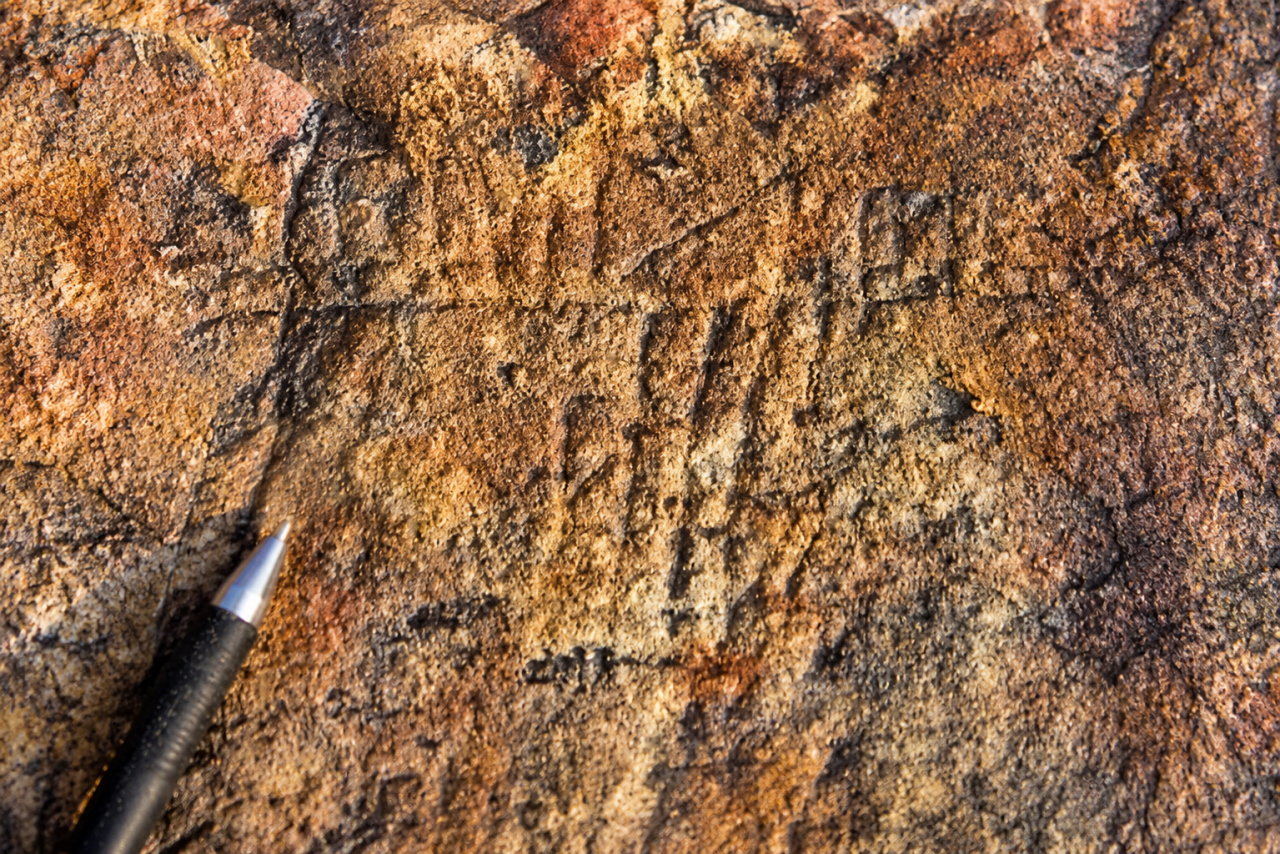
A chance walk through Delhi's Central Ridge has uncovered what experts believe could be the area's first documented ancient petroglyph, opening a new chapter in the city's prehistoric history.
A quartzite rock bearing intersecting grooves has been discovered near the Delhi Polo Club in the Central Ridge, and experts believe it could be the first documented petroglyph from this part of the ridge. The discovery was made by environmentalists Pradip Krishen and Chetan Agarwal during a routine walk, adding a new site to Delhi's small but growing list of ancient rock art locations.
Krishen recalled that the two had walked past the spot many times before without noticing anything unusual. It was only on this occasion that the carving caught their attention, hidden in plain sight along a path that sees regular foot traffic. Researchers who have since examined the find believe the carvings are considerably old, although their precise age remains unknown.
The engraving follows a distinct geometric pattern. Vertical and horizontal grooves cut into the quartzite surface intersect to form a ladder-like design, a style long associated with prehistoric rock art found at other sites across the region. A historian specialising in rock engravings, who reviewed photographs of the carving but requested anonymity, said the markings appeared consistent with known petroglyph traditions.
Location makes the discovery particularly significant. Rock art has previously been documented around the Jawaharlal Nehru University campus and in parts of the northern Ridge, while prehistoric stone tools have been found near the Kamla Nehru Ridge. Until now, however, the Central Ridge—the stretch closer to the Delhi Polo Club—had yielded no documented evidence of such carvings.
Agarwal noted that similar archaeological evidence exists just across the Haryana border in Anangpur, Mangar and Bhondsi, including caves where comparable carvings have been recorded. Areas farther afield, such as Surajkund, Mohabatabad, Dhauj and Alwar, have also produced engravings and prehistoric stone tools over the years, suggesting that the Aravalli belt stretching across Delhi and Haryana preserves a much broader, and still largely undocumented, archaeological landscape.
Archaeologist Banani Bhattacharyya, former deputy director of Haryana's archaeology department, examined the carving and described it as a linear petroglyph that is likely thousands of years old, based on its style and the weathering visible on the grooves. She cautioned, however, that this remains an informed assessment rather than a confirmed date, and that scientific analysis will be required to establish its true age.
Bhattacharyya also pointed to similarities with engravings documented at Mangar, which some researchers interpret as evidence of long-term prehistoric habitation across this section of the Aravalli range. More broadly, she stressed that discoveries of this nature require systematic documentation, archaeological investigation and scientific dating. Without such efforts, significant finds risk being briefly noted before slipping into obscurity.
That concern is not merely theoretical. The Delhi Ridge is one of the capital's last continuous green corridors and remains under constant pressure from encroachment, infrastructure development and a general lack of public awareness about the historical heritage concealed beneath its scrub forests. Unless the carved rock is protected, studied and officially recorded, it remains vulnerable to damage or even destruction by people unaware of its potential significance.
The discovery also highlights a broader challenge in the way archaeological stories reach the public. Finds like this rarely carry the urgency of breaking news or fit the fast-paced, high-volume content cycle that dominates digital platforms. They require careful observation, expert verification and thoughtful reporting. In an information environment driven increasingly by speed and brevity, such discoveries are often overlooked, despite adding valuable new evidence to the region's deep human history.
For now, the carved quartzite rock remains exactly where it was found near the Delhi Polo Club. Whether it is scientifically dated, formally protected or simply left exposed to the elements will ultimately reflect how seriously this discovery is regarded—and may determine whether an important piece of Delhi's prehistoric past is preserved for future generations.
A quartzite rock bearing intersecting grooves has been discovered near the Delhi Polo Club in the Central Ridge, and experts believe it could be the first documented petroglyph from this part of the ridge. The discovery was made by environmentalists Pradip Krishen and Chetan Agarwal during a routine walk, adding a new site to Delhi's small but growing list of ancient rock art locations.
Krishen recalled that the two had walked past the spot many times before without noticing anything unusual. It was only on this occasion that the carving caught their attention, hidden in plain sight along a path that sees regular foot traffic. Researchers who have since examined the find believe the carvings are considerably old, although their precise age remains unknown.
The engraving follows a distinct geometric pattern. Vertical and horizontal grooves cut into the quartzite surface intersect to form a ladder-like design, a style long associated with prehistoric rock art found at other sites across the region. A historian specialising in rock engravings, who reviewed photographs of the carving but requested anonymity, said the markings appeared consistent with known petroglyph traditions.
Location makes the discovery particularly significant. Rock art has previously been documented around the Jawaharlal Nehru University campus and in parts of the northern Ridge, while prehistoric stone tools have been found near the Kamla Nehru Ridge. Until now, however, the Central Ridge—the stretch closer to the Delhi Polo Club—had yielded no documented evidence of such carvings.
Agarwal noted that similar archaeological evidence exists just across the Haryana border in Anangpur, Mangar and Bhondsi, including caves where comparable carvings have been recorded. Areas farther afield, such as Surajkund, Mohabatabad, Dhauj and Alwar, have also produced engravings and prehistoric stone tools over the years, suggesting that the Aravalli belt stretching across Delhi and Haryana preserves a much broader, and still largely undocumented, archaeological landscape.
Archaeologist Banani Bhattacharyya, former deputy director of Haryana's archaeology department, examined the carving and described it as a linear petroglyph that is likely thousands of years old, based on its style and the weathering visible on the grooves. She cautioned, however, that this remains an informed assessment rather than a confirmed date, and that scientific analysis will be required to establish its true age.
Bhattacharyya also pointed to similarities with engravings documented at Mangar, which some researchers interpret as evidence of long-term prehistoric habitation across this section of the Aravalli range. More broadly, she stressed that discoveries of this nature require systematic documentation, archaeological investigation and scientific dating. Without such efforts, significant finds risk being briefly noted before slipping into obscurity.
That concern is not merely theoretical. The Delhi Ridge is one of the capital's last continuous green corridors and remains under constant pressure from encroachment, infrastructure development and a general lack of public awareness about the historical heritage concealed beneath its scrub forests. Unless the carved rock is protected, studied and officially recorded, it remains vulnerable to damage or even destruction by people unaware of its potential significance.
The discovery also highlights a broader challenge in the way archaeological stories reach the public. Finds like this rarely carry the urgency of breaking news or fit the fast-paced, high-volume content cycle that dominates digital platforms. They require careful observation, expert verification and thoughtful reporting. In an information environment driven increasingly by speed and brevity, such discoveries are often overlooked, despite adding valuable new evidence to the region's deep human history.
For now, the carved quartzite rock remains exactly where it was found near the Delhi Polo Club. Whether it is scientifically dated, formally protected or simply left exposed to the elements will ultimately reflect how seriously this discovery is regarded—and may determine whether an important piece of Delhi's prehistoric past is preserved for future generations.


























Leave a Comment