
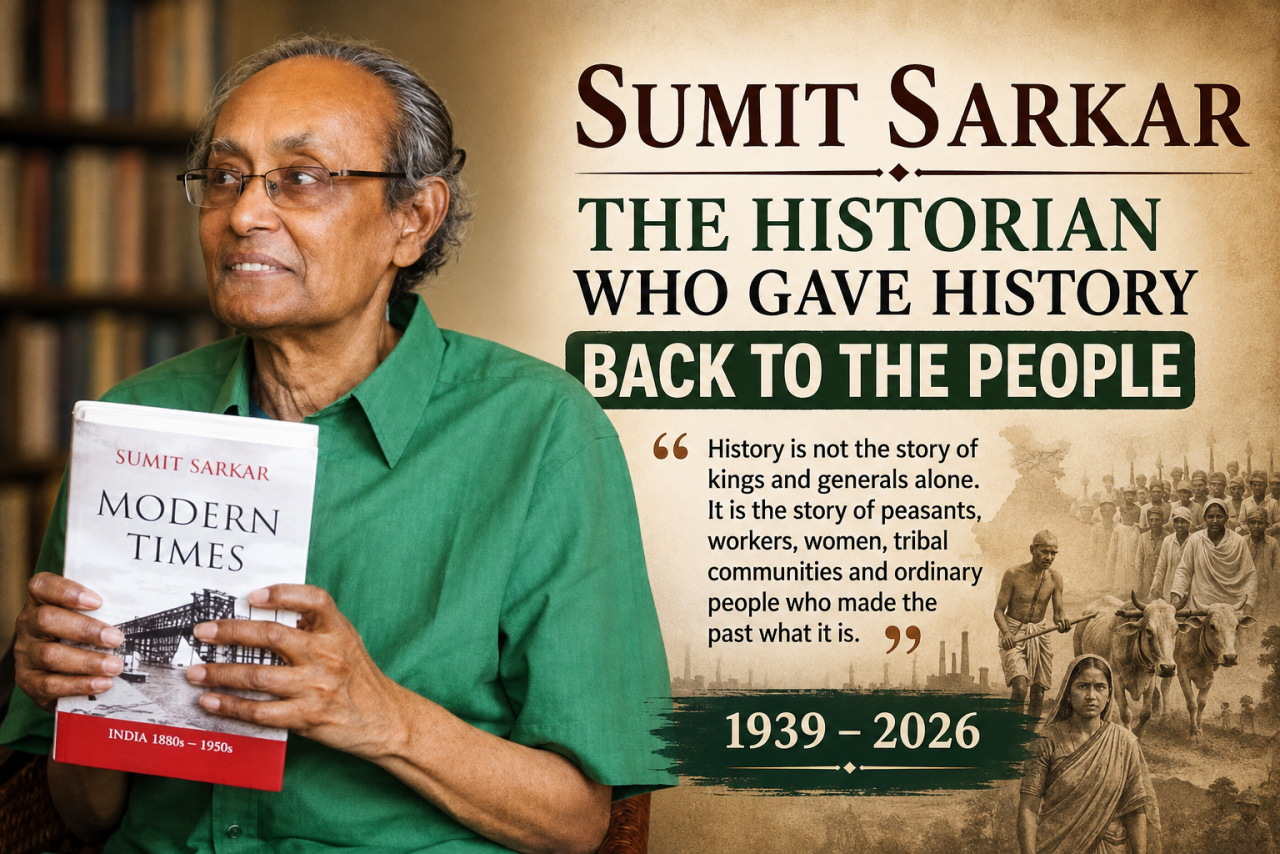
Sumit Sarkar changed how generations understood India's past. By bringing peasants, workers, women and marginalised communities into the historical narrative, he challenged the idea that history belongs only to great leaders.
A Sad Day for Indian History
On August 13, 2026, India lost one of its most influential modern historians. Professor Sumit Sarkar passed away at his home in Delhi at the age of 87, after being unwell for a considerable period due to age-related health issues.
His death marks the passing of a scholar whose influence extended far beyond university classrooms. Students, teachers, researchers and generations of general readers encountered Indian history through his books and ideas. He was not simply a historian who wrote about the past. He was a teacher who changed how many Indians understood their country's history.
History can sometimes appear to be a long list of dates, rulers and political events. Sarkar offered a different way of looking at it. He drew attention to farmers, workers, women, tribal communities and ordinary citizens who experienced major historical events but were often missing from conventional accounts.
His life's work was, in many ways, an attempt to bring those voices into the story.
Born Into a Family of Historians
Sumit Sarkar was born in 1939 into a Bengali Brahmo family deeply connected with scholarship and intellectual life.
His father, Sushobhan Sarkar, was a respected historian who had studied at Presidency College in Calcutta and later at Jesus College, Oxford. Growing up in such a household meant that books, history and intellectual debate were part of Sumit Sarkar's early life.
His maternal uncle was Prasanta Chandra Mahalanobis, the renowned statistician and scientist who played a major role in the development of modern statistics in India and in the country's early economic planning.
Sarkar therefore grew up surrounded by people who valued scholarship and public life. Yet his own intellectual journey developed in a distinct direction.
The Making of a Scholar
Sarkar studied at Presidency College, Calcutta, where he completed his Bachelor's degree with Honours in History. He subsequently earned his Master's degree and Ph.D. from the University of Calcutta.
He began his academic career as a lecturer at the University of Calcutta and later became a reader at the University of Burdwan. He eventually joined the University of Delhi, where he spent the most important part of his teaching career and became Professor of History.
Over the years, he taught and influenced generations of students who went on to become historians, teachers and scholars themselves.
What distinguished Sarkar was his belief that teaching, scholarship and public responsibility were closely connected. History, in his view, should not remain confined to specialists writing for other specialists. It should help ordinary citizens understand their own society and its past.
Understanding the Times He Lived In
Sarkar was born only eight years before India became independent. His formative years coincided with the final phase of the freedom struggle, Partition and the early decades of independent India.
These were also years when questions of poverty, inequality, class and social change occupied scholars across the world.
Sarkar became associated with Marxist historiography, which examines how class, economic structures and material conditions influence historical developments. His writings therefore paid considerable attention to workers, peasants and social inequalities alongside political leaders and institutions.
Yet he was never simply a follower of an intellectual school.
One of his most important qualities was his willingness to question ideas, including ideas that he had once supported. His scholarship evolved because he believed historical interpretation should remain open to evidence and critical examination.
The Swadeshi Movement in Bengal
One of Sarkar's earliest major works was The Swadeshi Movement in Bengal, 1903-1908, published in 1973.
The book examined the movement that emerged in response to the British decision to partition Bengal in 1905. The Partition triggered widespread protests, boycotts and political mobilisation.
Earlier accounts often concentrated on prominent nationalist leaders and middle-class political activism. Sarkar looked beyond these familiar figures.
He examined how the movement operated at the grassroots level and explored the responses of peasants, workers and other sections of Bengali society.
His analysis revealed an important tension. The aspirations of middle-class nationalist leaders did not always correspond with the concerns and interests of poorer sections of society.
Rather than presenting the Swadeshi Movement simply as a heroic chapter in nationalism, Sarkar examined its achievements, limitations and social contradictions.
That willingness to ask uncomfortable questions became a defining feature of his historical writing.
Modern India, 1885-1947: A Book That Changed Classrooms
For generations of students, Sumit Sarkar became closely associated with Modern India: 1885-1947, published in 1989.
The book offered a detailed account of Indian nationalism from the formation of the Indian National Congress in 1885 to independence in 1947.
Its strength lay not merely in the information it contained but in the way it approached the freedom struggle.
Sarkar did not present Indian nationalism as a simple story of great leaders moving steadily towards independence. He brought together peasant movements, labour struggles, women's participation, regional developments and social conflicts.
He also examined the limitations and contradictions within the nationalist movement.
His treatment of the Indian National Congress and Mahatma Gandhi was neither simple celebration nor dismissal. Instead, he asked why some sections of peasants, workers and other social groups did not always identify completely with mainstream nationalist politics.
This approach gave students a more complex understanding of the freedom struggle.
For many readers, Modern India became a trusted guide because it combined accessibility with intellectual seriousness.
Writing Social History
In 1998, Sarkar published Writing Social History, a work that turned attention towards the larger question of how history itself should be written.
Should history focus primarily on famous leaders, political parties and major events?
Or should it also examine how ordinary people lived, worked, worshipped, organised families and responded to political change?
Sarkar strongly supported the importance of social history.
He encouraged historians to move beyond official records and prominent personalities and investigate the experiences of people who rarely appeared in traditional historical narratives.
Workers, peasants, tribal communities, women and rural populations became important subjects of historical inquiry.
For younger historians, this represented an invitation to ask a fundamental question: Whose history are we writing?
The Subaltern Studies Group
A major part of Sarkar's intellectual legacy was his association with the Subaltern Studies project.
The term "subaltern" broadly refers to socially and politically marginalised groups with limited access to power and representation.
In the early 1980s, a group of Indian historians began developing a new approach to writing history from below. The project challenged histories that placed elites, political leaders and institutions at the centre of every major event.
Sumit Sarkar was among the founding members of this intellectual movement.
The Subaltern Studies project argued that peasants, workers and tribal communities were not merely passive followers of political leaders. They possessed their own political ideas, motivations and forms of resistance.
This approach transformed debates about Indian history and eventually influenced scholarship around the world, particularly in the study of colonialism, nationalism and resistance.
The Courage to Disagree
Perhaps one of the most remarkable aspects of Sarkar's intellectual journey was his willingness to question the very movement he had helped establish.
As Subaltern Studies developed, some of its later scholarship moved increasingly towards abstract theory and sophisticated theoretical language. Sarkar became critical of aspects of this direction.
He believed historical scholarship needed to remain firmly connected to evidence and the experiences of real people. He worried that excessive theoretical abstraction could distance history from both ordinary readers and concrete historical realities.
Eventually, he distanced himself from some of the later directions of Subaltern Studies.
That disagreement was significant because it demonstrated a rare form of intellectual independence. Sarkar did not believe that helping create an influential school of thought meant accepting all of its subsequent developments.
He was prepared to change his mind.
That may be one of the most valuable lessons he leaves behind.
Challenging the "Great Man" View of History
The simplest way to understand Sarkar's contribution is to see him as someone who challenged the idea that history is primarily the story of great individuals.
Indian history naturally contains towering figures such as Mahatma Gandhi, Jawaharlal Nehru and Subhas Chandra Bose. Sarkar never denied their importance.
But he insisted that they were only part of the story.
The freedom struggle also depended on millions of people whose names never entered textbooks.
There was the farmer resisting an unjust demand, the worker joining a strike, the woman supporting a political movement within her household and community, and the tribal population resisting colonial policies affecting its land and forests.
Sarkar's history made room for these people.
In doing so, he helped make Indian history more democratic.
Why His Work Matters to the Common Reader
Why should someone who is not a history student care about Sumit Sarkar?
Because the way we understand history influences the way we understand India.
If history is reduced to famous leaders and major political events, we risk forgetting the millions of ordinary people whose labour, struggles and sacrifices shaped the country.
Sarkar reminded readers that history was not simply something that happened to ordinary people. Ordinary people were also participants in making it.
His work also encouraged readers to question received narratives.
A historian, in his approach, must examine evidence honestly, even when the evidence challenges a popular or comfortable version of the past.
In an age when misinformation can spread rapidly, that habit of questioning, checking and examining evidence remains deeply relevant.
Standing Firm for Evidence-Based History
Sarkar's commitment to evidence and academic independence also brought him into public debates over the writing of Indian history.
He contributed a volume to the Indian Council of Historical Research's Towards Freedom project, which sought to compile historical documents relating to India's freedom struggle.
The publication of the volume was blocked in 2000, leading to controversy over political influence on historical scholarship.
Sarkar was among those who raised concerns about such interference.
His position was straightforward. Historians should be able to interpret evidence independently and should not be compelled to shape historical narratives according to the preferences of any political establishment.
His commitment to this principle became an important part of his intellectual legacy.
A Family Devoted to History
History was deeply woven into Sarkar's family life.
His father, Sushobhan Sarkar, was a distinguished historian. His wife, Tanika Sarkar, is also a prominent historian whose scholarship has focused extensively on gender, religion and women's history in modern India.
Their son, Aditya Sarkar, has continued the family's academic tradition and is an associate professor of South Asian History at the University of Warwick in the United Kingdom.
Across generations, the family has remained deeply engaged with the study and teaching of history.
Recognition and Honours
Sarkar's scholarship earned widespread recognition during his long academic career.
Among the honours he received was the Sarit Chatterjee Memorial Award from the Indian History and Culture Society in 2003 for his contribution to the study of the Indian freedom movement.
Yet awards offer only one measure of a scholar's influence.
Sarkar's deeper legacy can be found in the students who read his books, the teachers who used them in classrooms and the historians whose own work was influenced by his questions and arguments.
His intellectual influence extended well beyond university campuses.
A Life of Quiet Dedication
Despite his enormous influence, Sarkar remained known primarily for his scholarship rather than for public visibility.
In his later years, he became less publicly active and faced age-related health difficulties. Yet his books continued to be read, discussed and taught.
His life offers a lesson that is increasingly easy to overlook.
In an era that often rewards instant opinions and rapid fame, scholarship requires patience. Important intellectual work may take decades to reveal its full influence.
Sarkar's contribution was built through years of reading, teaching, researching, questioning and writing.
A Legacy for Future Generations
Several elements of Sumit Sarkar's legacy stand out.
First, he helped bring ordinary Indians into the mainstream narrative of Indian history.
Second, through his association with Subaltern Studies, he contributed to a new approach to understanding colonialism, nationalism and resistance.
Third, through Modern India: 1885-1947, he influenced generations of students studying India's freedom struggle.
Fourth, his willingness to question his own earlier intellectual positions demonstrated the value of independent thinking.
Finally, his defence of evidence-based scholarship and academic freedom reinforced the principle that history should not become merely an instrument of political convenience.
Remembering a True Teacher of History
The passing of Sumit Sarkar marks the end of an important chapter in Indian historical scholarship.
He belonged to a generation that viewed history not merely as an academic discipline but as a way of understanding society, identity and citizenship.
Through his books and teaching, Sarkar expanded the boundaries of Indian history.
He reminded us that the story of India is not only the story of its most famous leaders. It is also the story of farmers who cultivated the land, workers who built industries, women who sustained families and movements, tribal communities that resisted dispossession and ordinary citizens who participated in the making of modern India.
Perhaps that is why his work continues to matter.
The best way to remember Sumit Sarkar is not simply to remember the books he wrote. It is to embrace the intellectual habit he represented: ask questions, examine evidence, listen to voices that are often ignored and never assume that the first version of history is necessarily the complete one.
He gave history back to the people.
And in doing so, he reminded generations of Indians that history belongs to all of us.
A Sad Day for Indian History
On August 13, 2026, India lost one of its most influential modern historians. Professor Sumit Sarkar passed away at his home in Delhi at the age of 87, after being unwell for a considerable period due to age-related health issues.
His death marks the passing of a scholar whose influence extended far beyond university classrooms. Students, teachers, researchers and generations of general readers encountered Indian history through his books and ideas. He was not simply a historian who wrote about the past. He was a teacher who changed how many Indians understood their country's history.
History can sometimes appear to be a long list of dates, rulers and political events. Sarkar offered a different way of looking at it. He drew attention to farmers, workers, women, tribal communities and ordinary citizens who experienced major historical events but were often missing from conventional accounts.
His life's work was, in many ways, an attempt to bring those voices into the story.
Born Into a Family of Historians
Sumit Sarkar was born in 1939 into a Bengali Brahmo family deeply connected with scholarship and intellectual life.
His father, Sushobhan Sarkar, was a respected historian who had studied at Presidency College in Calcutta and later at Jesus College, Oxford. Growing up in such a household meant that books, history and intellectual debate were part of Sumit Sarkar's early life.
His maternal uncle was Prasanta Chandra Mahalanobis, the renowned statistician and scientist who played a major role in the development of modern statistics in India and in the country's early economic planning.
Sarkar therefore grew up surrounded by people who valued scholarship and public life. Yet his own intellectual journey developed in a distinct direction.
The Making of a Scholar
Sarkar studied at Presidency College, Calcutta, where he completed his Bachelor's degree with Honours in History. He subsequently earned his Master's degree and Ph.D. from the University of Calcutta.
He began his academic career as a lecturer at the University of Calcutta and later became a reader at the University of Burdwan. He eventually joined the University of Delhi, where he spent the most important part of his teaching career and became Professor of History.
Over the years, he taught and influenced generations of students who went on to become historians, teachers and scholars themselves.
What distinguished Sarkar was his belief that teaching, scholarship and public responsibility were closely connected. History, in his view, should not remain confined to specialists writing for other specialists. It should help ordinary citizens understand their own society and its past.
Understanding the Times He Lived In
Sarkar was born only eight years before India became independent. His formative years coincided with the final phase of the freedom struggle, Partition and the early decades of independent India.
These were also years when questions of poverty, inequality, class and social change occupied scholars across the world.
Sarkar became associated with Marxist historiography, which examines how class, economic structures and material conditions influence historical developments. His writings therefore paid considerable attention to workers, peasants and social inequalities alongside political leaders and institutions.
Yet he was never simply a follower of an intellectual school.
One of his most important qualities was his willingness to question ideas, including ideas that he had once supported. His scholarship evolved because he believed historical interpretation should remain open to evidence and critical examination.
The Swadeshi Movement in Bengal
One of Sarkar's earliest major works was The Swadeshi Movement in Bengal, 1903-1908, published in 1973.
The book examined the movement that emerged in response to the British decision to partition Bengal in 1905. The Partition triggered widespread protests, boycotts and political mobilisation.
Earlier accounts often concentrated on prominent nationalist leaders and middle-class political activism. Sarkar looked beyond these familiar figures.
He examined how the movement operated at the grassroots level and explored the responses of peasants, workers and other sections of Bengali society.
His analysis revealed an important tension. The aspirations of middle-class nationalist leaders did not always correspond with the concerns and interests of poorer sections of society.
Rather than presenting the Swadeshi Movement simply as a heroic chapter in nationalism, Sarkar examined its achievements, limitations and social contradictions.
That willingness to ask uncomfortable questions became a defining feature of his historical writing.
Modern India, 1885-1947: A Book That Changed Classrooms
For generations of students, Sumit Sarkar became closely associated with Modern India: 1885-1947, published in 1989.
The book offered a detailed account of Indian nationalism from the formation of the Indian National Congress in 1885 to independence in 1947.
Its strength lay not merely in the information it contained but in the way it approached the freedom struggle.
Sarkar did not present Indian nationalism as a simple story of great leaders moving steadily towards independence. He brought together peasant movements, labour struggles, women's participation, regional developments and social conflicts.
He also examined the limitations and contradictions within the nationalist movement.
His treatment of the Indian National Congress and Mahatma Gandhi was neither simple celebration nor dismissal. Instead, he asked why some sections of peasants, workers and other social groups did not always identify completely with mainstream nationalist politics.
This approach gave students a more complex understanding of the freedom struggle.
For many readers, Modern India became a trusted guide because it combined accessibility with intellectual seriousness.
Writing Social History
In 1998, Sarkar published Writing Social History, a work that turned attention towards the larger question of how history itself should be written.
Should history focus primarily on famous leaders, political parties and major events?
Or should it also examine how ordinary people lived, worked, worshipped, organised families and responded to political change?
Sarkar strongly supported the importance of social history.
He encouraged historians to move beyond official records and prominent personalities and investigate the experiences of people who rarely appeared in traditional historical narratives.
Workers, peasants, tribal communities, women and rural populations became important subjects of historical inquiry.
For younger historians, this represented an invitation to ask a fundamental question: Whose history are we writing?
The Subaltern Studies Group
A major part of Sarkar's intellectual legacy was his association with the Subaltern Studies project.
The term "subaltern" broadly refers to socially and politically marginalised groups with limited access to power and representation.
In the early 1980s, a group of Indian historians began developing a new approach to writing history from below. The project challenged histories that placed elites, political leaders and institutions at the centre of every major event.
Sumit Sarkar was among the founding members of this intellectual movement.
The Subaltern Studies project argued that peasants, workers and tribal communities were not merely passive followers of political leaders. They possessed their own political ideas, motivations and forms of resistance.
This approach transformed debates about Indian history and eventually influenced scholarship around the world, particularly in the study of colonialism, nationalism and resistance.
The Courage to Disagree
Perhaps one of the most remarkable aspects of Sarkar's intellectual journey was his willingness to question the very movement he had helped establish.
As Subaltern Studies developed, some of its later scholarship moved increasingly towards abstract theory and sophisticated theoretical language. Sarkar became critical of aspects of this direction.
He believed historical scholarship needed to remain firmly connected to evidence and the experiences of real people. He worried that excessive theoretical abstraction could distance history from both ordinary readers and concrete historical realities.
Eventually, he distanced himself from some of the later directions of Subaltern Studies.
That disagreement was significant because it demonstrated a rare form of intellectual independence. Sarkar did not believe that helping create an influential school of thought meant accepting all of its subsequent developments.
He was prepared to change his mind.
That may be one of the most valuable lessons he leaves behind.
Challenging the "Great Man" View of History
The simplest way to understand Sarkar's contribution is to see him as someone who challenged the idea that history is primarily the story of great individuals.
Indian history naturally contains towering figures such as Mahatma Gandhi, Jawaharlal Nehru and Subhas Chandra Bose. Sarkar never denied their importance.
But he insisted that they were only part of the story.
The freedom struggle also depended on millions of people whose names never entered textbooks.
There was the farmer resisting an unjust demand, the worker joining a strike, the woman supporting a political movement within her household and community, and the tribal population resisting colonial policies affecting its land and forests.
Sarkar's history made room for these people.
In doing so, he helped make Indian history more democratic.
Why His Work Matters to the Common Reader
Why should someone who is not a history student care about Sumit Sarkar?
Because the way we understand history influences the way we understand India.
If history is reduced to famous leaders and major political events, we risk forgetting the millions of ordinary people whose labour, struggles and sacrifices shaped the country.
Sarkar reminded readers that history was not simply something that happened to ordinary people. Ordinary people were also participants in making it.
His work also encouraged readers to question received narratives.
A historian, in his approach, must examine evidence honestly, even when the evidence challenges a popular or comfortable version of the past.
In an age when misinformation can spread rapidly, that habit of questioning, checking and examining evidence remains deeply relevant.
Standing Firm for Evidence-Based History
Sarkar's commitment to evidence and academic independence also brought him into public debates over the writing of Indian history.
He contributed a volume to the Indian Council of Historical Research's Towards Freedom project, which sought to compile historical documents relating to India's freedom struggle.
The publication of the volume was blocked in 2000, leading to controversy over political influence on historical scholarship.
Sarkar was among those who raised concerns about such interference.
His position was straightforward. Historians should be able to interpret evidence independently and should not be compelled to shape historical narratives according to the preferences of any political establishment.
His commitment to this principle became an important part of his intellectual legacy.
A Family Devoted to History
History was deeply woven into Sarkar's family life.
His father, Sushobhan Sarkar, was a distinguished historian. His wife, Tanika Sarkar, is also a prominent historian whose scholarship has focused extensively on gender, religion and women's history in modern India.
Their son, Aditya Sarkar, has continued the family's academic tradition and is an associate professor of South Asian History at the University of Warwick in the United Kingdom.
Across generations, the family has remained deeply engaged with the study and teaching of history.
Recognition and Honours
Sarkar's scholarship earned widespread recognition during his long academic career.
Among the honours he received was the Sarit Chatterjee Memorial Award from the Indian History and Culture Society in 2003 for his contribution to the study of the Indian freedom movement.
Yet awards offer only one measure of a scholar's influence.
Sarkar's deeper legacy can be found in the students who read his books, the teachers who used them in classrooms and the historians whose own work was influenced by his questions and arguments.
His intellectual influence extended well beyond university campuses.
A Life of Quiet Dedication
Despite his enormous influence, Sarkar remained known primarily for his scholarship rather than for public visibility.
In his later years, he became less publicly active and faced age-related health difficulties. Yet his books continued to be read, discussed and taught.
His life offers a lesson that is increasingly easy to overlook.
In an era that often rewards instant opinions and rapid fame, scholarship requires patience. Important intellectual work may take decades to reveal its full influence.
Sarkar's contribution was built through years of reading, teaching, researching, questioning and writing.
A Legacy for Future Generations
Several elements of Sumit Sarkar's legacy stand out.
First, he helped bring ordinary Indians into the mainstream narrative of Indian history.
Second, through his association with Subaltern Studies, he contributed to a new approach to understanding colonialism, nationalism and resistance.
Third, through Modern India: 1885-1947, he influenced generations of students studying India's freedom struggle.
Fourth, his willingness to question his own earlier intellectual positions demonstrated the value of independent thinking.
Finally, his defence of evidence-based scholarship and academic freedom reinforced the principle that history should not become merely an instrument of political convenience.
Remembering a True Teacher of History
The passing of Sumit Sarkar marks the end of an important chapter in Indian historical scholarship.
He belonged to a generation that viewed history not merely as an academic discipline but as a way of understanding society, identity and citizenship.
Through his books and teaching, Sarkar expanded the boundaries of Indian history.
He reminded us that the story of India is not only the story of its most famous leaders. It is also the story of farmers who cultivated the land, workers who built industries, women who sustained families and movements, tribal communities that resisted dispossession and ordinary citizens who participated in the making of modern India.
Perhaps that is why his work continues to matter.
The best way to remember Sumit Sarkar is not simply to remember the books he wrote. It is to embrace the intellectual habit he represented: ask questions, examine evidence, listen to voices that are often ignored and never assume that the first version of history is necessarily the complete one.
He gave history back to the people.
And in doing so, he reminded generations of Indians that history belongs to all of us.


















Leave a Comment