
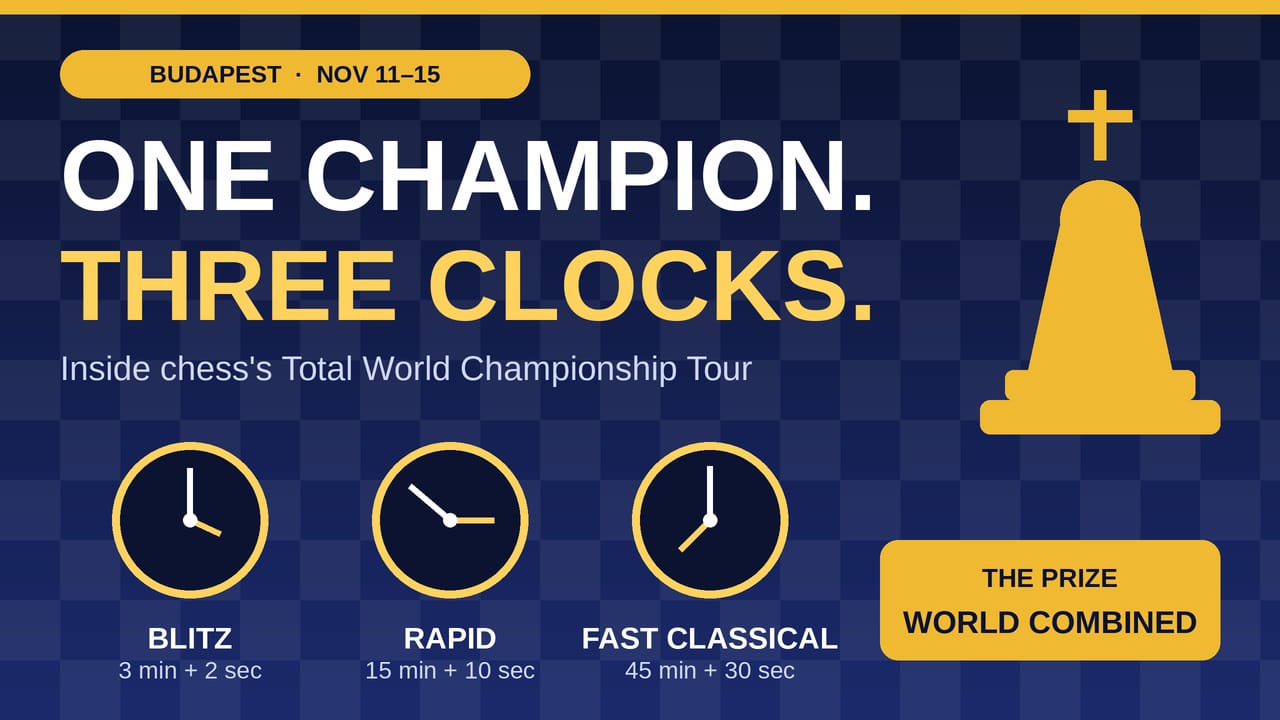
Can one player dominate classical, rapid and blitz? Budapest is testing a new formula to find chess's most versatile world champion.
Chess has spent years trying to answer one question: how do you crown the best player when the game is played at so many speeds? This week in Budapest, the sport is trying a new answer.
The Total Chess World Championship Tour, a pilot event running from November 11 to 15, brings together three formats: fast classical, rapid and blitz. Players must perform across all three to claim the new title of FIDE World Combined Champion.
The new format raises a simple question. Is the best chess player the one who dominates classical chess, or someone who can deliver across all three formats?
A Format Built Like a Ladder
The 24 players are divided into four groups of six. Each group plays a double round-robin in fast classical chess, with 45 minutes per game and a 30-second increment. A win earns three points, a draw one and a loss none.
A nine-round blitz Swiss tournament on the opening day carries no points and offers no prize money. However, it serves an important purpose by breaking ties and determining the seeding of the knockout semi-finalists. It may be a warm-up, but the results still matter.
The knockout stage brings all three formats into a single daily match:
- Four blitz games: 3 minutes plus a 2-second increment. Each win earns 1 point and each draw half a point.
- Two rapid games: 15 minutes plus a 10-second increment. Each win earns 4 points and each draw 2 points.
- One fast classical game: 45 minutes plus a 30-second increment. Each win earns 8 points and each draw 4 points.
The top four scorers across the three tour legs will qualify for the Grand Final. Scheduled over four days, it will feature semi-finals and a final played in sets. The first player to win two sets will claim the championship.
The Hidden Message in the Points Table
The scoring system reveals what the organisers want this championship to represent.
A complete knockout match offers 20 points, but the distribution is far from equal. Blitz, the format that dominates online streams and social media highlights, accounts for a maximum of just 4 points. Rapid and fast classical are worth 8 points each.
In other words, 80 per cent of the available points come from the slower formats.
This is perhaps the most interesting feature of the new championship. Speed chess is part of the contest, but it is not supposed to decide the outcome on its own.
A single fast classical game, worth 8 points, can overturn a blitz advantage. Even a draw in that game earns 4 points. A player who approaches the longer format with patience and composure can therefore offset an aggressive performance in blitz.
The scoring system rewards versatility, but it also gives strategic importance to consistency. A player cannot simply rely on spectacular wins in the fastest format.
The Cast: Carlsen, Caruana and India's Challenge
The field is strong, with Magnus Carlsen among the headline names. The Norwegian arrives in Budapest as a new father and finds himself in a group alongside Ian Nepomniachtchi and Anish Giri. He opens his campaign against Giri in Round 1.
Fabiano Caruana, currently ranked world No. 3, is also competing. So is Nodirbek Abdusattarov, who has been helping Javokhir Sindarov prepare for his World Championship match against D Gukesh.
India has three representatives: R Praggnanandhaa, Arjun Erigaisi and Vaishali Rameshbabu.
Arjun and Vaishali have been placed in the same group, alongside Bibisara Assaubayeva. Assaubayeva and Vaishali are the only two women in the tournament. Their presence is welcome, but the small number also highlights the continuing gender gap at the highest level of competitive chess.
Hikaru Nakamura is absent, although the field includes most of the other leading players from the world's top 20.
What the Players Are Saying
The response from leading players has been cautiously curious rather than openly celebratory.
Caruana, speaking on a podcast, pointed to an awkward dilemma surrounding the new title. If Carlsen wins, some observers may argue that the traditional classical championship is losing its relevance. If Carlsen fails to win, the new champion could struggle to earn recognition as the strongest player in the world.
Either outcome presents a challenge for a title that is expected to stand alongside the classical world championship.
Nepomniachtchi, according to a Hindustan Times report by Susan Ninan, appreciates the combination of formats but believes the classical championship will retain its unmatched prestige and historical importance.
He compared the new tour with the Grand Chess Tour and the earlier Grand Prix series. He also suggested that two leading players could begin earning qualification places for the Candidates Tournament through the tour from next season.
Such a connection could give the new championship greater significance by linking it to the traditional route towards the classical world title.
Format Fatigue or Format Evolution?
The Budapest experiment arrives just before the FIDE World Championship, raising another question: is chess creating too many titles and formats for audiences to follow?
The sport already has separate world championships in classical, rapid and blitz chess. Freestyle chess and franchise-based competitions have added further layers to an increasingly crowded calendar.
A combined championship introduces another trophy, another format and another set of rules for fans to understand.
Yet the idea has a genuine sporting argument behind it. The existing titles reward excellence in individual formats. The combined championship attempts to identify a player who can perform across all three.
A rapid specialist must demonstrate patience in classical chess. A classical specialist must handle the pressure of blitz. Success requires a wider range of skills, from calculation and preparation to time management and decision-making under pressure.
That is what makes the experiment worth watching.
Can the New Title Earn Its Place?
A full tour is planned for the first half of 2027. The Budapest pilot will offer the first indication of whether the format can attract players, audiences and institutional support.
The challenge is not simply to produce another world champion. Chess already has several. The real test is whether the combined title can establish an identity of its own without diminishing the prestige of the classical championship.
If it succeeds, chess may have found a new way to measure overall excellence. If it fails, the sport will have added another title without answering the question it set out to resolve.
For now, Budapest is testing whether the best chess player in the world should be judged by one clock or three.



















Leave a Comment