
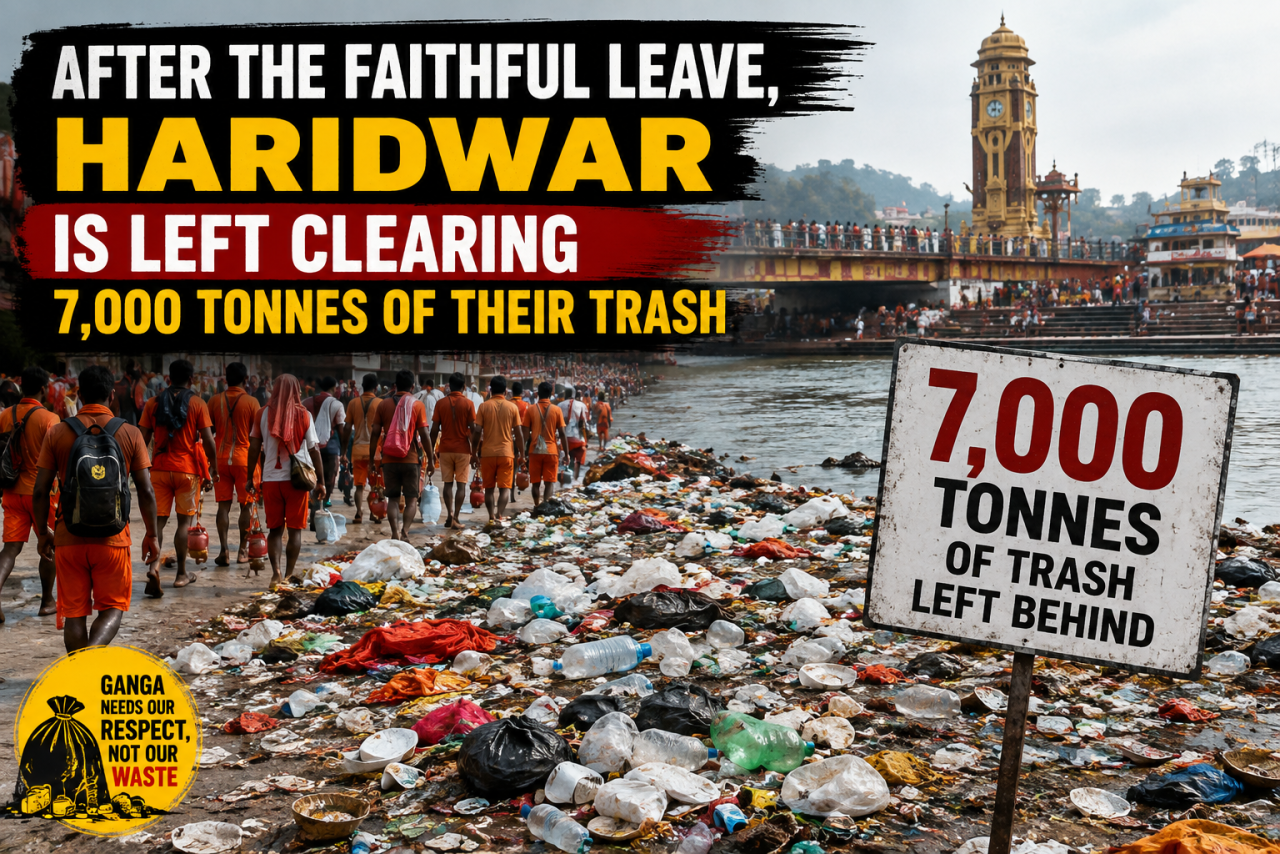
The pilgrims have left, but Haridwar is still dealing with the enormous environmental cost of their journey.
For two weeks every year, Haridwar becomes one of the busiest pilgrimage corridors in India. This year, when the Kanwar Yatra ended, it left behind an estimated 7,000 tonnes of garbage across the city's parking areas, camps, roads and Ganga ghats, according to Municipal Commissioner Nandan Kumar.
The scale of the crowd explains the scale of the mess. The final two days of the yatra, nearly one crore pilgrims passed through Haridwar to collect Ganga water before beginning their return journey. Many travelled in groups and relay teams, often without stopping for long periods.
Across the country, the number of kanwariyas this year is believed to have crossed four crore. The pilgrimage has expanded steadily in recent years, attracting devotees from across northern India. Many arrive in trucks equipped with loudspeakers, making sound and spectacle an increasingly visible part of the annual pilgrimage.
A City Struggles Under the Waste
The Haridwar Municipal Corporation normally handles around 250 tonnes of waste a day. During the Kanwar period, however, the pressure rises sharply.
Once the crowds began to thin, discarded clothes, plastic bottles, food packaging, polythene sheets and other waste were left along roads, lanes, parking areas and riverbanks.
The district administration launched a dedicated cleanliness drive on August 12, scheduled to continue until August 18. Officials have described the operation as being conducted on a war footing.
More than 100 outsourced sanitation workers have been deployed in teams around Har-ki-Pauri and the Mela area. They are working along pedestrian routes used by kanwariyas for travelling, resting and camping, as well as in parking areas that experienced heavy footfall.
Around 80 vehicles for garbage collection, transportation and disposal have also been deployed. Officials say more than 1,000 sanitation workers are involved in the overall cleanup operation. Senior officials are monitoring the work on the ground and through online systems to ensure that the waste is removed within the prescribed timeframe.
The Ganga Faces the Bigger Risk
The problem, however, is much larger than the appearance of dirty roads and overflowing garbage points.
Waste left close to the river can become an environmental threat, particularly when it contains polythene and other non-biodegradable materials. Such material can eventually break down into microplastics and enter the river system. The enormous human presence during the pilgrimage also creates the possibility of bacterial contamination from inadequate sanitation facilities.
Gagan Matta, an assistant professor in the Department of Environmental Science at Gurukul Kangri University, has pointed to the growing number of kanwariyas as a major challenge. If the number of pilgrims continues to rise, waste generation is likely to rise with it.
He has also welcomed efforts to involve residents and institutions in the cleanliness campaign, rather than leaving the entire responsibility to municipal workers.
That idea of shared responsibility has found support within Haridwar's religious establishment.
Religious Institutions Join the Cleanup
The Akhil Bharatiya Akhara Parishad, the apex body representing the city's recognised akhadas, has informed the district administration that monks and office-bearers from various akhadas will participate in the cleanliness drive.
Mahant Ravindra Puri, president of the Niranjani Akhada, and Swami Harichaitanyanand of the Bada Udasin Akhada have also warned that pollution levels in the Ganga could increase sharply if the accumulated waste is not removed before monsoon rains carry it into the river.
This is an important intervention because the Kanwar Yatra is not simply a civic event. It is a deeply religious journey for millions of devotees. Religious institutions therefore have an influence that government agencies alone cannot exercise.
If religious leaders ask devotees to respect the Ganga not only through worship but also through responsible waste disposal, the message could reach millions more effectively.
Cleanliness Cannot Be a Post-Yatra Exercise
Lalit Narayan Mishra, the district's chief development officer, said the administration is also trying to sensitise kanwariyas, pilgrims, tourists and local traders.
The concern is understandable. Haridwar's waste collection and disposal infrastructure is already under considerable pressure. Markets, local communities and religious institutions are being encouraged to treat the cleanliness of the Ganga as a shared civic responsibility.
There is a simple contradiction at the heart of the problem.
Millions of devotees come to Haridwar because they regard the Ganga as sacred. Yet some of the material brought into the city during the pilgrimage eventually finds its way onto the same riverbanks that devotees consider holy.
Faith cannot remain limited to rituals. If the Ganga is a mother or a deity in the religious imagination, then keeping her surroundings clean should be part of that reverence.
The Real Question Is What Happens Before the Waste Is Created
The annual cleanup is necessary, but it cannot become the permanent solution.
A week-long operation can remove thousands of tonnes of garbage and restore the appearance of Haridwar. But it does not answer the more important question of why so much waste is generated and abandoned in the first place.
The Kanwar Yatra is not going away. Nor should its enormous scale automatically be treated as a problem. It represents genuine religious devotion and has become one of India's largest recurring pilgrimages.
But the infrastructure supporting that devotion must evolve with the numbers.
If millions more people are arriving every year, the system must plan for millions more bottles, food packets, clothing, temporary shelters and sanitation requirements. Waste collection points need to be placed where pilgrims actually move. Reusable alternatives must be promoted. Plastic use needs to be reduced. Camp operators and traders must be made accountable for the waste generated around them.
Most importantly, pilgrims themselves must become part of the solution.
The responsibility cannot end with municipal workers arriving after the crowds have departed.
Haridwar's annual challenge is therefore not simply how quickly it can clear 7,000 tonnes of garbage. The real test is whether the next Kanwar Yatra can leave behind fewer tonnes in the first place.
Until that happens, the city will continue to welcome millions of faithful pilgrims with open arms and then spend the following days clearing the environmental cost of their devotion.
For two weeks every year, Haridwar becomes one of the busiest pilgrimage corridors in India. This year, when the Kanwar Yatra ended, it left behind an estimated 7,000 tonnes of garbage across the city's parking areas, camps, roads and Ganga ghats, according to Municipal Commissioner Nandan Kumar.
The scale of the crowd explains the scale of the mess. The final two days of the yatra, nearly one crore pilgrims passed through Haridwar to collect Ganga water before beginning their return journey. Many travelled in groups and relay teams, often without stopping for long periods.
Across the country, the number of kanwariyas this year is believed to have crossed four crore. The pilgrimage has expanded steadily in recent years, attracting devotees from across northern India. Many arrive in trucks equipped with loudspeakers, making sound and spectacle an increasingly visible part of the annual pilgrimage.
A City Struggles Under the Waste
The Haridwar Municipal Corporation normally handles around 250 tonnes of waste a day. During the Kanwar period, however, the pressure rises sharply.
Once the crowds began to thin, discarded clothes, plastic bottles, food packaging, polythene sheets and other waste were left along roads, lanes, parking areas and riverbanks.
The district administration launched a dedicated cleanliness drive on August 12, scheduled to continue until August 18. Officials have described the operation as being conducted on a war footing.
More than 100 outsourced sanitation workers have been deployed in teams around Har-ki-Pauri and the Mela area. They are working along pedestrian routes used by kanwariyas for travelling, resting and camping, as well as in parking areas that experienced heavy footfall.
Around 80 vehicles for garbage collection, transportation and disposal have also been deployed. Officials say more than 1,000 sanitation workers are involved in the overall cleanup operation. Senior officials are monitoring the work on the ground and through online systems to ensure that the waste is removed within the prescribed timeframe.
The Ganga Faces the Bigger Risk
The problem, however, is much larger than the appearance of dirty roads and overflowing garbage points.
Waste left close to the river can become an environmental threat, particularly when it contains polythene and other non-biodegradable materials. Such material can eventually break down into microplastics and enter the river system. The enormous human presence during the pilgrimage also creates the possibility of bacterial contamination from inadequate sanitation facilities.
Gagan Matta, an assistant professor in the Department of Environmental Science at Gurukul Kangri University, has pointed to the growing number of kanwariyas as a major challenge. If the number of pilgrims continues to rise, waste generation is likely to rise with it.
He has also welcomed efforts to involve residents and institutions in the cleanliness campaign, rather than leaving the entire responsibility to municipal workers.
That idea of shared responsibility has found support within Haridwar's religious establishment.
Religious Institutions Join the Cleanup
The Akhil Bharatiya Akhara Parishad, the apex body representing the city's recognised akhadas, has informed the district administration that monks and office-bearers from various akhadas will participate in the cleanliness drive.
Mahant Ravindra Puri, president of the Niranjani Akhada, and Swami Harichaitanyanand of the Bada Udasin Akhada have also warned that pollution levels in the Ganga could increase sharply if the accumulated waste is not removed before monsoon rains carry it into the river.
This is an important intervention because the Kanwar Yatra is not simply a civic event. It is a deeply religious journey for millions of devotees. Religious institutions therefore have an influence that government agencies alone cannot exercise.
If religious leaders ask devotees to respect the Ganga not only through worship but also through responsible waste disposal, the message could reach millions more effectively.
Cleanliness Cannot Be a Post-Yatra Exercise
Lalit Narayan Mishra, the district's chief development officer, said the administration is also trying to sensitise kanwariyas, pilgrims, tourists and local traders.
The concern is understandable. Haridwar's waste collection and disposal infrastructure is already under considerable pressure. Markets, local communities and religious institutions are being encouraged to treat the cleanliness of the Ganga as a shared civic responsibility.
There is a simple contradiction at the heart of the problem.
Millions of devotees come to Haridwar because they regard the Ganga as sacred. Yet some of the material brought into the city during the pilgrimage eventually finds its way onto the same riverbanks that devotees consider holy.
Faith cannot remain limited to rituals. If the Ganga is a mother or a deity in the religious imagination, then keeping her surroundings clean should be part of that reverence.
The Real Question Is What Happens Before the Waste Is Created
The annual cleanup is necessary, but it cannot become the permanent solution.
A week-long operation can remove thousands of tonnes of garbage and restore the appearance of Haridwar. But it does not answer the more important question of why so much waste is generated and abandoned in the first place.
The Kanwar Yatra is not going away. Nor should its enormous scale automatically be treated as a problem. It represents genuine religious devotion and has become one of India's largest recurring pilgrimages.
But the infrastructure supporting that devotion must evolve with the numbers.
If millions more people are arriving every year, the system must plan for millions more bottles, food packets, clothing, temporary shelters and sanitation requirements. Waste collection points need to be placed where pilgrims actually move. Reusable alternatives must be promoted. Plastic use needs to be reduced. Camp operators and traders must be made accountable for the waste generated around them.
Most importantly, pilgrims themselves must become part of the solution.
The responsibility cannot end with municipal workers arriving after the crowds have departed.
Haridwar's annual challenge is therefore not simply how quickly it can clear 7,000 tonnes of garbage. The real test is whether the next Kanwar Yatra can leave behind fewer tonnes in the first place.
Until that happens, the city will continue to welcome millions of faithful pilgrims with open arms and then spend the following days clearing the environmental cost of their devotion.























Leave a Comment