
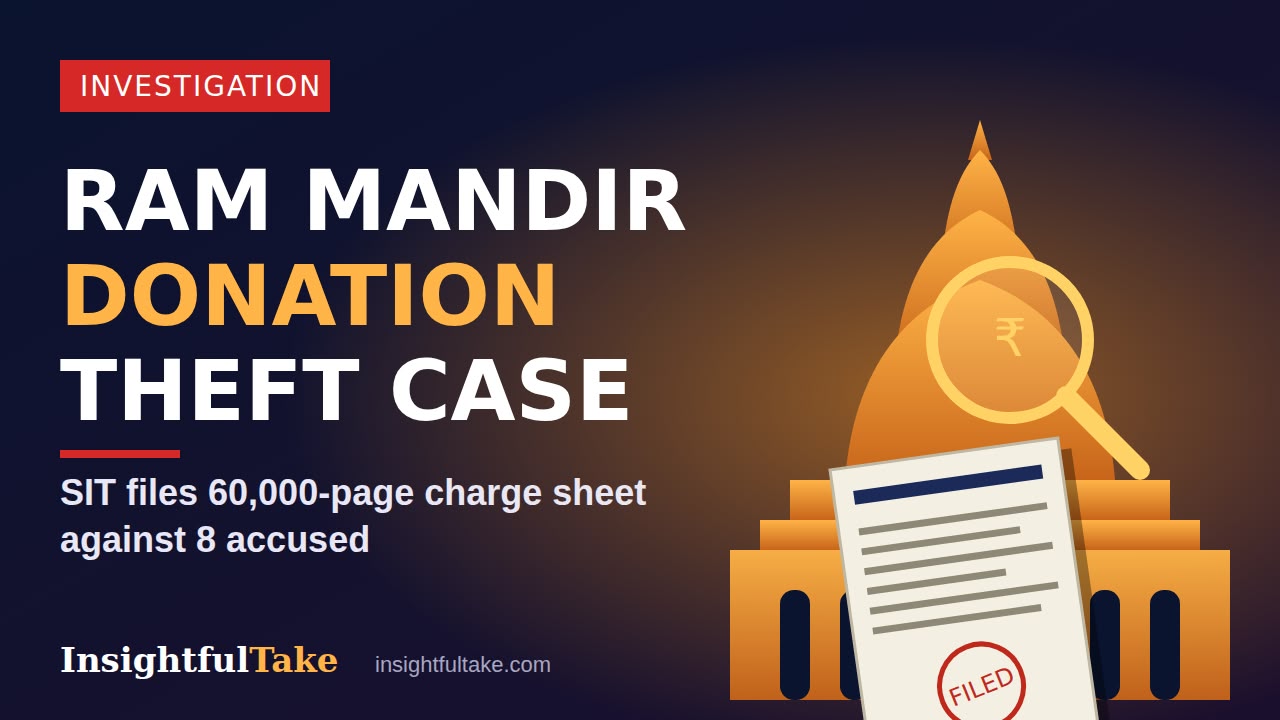
A massive charge sheet details alleged cash theft inside the Ram Mandir donation system, but it also leaves important questions about supervision and accountability unanswered.
When the Special Investigation Team (SIT) appeared before the Anti-Corruption Court in Ayodhya on Wednesday, it brought a prosecution file running into tens of thousands of pages.
Hindustan Times reported the charge sheet and its annexures at around 60,000 pages, while Business Today put the figure at nearly 74,000 pages. The case involves eight men accused of stealing cash during the counting of donations at the Ram temple.
The exact number of pages may vary depending on how the annexures are counted. What matters more is that the investigation has now formally reached the court, where the evidence and allegations will be tested.
How the Case Began
The case surfaced in June. An FIR was registered on June 25 following a complaint by Krishna Mohan, a member of the Shri Ram Janmbhoomi Teerth Kshetra Trust. Eight people were arrested the following day.
They are Avinash Shukla, Anukalp Mishra, Lavkush Mishra, Manish Kumar Yadav, Karunesh Pandey, Ramashankar Mishra, Subhash Srivastava and Ram Shankar Yadav, also known as Tinnu.
The family and institutional connections surrounding some of the accused have also attracted attention. Anukalp Mishra and Lavkush Mishra are related to each other and to Anil Mishra, a former trust member. Anil Mishra was removed along with trust general secretary Champat Rai.
Ram Shankar Yadav has been described as an aide of Champat Rai, while Manish Yadav is said to be related to him.
These connections, by themselves, do not establish wrongdoing by former office bearers. They do, however, explain why questions about the wider management of the donation system have continued.
What the Investigators Say They Found
According to an officer quoted by Hindustan Times, the SIT investigated the matter on three main fronts.
The first involved cash handled inside the temple during the counting process. This included collecting, counting, sorting and preparing the money for deposit.
Investigators examined CCTV footage, witness statements, donation records and electronic evidence. According to the police findings reported so far, they identified 105 instances in which cash was allegedly removed or concealed without authorisation inside the temple premises.
The second part of the investigation examined what happened after the cash left the counting area.
Deposit records and the movement of cash to banks were checked. Investigators reportedly found no evidence of theft during this stage. In other words, the police theory is that the alleged diversion happened inside the counting process rather than while the money was being transported to the banks.
The third area concerned valuable offerings, including gold and silver.
The SIT physically verified 803 articles for which receipts had been generated through the trust's software. It reportedly found no discrepancies. Another 86 items without receipts were examined separately to determine whether missing documentation concealed unrecorded donations.
The investigation also examined 173 witnesses. They included trust officials, counting staff, bank officials, security personnel, CCTV operators, chartered accountants and vendors.
The Cash Recovery
The police have reported recovering ₹79,85,493 from the eight accused.
According to the prosecution, some of the money was recovered from unusual locations, including bathrooms, haystacks and cow dung cakes.
No cash or valuables were reportedly recovered from Subhash Srivastava.
The charge sheet also contains details of bank transactions, properties and assets linked to the accused. It includes findings from a forensic audit conducted as part of the investigation.
These details will ultimately have to be examined by the court rather than treated as proof of guilt. The accused remain entitled to the legal presumption of innocence until the case is decided.
Why the Supreme Court Matters in This Case
The investigation carries an unusual layer of judicial oversight.
The SIT was reconstituted following directions from the Supreme Court. It is headed by IG Kiran S., with DIG Ayodhya Somen Verma and SSP Gaurav Grover as members.
The Supreme Court had also directed that a forensic auditor be associated with the investigation because of concerns surrounding the trust's funds.
The timing of the charge sheet was important as well.
Solicitor General Tushar Mehta told the court that the 90-day period from the first arrests was approaching. If the investigation did not result in a charge sheet within the statutory period, the accused could have become entitled to default bail.
The SIT therefore filed the charge sheet before the deadline. SSP Gaurav Grover said the court had accepted it and that all eight accused remained in judicial custody.
The case invokes provisions relating to criminal breach of trust and offences under the Prevention of Corruption Act.
What the Charge Sheet Does Not Fully Answer
The charge sheet appears to answer one important question: where does the investigation believe the alleged theft took place?
The answer is inside the cash-counting process.
The investigation reportedly found no discrepancy in the verified gold and silver articles and no evidence of theft during the movement of counted cash to banks.
That should provide some reassurance to devotees whose donations entered the temple system.
But it also raises another question.
If 105 instances of cash removal or concealment took place inside a highly secured temple complex, how did the supervision system allow it to happen?
Who was responsible for monitoring the counting process? Were there sufficient checks between counting, recording and depositing the money? Why were alleged irregularities not detected earlier?
These are questions about institutional safeguards rather than the guilt of any particular individual.
The Ayodhya Bar Association has raised another set of questions. Its president, Kalika Prasad Mishra, said the association had earlier sought an inquiry into the alleged roles of former trust office bearers, including Champat Rai, Anil Mishra and Gopal Rao.
The charge sheet, according to reports available so far, names the eight arrested men. It is not yet clear whether the investigation will result in further action against anyone else.
That distinction is important. The absence of a person from the present charge sheet does not establish either guilt or innocence. Investigations can continue, and police may file a supplementary charge sheet if additional evidence emerges.
Final Take
The next stage will move the focus from investigation to trial.
The court will examine whether the CCTV footage, witness testimony, financial records and alleged recoveries establish the charges against the accused. The prosecution's evidence will have to withstand scrutiny during the judicial process.
For the Shri Ram Janmbhoomi Teerth Kshetra Trust, however, the case also raises a larger administrative issue.
A temple receiving donations from millions of devotees needs a system in which cash handling is transparent, closely supervised and difficult to manipulate. Technology can help, but so can basic institutional safeguards such as multiple-person verification, clear accountability at every stage and regular independent audits.
For now, the reported audit of valuable offerings has found no discrepancy in the items examined. The bigger question remains unresolved.
How did cash allegedly disappear inside the temple's own counting system?
That question is no longer only about the eight accused. It is also about the systems that were supposed to protect devotees' money.
The courtroom will decide the criminal case. The trust will have to answer the institutional questions.
When the Special Investigation Team (SIT) appeared before the Anti-Corruption Court in Ayodhya on Wednesday, it brought a prosecution file running into tens of thousands of pages.
Hindustan Times reported the charge sheet and its annexures at around 60,000 pages, while Business Today put the figure at nearly 74,000 pages. The case involves eight men accused of stealing cash during the counting of donations at the Ram temple.
The exact number of pages may vary depending on how the annexures are counted. What matters more is that the investigation has now formally reached the court, where the evidence and allegations will be tested.
How the Case Began
The case surfaced in June. An FIR was registered on June 25 following a complaint by Krishna Mohan, a member of the Shri Ram Janmbhoomi Teerth Kshetra Trust. Eight people were arrested the following day.
They are Avinash Shukla, Anukalp Mishra, Lavkush Mishra, Manish Kumar Yadav, Karunesh Pandey, Ramashankar Mishra, Subhash Srivastava and Ram Shankar Yadav, also known as Tinnu.
The family and institutional connections surrounding some of the accused have also attracted attention. Anukalp Mishra and Lavkush Mishra are related to each other and to Anil Mishra, a former trust member. Anil Mishra was removed along with trust general secretary Champat Rai.
Ram Shankar Yadav has been described as an aide of Champat Rai, while Manish Yadav is said to be related to him.
These connections, by themselves, do not establish wrongdoing by former office bearers. They do, however, explain why questions about the wider management of the donation system have continued.
What the Investigators Say They Found
According to an officer quoted by Hindustan Times, the SIT investigated the matter on three main fronts.
The first involved cash handled inside the temple during the counting process. This included collecting, counting, sorting and preparing the money for deposit.
Investigators examined CCTV footage, witness statements, donation records and electronic evidence. According to the police findings reported so far, they identified 105 instances in which cash was allegedly removed or concealed without authorisation inside the temple premises.
The second part of the investigation examined what happened after the cash left the counting area.
Deposit records and the movement of cash to banks were checked. Investigators reportedly found no evidence of theft during this stage. In other words, the police theory is that the alleged diversion happened inside the counting process rather than while the money was being transported to the banks.
The third area concerned valuable offerings, including gold and silver.
The SIT physically verified 803 articles for which receipts had been generated through the trust's software. It reportedly found no discrepancies. Another 86 items without receipts were examined separately to determine whether missing documentation concealed unrecorded donations.
The investigation also examined 173 witnesses. They included trust officials, counting staff, bank officials, security personnel, CCTV operators, chartered accountants and vendors.
The Cash Recovery
The police have reported recovering ₹79,85,493 from the eight accused.
According to the prosecution, some of the money was recovered from unusual locations, including bathrooms, haystacks and cow dung cakes.
No cash or valuables were reportedly recovered from Subhash Srivastava.
The charge sheet also contains details of bank transactions, properties and assets linked to the accused. It includes findings from a forensic audit conducted as part of the investigation.
These details will ultimately have to be examined by the court rather than treated as proof of guilt. The accused remain entitled to the legal presumption of innocence until the case is decided.
Why the Supreme Court Matters in This Case
The investigation carries an unusual layer of judicial oversight.
The SIT was reconstituted following directions from the Supreme Court. It is headed by IG Kiran S., with DIG Ayodhya Somen Verma and SSP Gaurav Grover as members.
The Supreme Court had also directed that a forensic auditor be associated with the investigation because of concerns surrounding the trust's funds.
The timing of the charge sheet was important as well.
Solicitor General Tushar Mehta told the court that the 90-day period from the first arrests was approaching. If the investigation did not result in a charge sheet within the statutory period, the accused could have become entitled to default bail.
The SIT therefore filed the charge sheet before the deadline. SSP Gaurav Grover said the court had accepted it and that all eight accused remained in judicial custody.
The case invokes provisions relating to criminal breach of trust and offences under the Prevention of Corruption Act.
What the Charge Sheet Does Not Fully Answer
The charge sheet appears to answer one important question: where does the investigation believe the alleged theft took place?
The answer is inside the cash-counting process.
The investigation reportedly found no discrepancy in the verified gold and silver articles and no evidence of theft during the movement of counted cash to banks.
That should provide some reassurance to devotees whose donations entered the temple system.
But it also raises another question.
If 105 instances of cash removal or concealment took place inside a highly secured temple complex, how did the supervision system allow it to happen?
Who was responsible for monitoring the counting process? Were there sufficient checks between counting, recording and depositing the money? Why were alleged irregularities not detected earlier?
These are questions about institutional safeguards rather than the guilt of any particular individual.
The Ayodhya Bar Association has raised another set of questions. Its president, Kalika Prasad Mishra, said the association had earlier sought an inquiry into the alleged roles of former trust office bearers, including Champat Rai, Anil Mishra and Gopal Rao.
The charge sheet, according to reports available so far, names the eight arrested men. It is not yet clear whether the investigation will result in further action against anyone else.
That distinction is important. The absence of a person from the present charge sheet does not establish either guilt or innocence. Investigations can continue, and police may file a supplementary charge sheet if additional evidence emerges.
Final Take
The next stage will move the focus from investigation to trial.
The court will examine whether the CCTV footage, witness testimony, financial records and alleged recoveries establish the charges against the accused. The prosecution's evidence will have to withstand scrutiny during the judicial process.
For the Shri Ram Janmbhoomi Teerth Kshetra Trust, however, the case also raises a larger administrative issue.
A temple receiving donations from millions of devotees needs a system in which cash handling is transparent, closely supervised and difficult to manipulate. Technology can help, but so can basic institutional safeguards such as multiple-person verification, clear accountability at every stage and regular independent audits.
For now, the reported audit of valuable offerings has found no discrepancy in the items examined. The bigger question remains unresolved.
How did cash allegedly disappear inside the temple's own counting system?
That question is no longer only about the eight accused. It is also about the systems that were supposed to protect devotees' money.
The courtroom will decide the criminal case. The trust will have to answer the institutional questions.



















Leave a Comment