
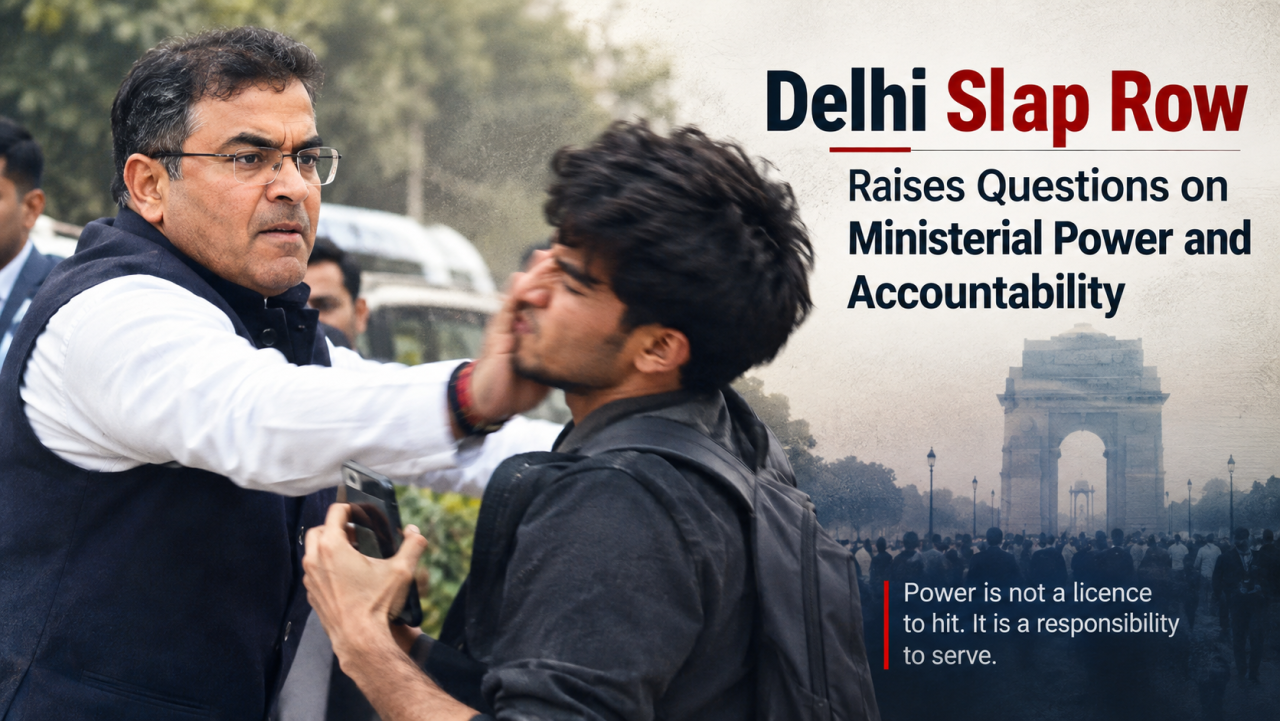
When a minister is caught on camera slapping a citizen, the issue goes beyond one confrontation. It raises a fundamental question about power, accountability and democratic conduct.
A minister is not an ordinary citizen when it comes to the exercise of public power. He represents the government, carries constitutional responsibility and is expected to respond to disagreement through the institutions of democracy, not through physical force.
That is why the incident involving Delhi PWD Minister Parvesh Verma in Tilak Nagar on Sunday deserves attention beyond the immediate political controversy.
A video circulated by AAP leaders appears to show Verma pulling down the mobile phone of a young man who was recording a road inspection and then slapping him. The incident occurred during an inspection of a newly constructed road, where questions were being raised about its condition. The video has since triggered a political confrontation between the BJP and AAP.
The first question is simple. How can a minister slap a citizen?
There may have been provocation. There may have been heated words. There may have been political workers at the site. There may even have been allegations of personal abuse. But none of these questions can be settled by a slap.
If a citizen abuses a minister, there are laws to deal with it. If someone threatens a public representative, the police can act. If a person obstructs government work, there are legal procedures. A minister has access to the entire machinery of the state. Physical retaliation is therefore a particularly serious matter because the imbalance of power is obvious.
Verma has offered his own explanation. He said he lost his temper after people accompanying AAP MLA Jarnail Singh allegedly abused his family. He has also argued that the video circulating publicly does not show the full context of the incident.
That explanation should be heard and investigated. But it also raises a larger question about public office. Should a minister's personal anger become an acceptable explanation for physical action against a citizen?
The second issue is equally troubling.
After the video emerged, the discussion shifted towards the alleged background of the young man. BJP leaders described him as a “habitual offender” and referred to an earlier arrest related to an alleged assault on an MCD employee. The minister and his supporters have also sought to highlight the circumstances surrounding the people accompanying AAP MLA Jarnail Singh.
But a person's alleged criminal history, even if established, does not automatically answer the question of what happened in front of the camera.
If the young man committed an offence, that offence should be investigated and prosecuted according to law. If he abused the minister, that allegation should also be examined. If there was provocation, witnesses and available recordings can help establish it.
The existence of a criminal case or an allegation against a person does not give another person a licence to assault him.
This distinction matters because democracy is built on a basic principle: the law is supposed to decide guilt, not personal anger or political status.
The young man, identified in reports as Sahib Singh, has denied abusing the minister and said he was recording the proceedings while working with the social media team of the local AAP MLA. He has also said that he submitted a complaint to the police.
There are therefore competing versions of the confrontation. Those claims should be investigated rather than converted into political conclusions.
Yet the video creates a separate public question that cannot simply disappear into the competing narratives.
When an ordinary citizen is seen being slapped by a minister, people naturally ask whether the same standard of power and accountability would apply if the roles were reversed.
Would a common citizen be allowed to justify hitting a minister by saying that he had been provoked?
The answer under the rule of law cannot depend on who is more powerful.
Democracy is not merely about elections. It is also about how those who hold public office behave when confronted, criticised or challenged. Roads can be inspected. Contractors can be questioned. Political workers can argue. Citizens can record public activity where the law permits it. Allegations can be investigated.
But when disagreement turns into physical action by someone holding ministerial office, the matter acquires a different significance.
The real test now is not which political party can produce the stronger narrative. It is whether the incident will be examined fairly, whether all available video and witness evidence will be considered, and whether responsibility will be determined through due process.
A minister has the right to defend himself against allegations. A citizen has the right to defend himself against allegations too.
That is precisely why the focus should remain on evidence rather than character assassination.
If democracy means equality before law, then the identity, political affiliation or alleged past of the person on the receiving end of a slap cannot determine whether the act itself deserves scrutiny.
When power is caught on camera using physical force against a citizen, who holds power accountable?
Neither an AAP question nor a BJP question.
It is a democratic question.
A minister is not an ordinary citizen when it comes to the exercise of public power. He represents the government, carries constitutional responsibility and is expected to respond to disagreement through the institutions of democracy, not through physical force.
That is why the incident involving Delhi PWD Minister Parvesh Verma in Tilak Nagar on Sunday deserves attention beyond the immediate political controversy.
A video circulated by AAP leaders appears to show Verma pulling down the mobile phone of a young man who was recording a road inspection and then slapping him. The incident occurred during an inspection of a newly constructed road, where questions were being raised about its condition. The video has since triggered a political confrontation between the BJP and AAP.
The first question is simple. How can a minister slap a citizen?
There may have been provocation. There may have been heated words. There may have been political workers at the site. There may even have been allegations of personal abuse. But none of these questions can be settled by a slap.
If a citizen abuses a minister, there are laws to deal with it. If someone threatens a public representative, the police can act. If a person obstructs government work, there are legal procedures. A minister has access to the entire machinery of the state. Physical retaliation is therefore a particularly serious matter because the imbalance of power is obvious.
Verma has offered his own explanation. He said he lost his temper after people accompanying AAP MLA Jarnail Singh allegedly abused his family. He has also argued that the video circulating publicly does not show the full context of the incident.
That explanation should be heard and investigated. But it also raises a larger question about public office. Should a minister's personal anger become an acceptable explanation for physical action against a citizen?
The second issue is equally troubling.
After the video emerged, the discussion shifted towards the alleged background of the young man. BJP leaders described him as a “habitual offender” and referred to an earlier arrest related to an alleged assault on an MCD employee. The minister and his supporters have also sought to highlight the circumstances surrounding the people accompanying AAP MLA Jarnail Singh.
But a person's alleged criminal history, even if established, does not automatically answer the question of what happened in front of the camera.
If the young man committed an offence, that offence should be investigated and prosecuted according to law. If he abused the minister, that allegation should also be examined. If there was provocation, witnesses and available recordings can help establish it.
The existence of a criminal case or an allegation against a person does not give another person a licence to assault him.
This distinction matters because democracy is built on a basic principle: the law is supposed to decide guilt, not personal anger or political status.
The young man, identified in reports as Sahib Singh, has denied abusing the minister and said he was recording the proceedings while working with the social media team of the local AAP MLA. He has also said that he submitted a complaint to the police.
There are therefore competing versions of the confrontation. Those claims should be investigated rather than converted into political conclusions.
Yet the video creates a separate public question that cannot simply disappear into the competing narratives.
When an ordinary citizen is seen being slapped by a minister, people naturally ask whether the same standard of power and accountability would apply if the roles were reversed.
Would a common citizen be allowed to justify hitting a minister by saying that he had been provoked?
The answer under the rule of law cannot depend on who is more powerful.
Democracy is not merely about elections. It is also about how those who hold public office behave when confronted, criticised or challenged. Roads can be inspected. Contractors can be questioned. Political workers can argue. Citizens can record public activity where the law permits it. Allegations can be investigated.
But when disagreement turns into physical action by someone holding ministerial office, the matter acquires a different significance.
The real test now is not which political party can produce the stronger narrative. It is whether the incident will be examined fairly, whether all available video and witness evidence will be considered, and whether responsibility will be determined through due process.
A minister has the right to defend himself against allegations. A citizen has the right to defend himself against allegations too.
That is precisely why the focus should remain on evidence rather than character assassination.
If democracy means equality before law, then the identity, political affiliation or alleged past of the person on the receiving end of a slap cannot determine whether the act itself deserves scrutiny.
When power is caught on camera using physical force against a citizen, who holds power accountable?
Neither an AAP question nor a BJP question.
It is a democratic question.

















Leave a Comment