
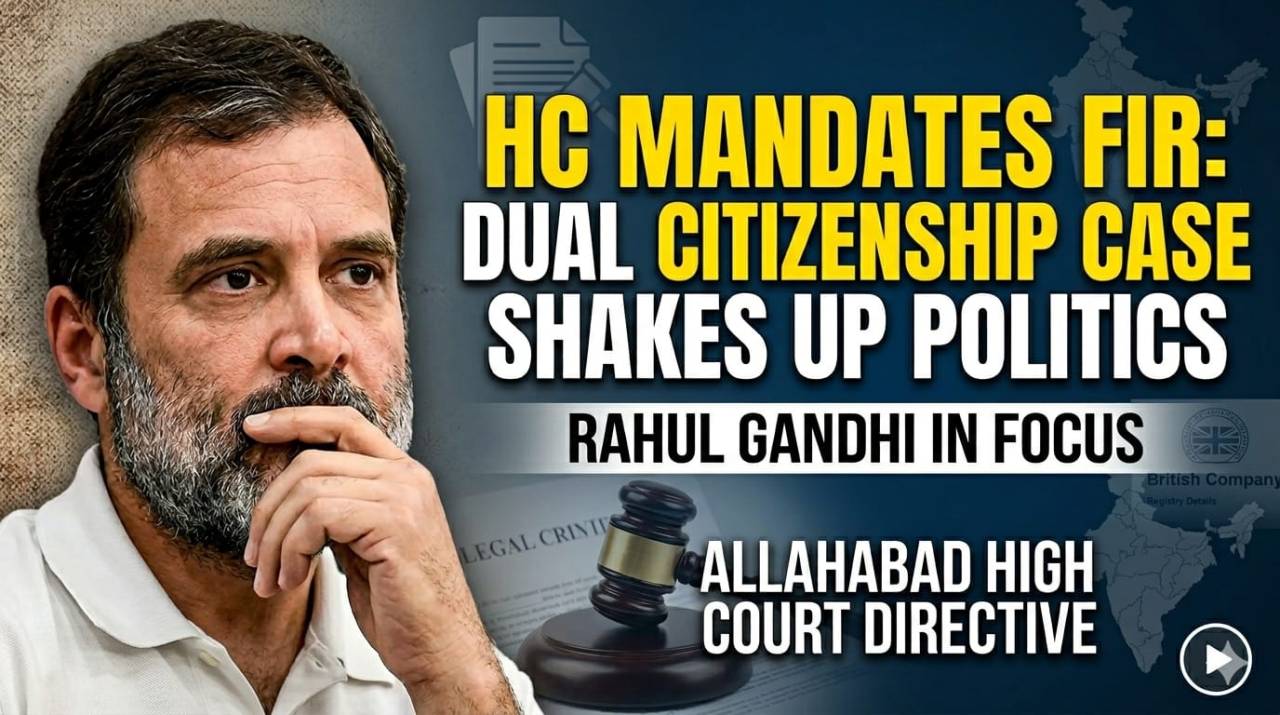
Can a question of citizenship reshape national politics? With the Allahabad High Court ordering an FIR into Rahul Gandhi’s alleged dual nationality, a long-simmering controversy has returned to the spotlight—raising critical questions about law, identity,
The long-standing debate surrounding the citizenship of Rahul Gandhi, Leader of the Opposition in the Lok Sabha, has entered a critical new phase. Following a directive from the Lucknow bench of the Allahabad High Court, the Uttar Pradesh government is now tasked with lodging a First Information Report (FIR) to investigate allegations of dual citizenship. This development not only raises significant legal questions but also underscores the increasingly litigious nature of Indian political discourse, where identity and legality frequently collide.
A Judicial Pivot
The core of the current controversy stems from a petition filed by S. Vignesh Shishir, a political worker from Karnataka. The petitioner alleges that Rahul Gandhi held British citizenship through his involvement with a UK-based company, “Backops Ltd.,” where he was reportedly listed as a British national in official filings.
While a special MP/MLA court had previously dismissed the plea in early 2026 on jurisdictional grounds, the High Court’s recent intervention has shifted the momentum. By directing the registration of an FIR, the court has signalled that the allegations—given their international implications and the gravity of the statutes involved—warrant a formal and centralized investigation.
The Legal Framework under Review
The investigation is expected to examine potential violations under a stringent set of Indian laws, reflecting the seriousness of the matter:
- Citizenship Act, 1955: India does not permit dual citizenship. Acquiring foreign nationality typically leads to automatic termination of Indian citizenship.
- Passport Act, 1967: Misrepresentation of nationality in obtaining or holding a passport carries significant legal consequences.
- Official Secrets Act (OSA): Its possible invocation suggests scrutiny over whether non-disclosure of foreign status could raise national security concerns.
- Bharatiya Nyaya Sanhita (BNS): Provisions relating to fraud and misrepresentation may also come into play.
Beyond the Courtroom: The Political Ripple Effect
The timing and nature of this directive have triggered a sharp political response. The Congress party, through senior leaders such as Abhishek Singhvi, has dismissed the allegations as “baseless” and “politically motivated,” arguing that similar claims have surfaced and been rejected multiple times over the past decade.
On the other side, leaders from the ruling Bharatiya Janata Party (BJP) and the Uttar Pradesh government maintain that the issue is one of constitutional integrity. Their position rests on the principle that no individual, regardless of political stature, is above legal scrutiny—particularly when it concerns citizenship.
A Fresh Perspective: The Need for Clarity
Beyond the immediate political contest, the case reflects a deeper challenge within Indian democracy—the growing tendency to weaponize questions of eligibility and identity. When the citizenship of a major political figure is contested, it introduces uncertainty that extends beyond the individual and influences public trust.
The High Court’s observation that the state may seek assistance from a central agency points toward the need for a specialized and credible investigation. Such a probe is essential not only to validate or dismiss the allegations but also to bring long-awaited clarity to an issue that has lingered in the public domain for years.
Final Take
As the FIR process begins, the discourse is expected to shift from political rhetoric to documentary evidence. The credibility of the investigation will depend on its transparency and adherence to legal standards, ensuring it is not perceived as a political vendetta.
For the public, the outcome carries significance beyond partisan lines. It is not merely about the legal standing of one leader but about reinforcing constitutional principles and safeguarding the integrity of citizenship in India. In a functioning democracy, the resolution must rest on verifiable facts—ensuring that truth, rather than narrative, ultimately prevails.
The long-standing debate surrounding the citizenship of Rahul Gandhi, Leader of the Opposition in the Lok Sabha, has entered a critical new phase. Following a directive from the Lucknow bench of the Allahabad High Court, the Uttar Pradesh government is now tasked with lodging a First Information Report (FIR) to investigate allegations of dual citizenship. This development not only raises significant legal questions but also underscores the increasingly litigious nature of Indian political discourse, where identity and legality frequently collide.
A Judicial Pivot
The core of the current controversy stems from a petition filed by S. Vignesh Shishir, a political worker from Karnataka. The petitioner alleges that Rahul Gandhi held British citizenship through his involvement with a UK-based company, “Backops Ltd.,” where he was reportedly listed as a British national in official filings.
While a special MP/MLA court had previously dismissed the plea in early 2026 on jurisdictional grounds, the High Court’s recent intervention has shifted the momentum. By directing the registration of an FIR, the court has signalled that the allegations—given their international implications and the gravity of the statutes involved—warrant a formal and centralized investigation.
The Legal Framework under Review
The investigation is expected to examine potential violations under a stringent set of Indian laws, reflecting the seriousness of the matter:
- Citizenship Act, 1955: India does not permit dual citizenship. Acquiring foreign nationality typically leads to automatic termination of Indian citizenship.
- Passport Act, 1967: Misrepresentation of nationality in obtaining or holding a passport carries significant legal consequences.
- Official Secrets Act (OSA): Its possible invocation suggests scrutiny over whether non-disclosure of foreign status could raise national security concerns.
- Bharatiya Nyaya Sanhita (BNS): Provisions relating to fraud and misrepresentation may also come into play.
Beyond the Courtroom: The Political Ripple Effect
The timing and nature of this directive have triggered a sharp political response. The Congress party, through senior leaders such as Abhishek Singhvi, has dismissed the allegations as “baseless” and “politically motivated,” arguing that similar claims have surfaced and been rejected multiple times over the past decade.
On the other side, leaders from the ruling Bharatiya Janata Party (BJP) and the Uttar Pradesh government maintain that the issue is one of constitutional integrity. Their position rests on the principle that no individual, regardless of political stature, is above legal scrutiny—particularly when it concerns citizenship.
A Fresh Perspective: The Need for Clarity
Beyond the immediate political contest, the case reflects a deeper challenge within Indian democracy—the growing tendency to weaponize questions of eligibility and identity. When the citizenship of a major political figure is contested, it introduces uncertainty that extends beyond the individual and influences public trust.
The High Court’s observation that the state may seek assistance from a central agency points toward the need for a specialized and credible investigation. Such a probe is essential not only to validate or dismiss the allegations but also to bring long-awaited clarity to an issue that has lingered in the public domain for years.
Final Take
As the FIR process begins, the discourse is expected to shift from political rhetoric to documentary evidence. The credibility of the investigation will depend on its transparency and adherence to legal standards, ensuring it is not perceived as a political vendetta.
For the public, the outcome carries significance beyond partisan lines. It is not merely about the legal standing of one leader but about reinforcing constitutional principles and safeguarding the integrity of citizenship in India. In a functioning democracy, the resolution must rest on verifiable facts—ensuring that truth, rather than narrative, ultimately prevails.





















Leave a Comment