
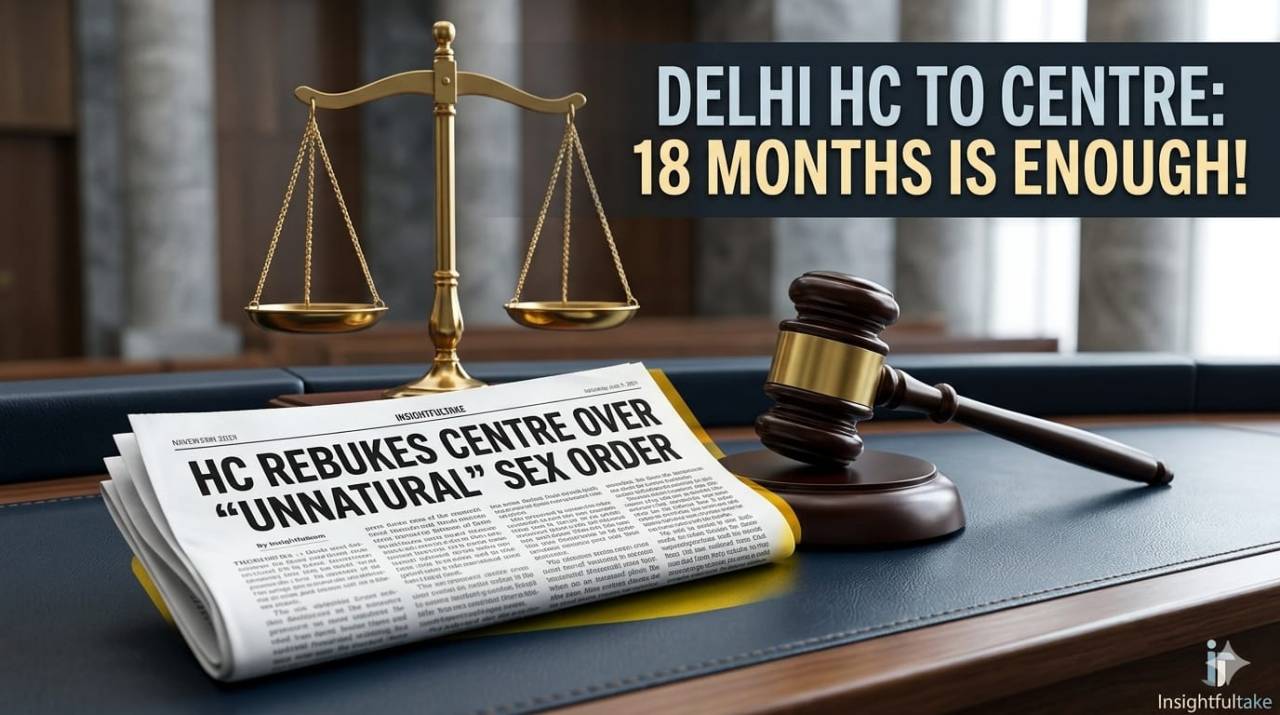
For 18 months, a critical gap in India’s new criminal law has left an entire category of sexual assault victims without clear legal protection—and now, the Delhi High Court is demanding to know why.
The Delhi High Court has officially restored a writ petition against the Central Government, expressing "displeasure" over the failure to address a significant legislative gap in the Bharatiya Nyaya Sanhita (BNS). The issue centers on the total removal of Section 377 of the old Indian Penal Code (IPC) without a corresponding replacement to protect male and LGBTQ+ victims of non-consensual sexual acts.
The Background of the 2024 Order
In August 2024, the High Court directed the Union of India to take a "holistic view" and an "expeditious decision" regarding the exclusion of penalties for "unnatural sex" and "sodomy" under the new criminal code. Under the previous IPC, Section 377—while decriminalized for consensual acts by the Supreme Court of India in 2018—remained the only legal mechanism to prosecute non-consensual sexual assault against men.
With the BNS replacing the IPC on July 1, 2024, this provision was deleted entirely. This has resulted in a situation where men who are sexually assaulted by other men currently have no specific section under which to file a First Information Report (FIR).
Current Court Proceedings
The Bench, consisting of Chief Justice DK Upadhyaya and Justice Tejas Karia, noted that although 1.5 years have passed since their initial direction, the government has yet to take a definitive stance. The court remarked that the "decision is nowhere in sight," despite the petitioner, Gantavya Gulati, making multiple follow-ups with the Ministry.
The Centre defended the delay by stating the issue is "sensitive" and requires gathering views from various stakeholders. However, the Court found this justification insufficient given the timeline and has now ordered the Centre to file an affidavit within four weeks detailing exactly what steps have been taken toward compliance.
Legal Analysis: The Constitutional Vacuum
From a legal standpoint, the transition from IPC to BNS was marketed as a move toward a more indigenous and modern justice system. However, by failing to adopt gender-neutral language in the sections dealing with rape (now Section 63 of the BNS), the legislature has created a hierarchy of victims.
The petitioner argues that this "legal void" leaves vulnerable communities without adequate protection. Under Article 14 (Right to Equality) and Article 21 (Right to Life and Liberty) of the Constitution, the state is obligated to provide equal protection of the law to all citizens, regardless of gender. The current draft of the BNS effectively excludes adult men from the definition of a victim in cases of non-consensual sexual intercourse.
Final Take
The restoration of this petition indicates that the judiciary is no longer willing to wait for the executive to deliberate indefinitely. The upcoming affidavit from the Centre will be a crucial document in determining whether the BNS will be amended to include gender-neutral sexual assault provisions or if a new specific section will be introduced to cover the gaps left by the repeal of Section 377.
























Leave a Comment