
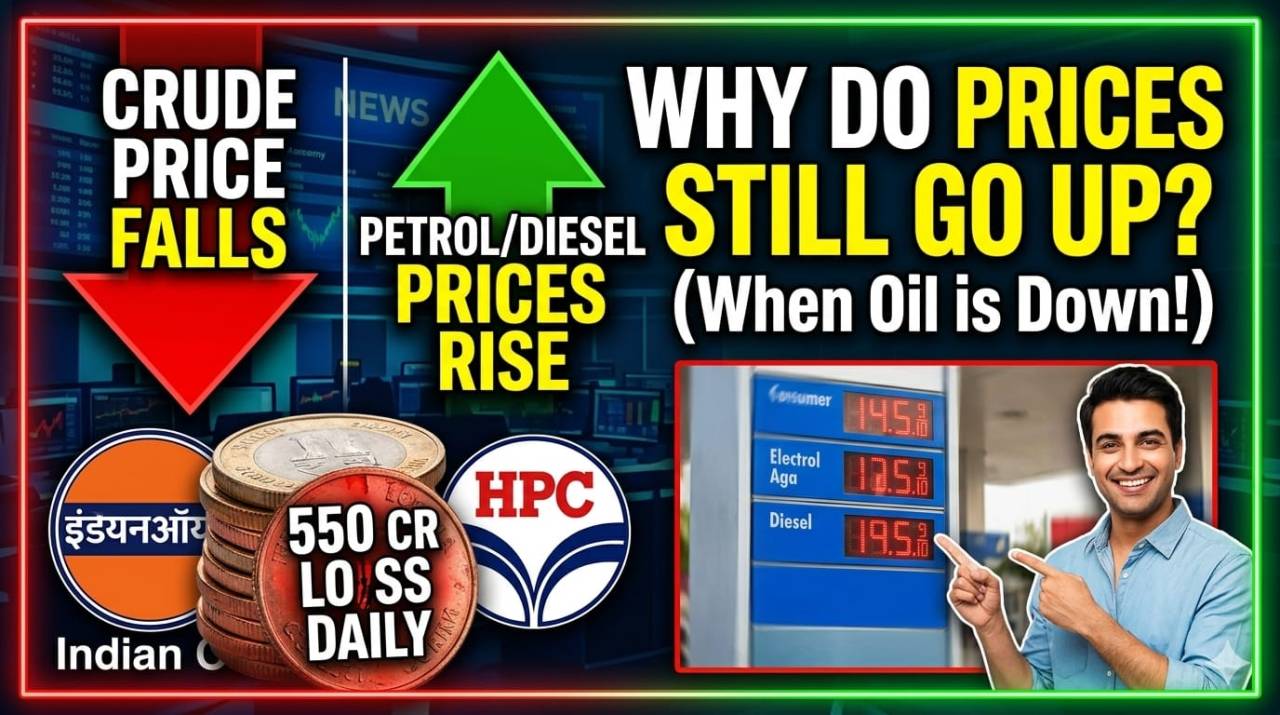
Global crude oil prices have fallen from their recent peaks, yet Indian consumers continue to pay high prices for petrol and diesel. Why hasn't cheaper oil translated into cheaper fuel? The answer lies in a web of geopolitics and taxes.
Every morning, millions of Indians pull up to petrol pumps, watch the digital meters tick upward, and wonder the same thing: if global crude oil prices have fallen from their recent highs, why are fuel prices still so expensive at home?
At first glance, the situation seems contradictory. News reports frequently highlight declines in international crude oil prices, creating the expectation that petrol and diesel should immediately become cheaper. Yet for many consumers, relief at the pump remains elusive. The answer lies in a complex mix of global geopolitics, government policy, and the financial pressures faced by India’s state-run oil companies.
Understanding this relationship reveals a deeper story about India's energy security and its dependence on international markets.
How Global Events Affect Indian Fuel Prices
India is the world's third-largest consumer of crude oil and imports more than 85 percent of its oil requirements. As a result, international developments have a direct impact on domestic fuel economics.
In recent months, geopolitical tensions in West Asia disrupted global energy markets and sent crude oil prices soaring. Benchmark Brent crude, which had been trading at relatively moderate levels, surged sharply as fears of supply disruptions spread across the market. For oil-importing nations like India, such spikes significantly increase the cost of purchasing crude oil from overseas suppliers.
Although international prices later retreated from their peak levels, they remained high enough to create substantial financial pressure on India's fuel ecosystem. The temporary decline in crude prices may seem encouraging, but it does not instantly erase the economic damage caused during months of elevated costs.
The Role of India's Oil Marketing Companies
At the center of this story are India's three major state-run Oil Marketing Companies (OMCs): Indian Oil Corporation, Bharat Petroleum, and Hindustan Petroleum.
Together, these companies account for the overwhelming majority of India's fuel retail market. They import crude oil, refine it into usable products, and distribute petrol, diesel, LPG, and aviation fuel across the country.
When international crude prices rise sharply, these companies face a difficult choice. They can either pass the full increase on to consumers immediately or absorb part of the burden themselves.
In many cases, they choose the second option.
The "Shock Absorber" Effect
Fuel prices influence nearly every sector of the economy. A sudden surge in petrol and diesel prices increases transportation costs, which can quickly raise the prices of food, household goods, and essential services.
To prevent inflation from spiraling out of control, India’s fuel pricing system often acts as a shock absorber. Instead of allowing retail prices to rise in perfect sync with international crude markets, oil companies may temporarily absorb losses.
This phenomenon is known as under-recovery—a situation where the cost of producing and supplying fuel exceeds the price at which it is sold.
During periods of extreme volatility, these losses can become enormous. While such measures protect consumers from immediate price shocks, they also create financial strain that eventually needs to be addressed.
Why Fuel Prices Don't Fall Immediately
Many consumers assume that lower crude oil prices should automatically translate into cheaper fuel. In reality, fuel pricing works more like a delayed system.
When oil companies absorb losses during periods of high crude prices, those losses do not disappear once international markets stabilize. Instead, companies must gradually recover the financial gap created during the crisis.
As a result, even when crude prices begin to decline, domestic fuel prices may remain elevated or continue to rise modestly. The additional revenue helps oil companies offset previous losses and strengthen their balance sheets.
A useful analogy is a household budget. If a family uses savings to cope with a financial emergency, the crisis may end, but rebuilding those savings takes time. Similarly, oil companies use periods of relative stability to recover from earlier losses.
What Makes Up the Price of Fuel?
Another common misconception is that fuel prices depend solely on crude oil costs.
In reality, the price consumers pay at the pump includes several components:
- Cost of crude oil imports
- Refining and processing expenses
- Transportation and freight charges
- Dealer commissions
- Central government excise duties
- State-level Value Added Tax (VAT)
- Marketing and distribution costs
Because crude oil is only one part of the overall pricing structure, a fall in international oil prices does not always produce a proportionate reduction in retail fuel prices.
The Bigger Energy Challenge
The current situation highlights a larger issue facing India: energy dependence.
As long as the country relies heavily on imported crude oil, domestic fuel prices will remain vulnerable to international conflicts, supply disruptions, and market volatility. Events occurring thousands of kilometers away can ultimately influence the amount Indian consumers pay at local fuel stations.
This dependence also affects public finances and the investment capacity of state-run energy companies. Resources used to absorb short-term losses could otherwise be directed toward expanding infrastructure, modernizing refineries, or investing in cleaner energy technologies.
Final Take
The fuel price debate is about much more than petrol and diesel. It reflects the broader challenge of balancing consumer affordability, economic stability, and energy security.
Greater transparency in fuel pricing could help consumers better understand why prices move the way they do. At the same time, long-term solutions will require reducing dependence on imported oil through renewable energy, electric mobility, and domestic energy development.
For now, the numbers displayed on fuel pumps remain closely linked to global events, geopolitical tensions, and economic realities that extend far beyond India's borders. While crude oil prices may fall, the path from international markets to local petrol stations is rarely straightforward—and that is why cheaper crude does not always mean cheaper fuel.
Every morning, millions of Indians pull up to petrol pumps, watch the digital meters tick upward, and wonder the same thing: if global crude oil prices have fallen from their recent highs, why are fuel prices still so expensive at home?
At first glance, the situation seems contradictory. News reports frequently highlight declines in international crude oil prices, creating the expectation that petrol and diesel should immediately become cheaper. Yet for many consumers, relief at the pump remains elusive. The answer lies in a complex mix of global geopolitics, government policy, and the financial pressures faced by India’s state-run oil companies.
Understanding this relationship reveals a deeper story about India's energy security and its dependence on international markets.
How Global Events Affect Indian Fuel Prices
India is the world's third-largest consumer of crude oil and imports more than 85 percent of its oil requirements. As a result, international developments have a direct impact on domestic fuel economics.
In recent months, geopolitical tensions in West Asia disrupted global energy markets and sent crude oil prices soaring. Benchmark Brent crude, which had been trading at relatively moderate levels, surged sharply as fears of supply disruptions spread across the market. For oil-importing nations like India, such spikes significantly increase the cost of purchasing crude oil from overseas suppliers.
Although international prices later retreated from their peak levels, they remained high enough to create substantial financial pressure on India's fuel ecosystem. The temporary decline in crude prices may seem encouraging, but it does not instantly erase the economic damage caused during months of elevated costs.
The Role of India's Oil Marketing Companies
At the center of this story are India's three major state-run Oil Marketing Companies (OMCs): Indian Oil Corporation, Bharat Petroleum, and Hindustan Petroleum.
Together, these companies account for the overwhelming majority of India's fuel retail market. They import crude oil, refine it into usable products, and distribute petrol, diesel, LPG, and aviation fuel across the country.
When international crude prices rise sharply, these companies face a difficult choice. They can either pass the full increase on to consumers immediately or absorb part of the burden themselves.
In many cases, they choose the second option.
The "Shock Absorber" Effect
Fuel prices influence nearly every sector of the economy. A sudden surge in petrol and diesel prices increases transportation costs, which can quickly raise the prices of food, household goods, and essential services.
To prevent inflation from spiraling out of control, India’s fuel pricing system often acts as a shock absorber. Instead of allowing retail prices to rise in perfect sync with international crude markets, oil companies may temporarily absorb losses.
This phenomenon is known as under-recovery—a situation where the cost of producing and supplying fuel exceeds the price at which it is sold.
During periods of extreme volatility, these losses can become enormous. While such measures protect consumers from immediate price shocks, they also create financial strain that eventually needs to be addressed.
Why Fuel Prices Don't Fall Immediately
Many consumers assume that lower crude oil prices should automatically translate into cheaper fuel. In reality, fuel pricing works more like a delayed system.
When oil companies absorb losses during periods of high crude prices, those losses do not disappear once international markets stabilize. Instead, companies must gradually recover the financial gap created during the crisis.
As a result, even when crude prices begin to decline, domestic fuel prices may remain elevated or continue to rise modestly. The additional revenue helps oil companies offset previous losses and strengthen their balance sheets.
A useful analogy is a household budget. If a family uses savings to cope with a financial emergency, the crisis may end, but rebuilding those savings takes time. Similarly, oil companies use periods of relative stability to recover from earlier losses.
What Makes Up the Price of Fuel?
Another common misconception is that fuel prices depend solely on crude oil costs.
In reality, the price consumers pay at the pump includes several components:
- Cost of crude oil imports
- Refining and processing expenses
- Transportation and freight charges
- Dealer commissions
- Central government excise duties
- State-level Value Added Tax (VAT)
- Marketing and distribution costs
Because crude oil is only one part of the overall pricing structure, a fall in international oil prices does not always produce a proportionate reduction in retail fuel prices.
The Bigger Energy Challenge
The current situation highlights a larger issue facing India: energy dependence.
As long as the country relies heavily on imported crude oil, domestic fuel prices will remain vulnerable to international conflicts, supply disruptions, and market volatility. Events occurring thousands of kilometers away can ultimately influence the amount Indian consumers pay at local fuel stations.
This dependence also affects public finances and the investment capacity of state-run energy companies. Resources used to absorb short-term losses could otherwise be directed toward expanding infrastructure, modernizing refineries, or investing in cleaner energy technologies.
Final Take
The fuel price debate is about much more than petrol and diesel. It reflects the broader challenge of balancing consumer affordability, economic stability, and energy security.
Greater transparency in fuel pricing could help consumers better understand why prices move the way they do. At the same time, long-term solutions will require reducing dependence on imported oil through renewable energy, electric mobility, and domestic energy development.
For now, the numbers displayed on fuel pumps remain closely linked to global events, geopolitical tensions, and economic realities that extend far beyond India's borders. While crude oil prices may fall, the path from international markets to local petrol stations is rarely straightforward—and that is why cheaper crude does not always mean cheaper fuel.
























Leave a Comment