
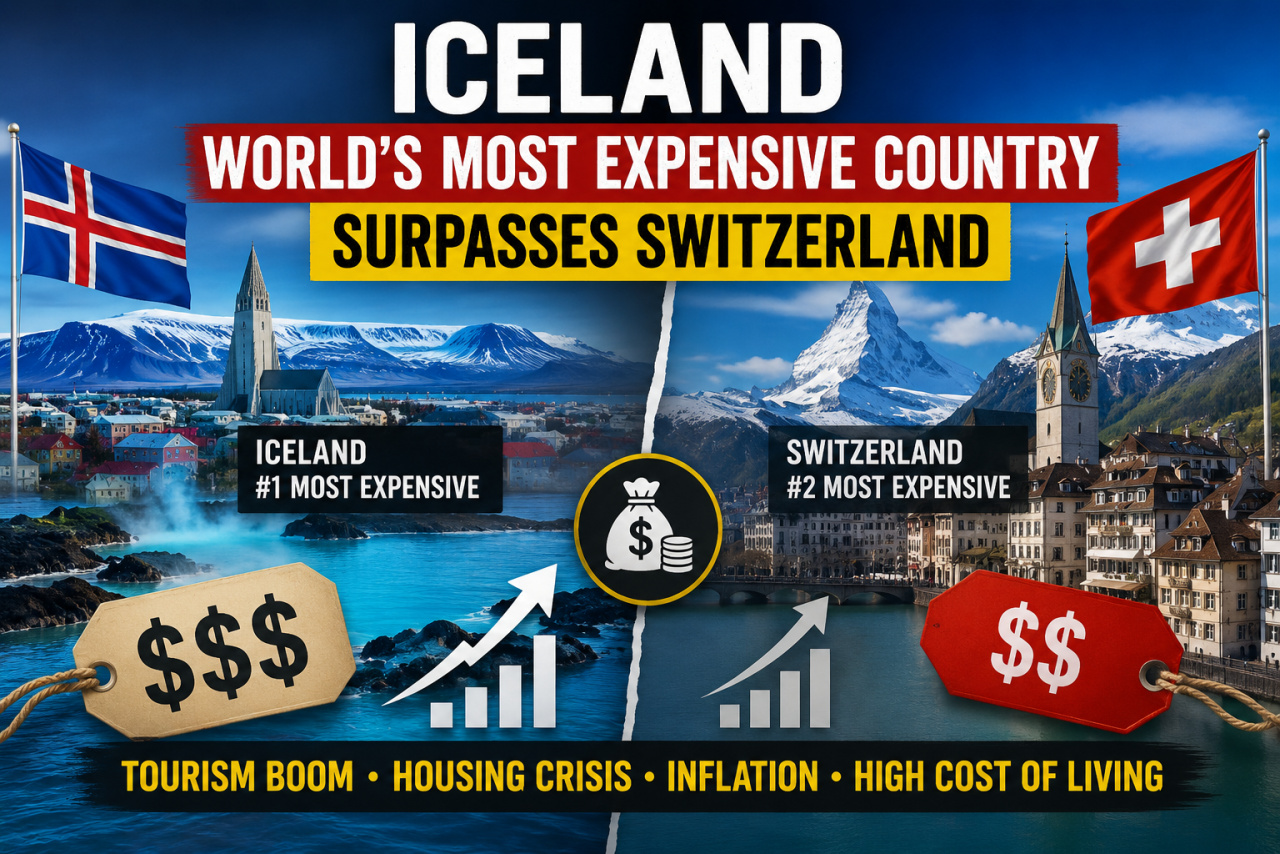
Iceland has surpassed Switzerland as the world's most expensive country, revealing how tourism success and housing shortages can reshape an economy.
For years, Switzerland has been synonymous with high prices. From luxury watches and banking services to costly restaurants and housing, the Alpine nation has long topped global rankings for the cost of living. But a surprising shift is now drawing international attention: Iceland has overtaken Switzerland to become the world's most expensive country.
The development, first highlighted through calculations by Icelandic trade union Viska using data from Eurostat and the Central Bank of Iceland, marks the first time since 2018 that Iceland has surpassed Switzerland in overall price levels. According to the analysis, prices in Iceland are now roughly three percentage points higher than those in Switzerland.
While the ranking may appear to be a statistical curiosity, economists say it reflects deeper structural challenges facing the small North Atlantic nation. Iceland's struggle is not merely about expensive coffee, hotel rooms, or grocery bills. It is about the economic consequences of rapid growth, a booming tourism industry, housing shortages, and an economy heavily dependent on a limited number of sectors.
A Tourism Success Story With Side Effects
Few countries have benefited from tourism as dramatically as Iceland.
Over the past decade, the island nation of about 400,000 people has transformed into one of the world's most sought-after travel destinations. Spectacular volcanoes, glaciers, geothermal springs, and the Northern Lights have attracted millions of visitors annually. Following the pandemic, tourism rebounded strongly and became one of the main engines of economic growth.
However, success has come at a price.
Economists argue that the surge in tourist demand has pushed up costs across the economy. Hotels, restaurants, transportation services, and entertainment businesses require more workers, leading employers to offer higher wages. While rising wages can benefit workers, they also increase operating costs for businesses, which are often passed on to consumers through higher prices.
The result is a cycle in which growing tourism contributes to inflation, making everyday life more expensive for residents.
The Housing Crunch
Housing has emerged as one of the most visible signs of Iceland's affordability crisis.
In Reykjavík and other popular destinations, short-term rental platforms have created intense competition between tourists and residents. Apartments that once housed local families are increasingly being used to accommodate visitors willing to pay premium rates. This has reduced housing supply and contributed to rising rents and property prices.
For many Icelanders, the issue extends beyond rent. Housing costs affect wages, consumer spending, and broader inflation trends. As workers demand higher salaries to cope with rising living expenses, businesses face additional cost pressures, further fueling price increases.
The challenge is particularly difficult in a country with a relatively small housing market and limited land suitable for large-scale urban development.
Geography and Imports Add to Costs
Iceland's location also plays a significant role in its high prices.
Situated in the North Atlantic Ocean, far from major European markets, the country relies heavily on imports for a wide range of consumer goods. Transportation and logistics costs are naturally higher than in continental Europe. Many products must travel long distances before reaching Icelandic shelves, increasing their final price for consumers.
A small population also limits economies of scale. Businesses often operate in a relatively small domestic market, making it difficult to spread costs across large numbers of customers.
These geographic realities have long made Iceland an expensive place to live. The recent surge in tourism and housing demand has simply intensified existing pressures.
A Warning Sign for the Economy
Some economists view Iceland's new ranking as a warning rather than a badge of prosperity.
According to analysts involved in the study, the country remains heavily dependent on labour-intensive industries such as tourism. While tourism generates jobs and foreign income, it does not necessarily create the kind of productivity growth that can keep inflation under control over the long term.
Recent surveys suggest that rising prices may already be affecting visitor behaviour. Higher travel costs are beginning to discourage some tourists, raising concerns about whether Iceland can continue relying so heavily on the sector for economic growth.
The challenge for policymakers is clear: maintain the benefits of a thriving tourism industry while preventing housing shortages, controlling inflation, and diversifying the economy.
More Than a Ranking
Iceland's rise above Switzerland in global cost-of-living rankings is more than a symbolic shift. It highlights the delicate balance that small economies must strike between growth and affordability.
For visitors, Iceland remains a destination of extraordinary natural beauty. For residents, however, the world's most expensive country title serves as a reminder that economic success can bring difficult trade-offs. The country's next challenge will be ensuring that prosperity remains sustainable—not only for tourists seeking adventure, but also for the people who call Iceland home.
For years, Switzerland has been synonymous with high prices. From luxury watches and banking services to costly restaurants and housing, the Alpine nation has long topped global rankings for the cost of living. But a surprising shift is now drawing international attention: Iceland has overtaken Switzerland to become the world's most expensive country.
The development, first highlighted through calculations by Icelandic trade union Viska using data from Eurostat and the Central Bank of Iceland, marks the first time since 2018 that Iceland has surpassed Switzerland in overall price levels. According to the analysis, prices in Iceland are now roughly three percentage points higher than those in Switzerland.
While the ranking may appear to be a statistical curiosity, economists say it reflects deeper structural challenges facing the small North Atlantic nation. Iceland's struggle is not merely about expensive coffee, hotel rooms, or grocery bills. It is about the economic consequences of rapid growth, a booming tourism industry, housing shortages, and an economy heavily dependent on a limited number of sectors.
A Tourism Success Story With Side Effects
Few countries have benefited from tourism as dramatically as Iceland.
Over the past decade, the island nation of about 400,000 people has transformed into one of the world's most sought-after travel destinations. Spectacular volcanoes, glaciers, geothermal springs, and the Northern Lights have attracted millions of visitors annually. Following the pandemic, tourism rebounded strongly and became one of the main engines of economic growth.
However, success has come at a price.
Economists argue that the surge in tourist demand has pushed up costs across the economy. Hotels, restaurants, transportation services, and entertainment businesses require more workers, leading employers to offer higher wages. While rising wages can benefit workers, they also increase operating costs for businesses, which are often passed on to consumers through higher prices.
The result is a cycle in which growing tourism contributes to inflation, making everyday life more expensive for residents.
The Housing Crunch
Housing has emerged as one of the most visible signs of Iceland's affordability crisis.
In Reykjavík and other popular destinations, short-term rental platforms have created intense competition between tourists and residents. Apartments that once housed local families are increasingly being used to accommodate visitors willing to pay premium rates. This has reduced housing supply and contributed to rising rents and property prices.
For many Icelanders, the issue extends beyond rent. Housing costs affect wages, consumer spending, and broader inflation trends. As workers demand higher salaries to cope with rising living expenses, businesses face additional cost pressures, further fueling price increases.
The challenge is particularly difficult in a country with a relatively small housing market and limited land suitable for large-scale urban development.
Geography and Imports Add to Costs
Iceland's location also plays a significant role in its high prices.
Situated in the North Atlantic Ocean, far from major European markets, the country relies heavily on imports for a wide range of consumer goods. Transportation and logistics costs are naturally higher than in continental Europe. Many products must travel long distances before reaching Icelandic shelves, increasing their final price for consumers.
A small population also limits economies of scale. Businesses often operate in a relatively small domestic market, making it difficult to spread costs across large numbers of customers.
These geographic realities have long made Iceland an expensive place to live. The recent surge in tourism and housing demand has simply intensified existing pressures.
A Warning Sign for the Economy
Some economists view Iceland's new ranking as a warning rather than a badge of prosperity.
According to analysts involved in the study, the country remains heavily dependent on labour-intensive industries such as tourism. While tourism generates jobs and foreign income, it does not necessarily create the kind of productivity growth that can keep inflation under control over the long term.
Recent surveys suggest that rising prices may already be affecting visitor behaviour. Higher travel costs are beginning to discourage some tourists, raising concerns about whether Iceland can continue relying so heavily on the sector for economic growth.
The challenge for policymakers is clear: maintain the benefits of a thriving tourism industry while preventing housing shortages, controlling inflation, and diversifying the economy.
More Than a Ranking
Iceland's rise above Switzerland in global cost-of-living rankings is more than a symbolic shift. It highlights the delicate balance that small economies must strike between growth and affordability.
For visitors, Iceland remains a destination of extraordinary natural beauty. For residents, however, the world's most expensive country title serves as a reminder that economic success can bring difficult trade-offs. The country's next challenge will be ensuring that prosperity remains sustainable—not only for tourists seeking adventure, but also for the people who call Iceland home.

















Leave a Comment