
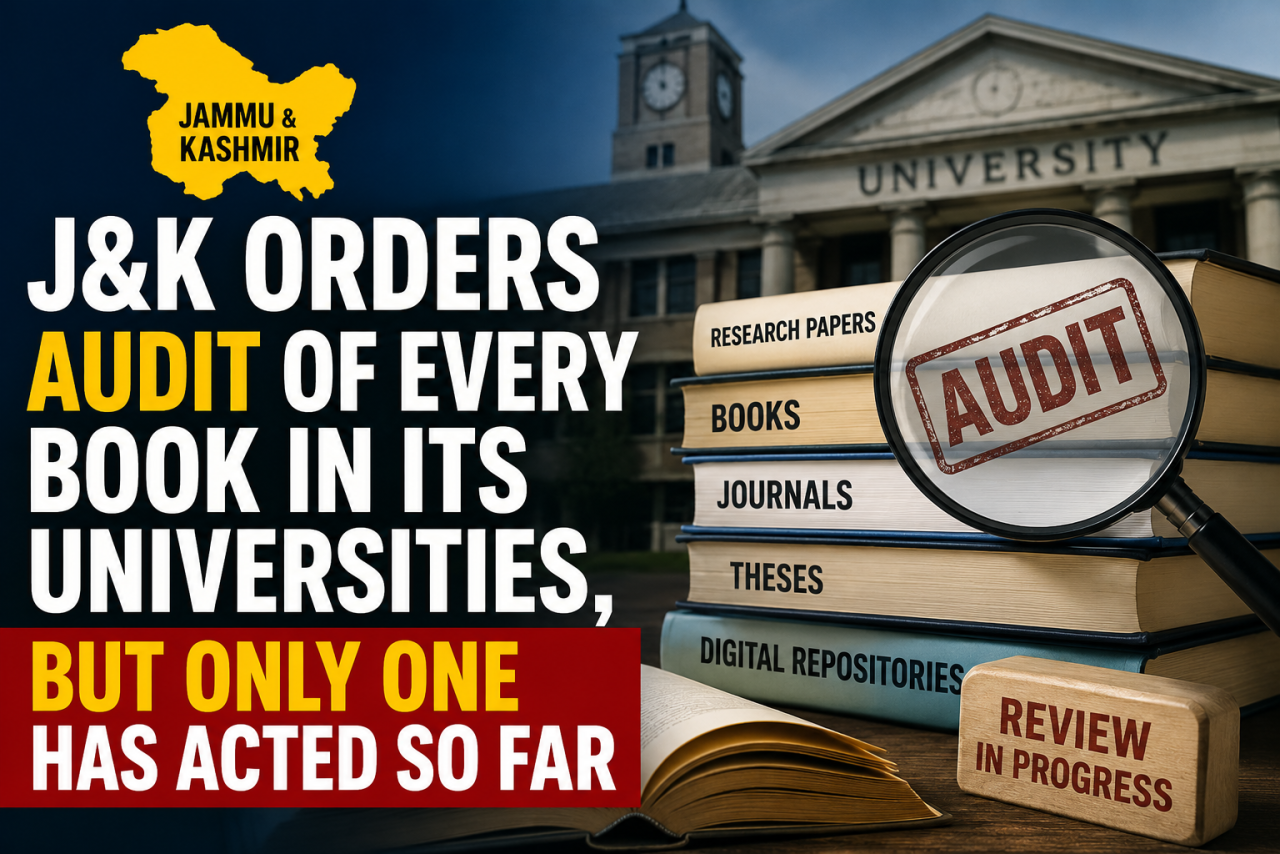
After a school library controversy, Jammu and Kashmir has ordered a territory-wide audit of books and academic material. Yet, only one of its 11 universities has formally begun the process.
The Jammu and Kashmir government has launched a comprehensive review of books, research theses, journals and other academic material across schools, colleges, universities and public libraries in the Union Territory. The School Education Department and the Higher Education Department have issued detailed circulars directing all educational institutions to ensure that no publication contains material promoting or justifying terrorism, violent extremism, secessionism, radicalisation or activities considered prejudicial to the sovereignty, unity, integrity and security of India.
The review follows the withdrawal of two books, Personalities and Legends of Jammu and Kashmir and Great Personalities of Jammu and Kashmir, which had been supplied to government school libraries under the Centre's Samagra Shiksha scheme. The books came under scrutiny after they described separatist leaders, including Syed Ali Shah Geelani, Masrat Alam and JKLF founder Maqbool Bhat, as "great personalities."
The controversy led to the suspension of eight officials from the School Education Department earlier this month. Police also registered an FIR under the Unlawful Activities (Prevention) Act on July 4, and three publishers associated with the books were later remanded to 10 days of police custody.
Following the incident, authorities initially ordered a review of all books in government and private school libraries across Kashmir. The exercise has now been expanded into a structured framework covering higher education. Under the new directives, vice chancellors, college principals, chief education officers and heads of institutions have been made responsible for verifying educational material and conducting periodic reviews of books, research publications, dissertations and digital repositories.
Jammu and Kashmir has 11 universities, including two central universities and nine state universities, along with nearly 125 affiliated colleges. So far, however, only the University of Jammu has issued an institutional order implementing the government's directive. The university has instructed all libraries, offices and digital repositories to identify and remove any material containing anti-national, separatist or otherwise objectionable content.
The University's Registrar has also announced that a committee will be formed to prepare a standard operating procedure for future book procurement. The proposed framework will include a screening process before acquisition and periodic random reviews by a panel of academicians.
No other university or college in the Union Territory has publicly issued a similar order, although officials say the audit process has formally begun. The gap between the government's directive and institutional action reflects the scale of the exercise. University libraries typically contain tens of thousands of books collected over several decades, making a thorough content review a significant administrative task.
The audit follows a three-stage compliance process. Institutions were first instructed to verify their collections and submit compliance certificates to their respective Chief Education Officers or Zonal Education Officers. Government schools were given a deadline of July 13. Where objectionable material is identified, institutions must submit a detailed report specifying the title, author, publisher, year of publication and number of copies. The higher education circulars adopt the same framework but do not prescribe similarly strict timelines, leaving uncertainty over when universities are expected to complete the exercise.
Although Indian higher education has witnessed institutional inspections in the past, the scope of the Jammu and Kashmir initiative is unusual. Previous reviews conducted by the University Grants Commission primarily focused on regulatory compliance, infrastructure, faculty strength and financial management rather than the content of library collections. Even those exercises often saw uneven compliance across institutions.
The government says the current audit is intended to strengthen academic standards, improve institutional accountability and establish a transparent mechanism for reviewing educational material in the future. Whether the exercise results in uniform implementation across all 11 universities, or whether the University of Jammu remains the only institution to act promptly, will become clearer as the review progresses.
The Jammu and Kashmir government has launched a comprehensive review of books, research theses, journals and other academic material across schools, colleges, universities and public libraries in the Union Territory. The School Education Department and the Higher Education Department have issued detailed circulars directing all educational institutions to ensure that no publication contains material promoting or justifying terrorism, violent extremism, secessionism, radicalisation or activities considered prejudicial to the sovereignty, unity, integrity and security of India.
The review follows the withdrawal of two books, Personalities and Legends of Jammu and Kashmir and Great Personalities of Jammu and Kashmir, which had been supplied to government school libraries under the Centre's Samagra Shiksha scheme. The books came under scrutiny after they described separatist leaders, including Syed Ali Shah Geelani, Masrat Alam and JKLF founder Maqbool Bhat, as "great personalities."
The controversy led to the suspension of eight officials from the School Education Department earlier this month. Police also registered an FIR under the Unlawful Activities (Prevention) Act on July 4, and three publishers associated with the books were later remanded to 10 days of police custody.
Following the incident, authorities initially ordered a review of all books in government and private school libraries across Kashmir. The exercise has now been expanded into a structured framework covering higher education. Under the new directives, vice chancellors, college principals, chief education officers and heads of institutions have been made responsible for verifying educational material and conducting periodic reviews of books, research publications, dissertations and digital repositories.
Jammu and Kashmir has 11 universities, including two central universities and nine state universities, along with nearly 125 affiliated colleges. So far, however, only the University of Jammu has issued an institutional order implementing the government's directive. The university has instructed all libraries, offices and digital repositories to identify and remove any material containing anti-national, separatist or otherwise objectionable content.
The University's Registrar has also announced that a committee will be formed to prepare a standard operating procedure for future book procurement. The proposed framework will include a screening process before acquisition and periodic random reviews by a panel of academicians.
No other university or college in the Union Territory has publicly issued a similar order, although officials say the audit process has formally begun. The gap between the government's directive and institutional action reflects the scale of the exercise. University libraries typically contain tens of thousands of books collected over several decades, making a thorough content review a significant administrative task.
The audit follows a three-stage compliance process. Institutions were first instructed to verify their collections and submit compliance certificates to their respective Chief Education Officers or Zonal Education Officers. Government schools were given a deadline of July 13. Where objectionable material is identified, institutions must submit a detailed report specifying the title, author, publisher, year of publication and number of copies. The higher education circulars adopt the same framework but do not prescribe similarly strict timelines, leaving uncertainty over when universities are expected to complete the exercise.
Although Indian higher education has witnessed institutional inspections in the past, the scope of the Jammu and Kashmir initiative is unusual. Previous reviews conducted by the University Grants Commission primarily focused on regulatory compliance, infrastructure, faculty strength and financial management rather than the content of library collections. Even those exercises often saw uneven compliance across institutions.
The government says the current audit is intended to strengthen academic standards, improve institutional accountability and establish a transparent mechanism for reviewing educational material in the future. Whether the exercise results in uniform implementation across all 11 universities, or whether the University of Jammu remains the only institution to act promptly, will become clearer as the review progresses.

















Leave a Comment