
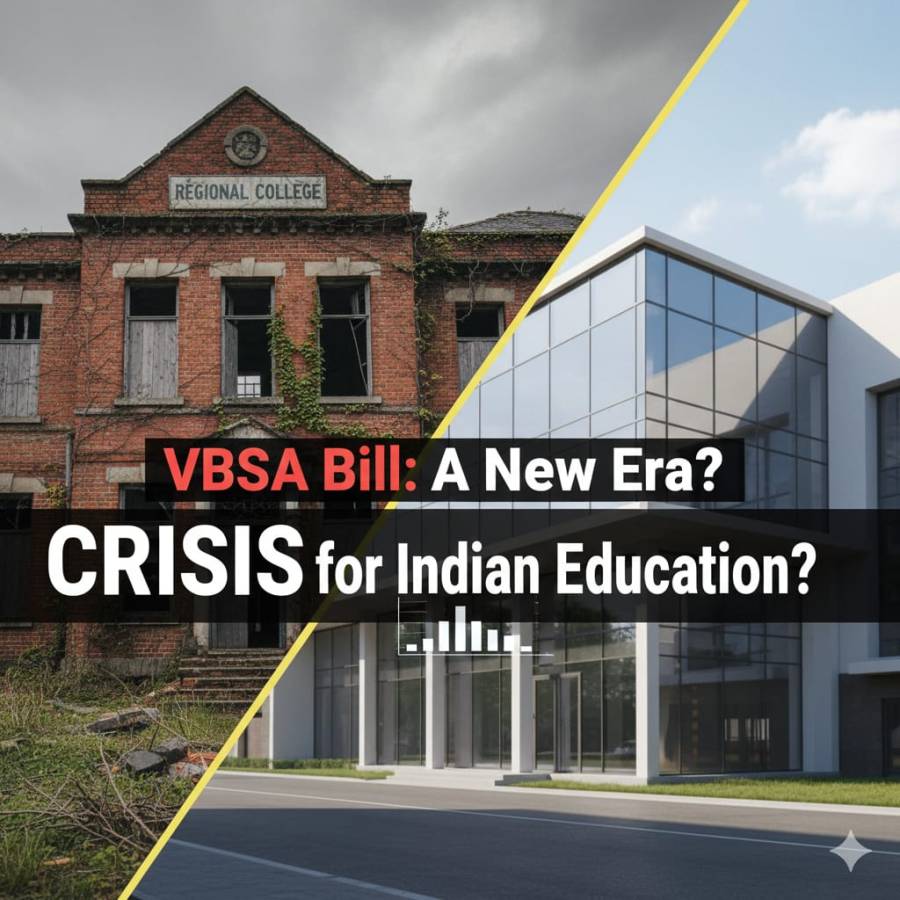
As India prepares for a sweeping overhaul of its higher education system, the Viksit Bharat Shiksha Adhikshak (VBSA) Bill, 2025 has ignited a national debate. Is it a long-awaited reform—or a quiet threat to the universities that educate the heart of India?
Indian Education System at the Brink of Transformation
The Indian higher education system is on the verge of a massive transformation. The introduction of the Viksit Bharat Shiksha Adhikshak (VBSA) Bill, 2025, has sparked a heated debate across the country. While the government presents it as a "revamp" to modernize education, many experts and academics are waving a red flag. They warn that this bill could inadvertently marginalize regional and state universities, creating a wider gap between "elite" institutions and the colleges that serve the heart of India.
But why should this matter to a common citizen or a student in a small town? Let’s break down the VBSA Bill, its implications, and why it concerns every Indian family.
What is the VBSA Bill?
To understand the future, we must look at the present. Currently, higher education in India is governed by three main bodies:
- UGC (University Grants Commission): Handles funding and standards.
- AICTE (All India Council for Technical Education): Regulates technical and engineering colleges.
- NCTE (National Council for Teacher Education): Manages teacher training.
The VBSA Bill proposes to dissolve these bodies and replace them with a single "umbrella" regulator. This new commission will have three specialized councils: one for regulation, one for setting standards, and one for accreditation (grading colleges).
Why is there an Outcry? The fear for Regional Universities
The primary concern raised by experts is that the VBSA framework links funding to "institutional performance" and "regulatory feedback." On paper, this sounds logical—reward the best performers. However, in a diverse country like India, this "one-size-fits-all" approach can be dangerous.
1. The Funding Trap
State and regional universities often operate in rural areas with limited infrastructure. They serve students who may not have access to high-end coaching or elite resources. If the government decides to give more funds only to those who already have high research output and top-tier ratings, these rural colleges will be left behind. As Sanjay Chaudhary, a faculty member at Dr. Ram Manohar Lohia Avadh University, points out, many state universities are already struggling with severe fund shortages. If their funding is further squeezed based on "performance," they might never be able to improve.
2. Standardized vs. Local Needs
The bill encourages a "centrally aligned curriculum." Critics argue that this might force universities to adopt a template-based model, ignoring local culture, regional languages, and specific community needs. Education should be a tool for local empowerment, not just a factory producing standardized graduates.
3. The Rise of Fees
With central grants declining—AICTE grants dropped by 67% in just two years—colleges are being pushed toward "HEFA loans" (Higher Education Financing Agency). Unlike grants, loans must be repaid. To repay these loans, institutions often have no choice but to increase student fees. This directly affects the common Indian family, making higher education a luxury rather than a right.
Why Does This Matter to the Indian Mass?
For a middle-class or lower-income family in India, a local state university is the only gateway to a better life. If these regional universities are marginalized:
- Accessibility Drops: If local colleges lack funds, they cannot provide quality labs, libraries, or teachers. Students from villages will have to migrate to big cities, which many cannot afford.
- Education Inequality: We might end up with a "tiered" system. At the top will be a few well-funded, elite central institutions (like IITs), and at the bottom will be hundreds of struggling state universities. This creates a class divide in the job market.
- The Burden of Debt: If universities switch to a loan-based model, the cost of a degree will skyrocket. For a country where education is the primary ladder for social mobility, high fees act as a permanent barrier.
A Needed Rethink: Education as a Public Good
The government’s goal to "revamp" education is noble. We do need better standards and less bureaucracy. However, we must ask: Should education be treated like a corporate competition or a public service?
In a corporate model, the "weak" are allowed to fail. But in a democracy, the "weak" institutions need the most support. Instead of a "reward-the-best" funding model, India needs a "support-the-struggling" model.
True "Viksit Bharat" (Developed India) cannot be achieved if only the top 10% of institutions thrive. Real development happens when a small college in a remote district of Bihar or Odisha has the same quality of teachers and facilities as a college in Delhi or Mumbai.
Final Take
The VBSA Bill, 2025 marks a decisive moment in India’s education journey. While it promises efficiency and freedom from the old “inspector raj,” the fear of silencing regional voices is real and justified.
Autonomy must not translate into abandonment.
It should mean freedom to innovate, backed by strong public support, not survival through debt and competition. As the bill moves forward, policymakers must ensure that performance metrics reflect India’s social realities.
Because the strength of India’s future does not lie only in its top institutions—but in how well it lifts those at the margins.
Education must remain a ladder—sturdy, inclusive, and within reach of every Indian student, regardless of their pin code.

















Leave a Comment