
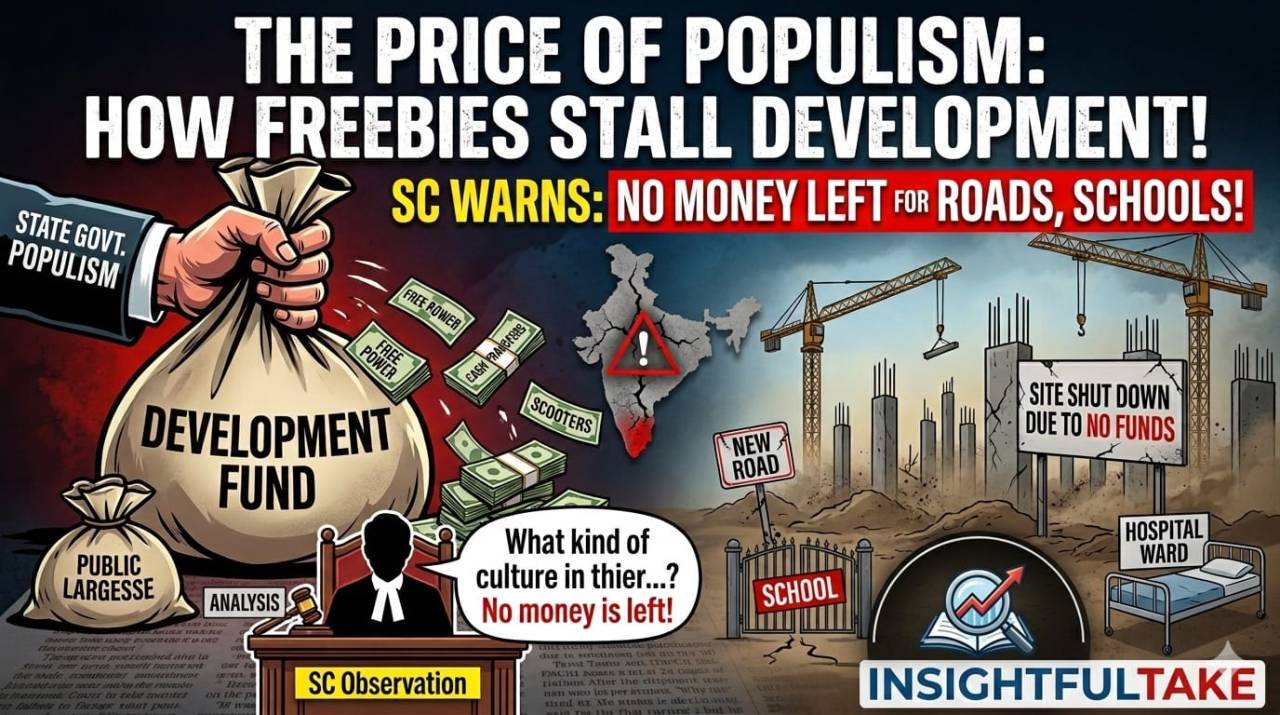
India’s growing freebie culture is raising a serious question: are we funding welfare—or quietly mortgaging the future of development?
In a remark that has quietly shaken India’s political conversation, the Supreme Court of India recently asked a question that goes far beyond courtroom debate: What kind of economic culture is India building?
The question arose during a hearing related to the finances of the Tamil Nadu Power Distribution Corporation. But the concern was not limited to a single power utility or even a single state. The court’s worry was deeper. Across India, governments are increasingly choosing short-term political giveaways over long-term developmental investments.
The result, the bench warned, is a dangerous pattern where public money flows into populist handouts while essential infrastructure struggles for funding. When that happens, development itself begins to slow.
This is the dilemma India must confront: where does welfare end and populism begin?
When Welfare Turns into Populism
In a developing country, welfare policies are not just desirable—they are necessary. Public spending on food security, education, healthcare and social protection has helped millions escape poverty.
But over the last decade, a new political competition has emerged: the race to promise more “free” benefits.
Televisions, mixers, laptops, scooters, cash transfers, and electricity waivers have increasingly become tools of electoral messaging. What was once targeted welfare is now often competitive populism.
The economic consequences are beginning to show.
According to recent estimates cited in policy discussions around the Government of India’s Economic Survey, spending on unconditional transfers and various subsidies has expanded dramatically, touching roughly ₹1.7 lakh crore annually in recent years.
This is not a small fiscal adjustment. It represents resources that could otherwise build the foundations of future growth.
The Invisible Cost of “Free”
The most visible example lies in India’s power sector.
Several states offer free or heavily subsidized electricity, particularly to agricultural users. While politically popular, these policies have created deep financial stress within state power utilities.
Distribution companies struggle to recover costs. Debts accumulate. Investments in grid modernization and renewable energy get delayed.
The result is a familiar cycle: financially weak utilities, unreliable supply, and rising debt.
Even in the case examined by the Supreme Court, concerns emerged that the state utility was struggling to meet its Annual Revenue Requirement (ARR) while subsidy commitments continued to expand.
The problem is not merely accounting. It reflects a larger question of economic priorities.
The Opportunity Cost of Populism
Every public budget reflects a choice.
Money spent on consumption today is money not invested in the future.
Economists call this the crowding-out effect. When large portions of state finances go toward subsidies and giveaways, governments have less room to fund capital expenditure—roads, railways, hospitals, research institutions and digital infrastructure.
These investments may not win elections immediately, but they are what ultimately drive productivity and economic growth.
India’s national highway network, for example, has expanded significantly in the past decade—from about 91,000 kilometres in 2014 to over 146,000 kilometres by 2024. Such projects require sustained investment.
But many states find themselves constrained because their budgets are already tied up in salaries, pensions and subsidies.
The warnings from the Reserve Bank of India reinforce this concern. Several states are now approaching or exceeding dangerous debt thresholds, with a large share of revenue going simply toward interest payments.
In other words, past populism begins to limit future choices.
Relief or Dependency?
Supporters of freebie policies often frame them as tools of empowerment. For families struggling with rising costs, immediate relief matters.
Yet the Supreme Court posed a fundamental question: Are we redistributing opportunity—or merely redistributing consumption?
A free appliance may help a household today. But better schools, reliable electricity, healthcare systems and job creation change a household’s trajectory permanently.
If governments increasingly prioritise symbolic giveaways over structural improvements, the long-term impact may be the opposite of empowerment.
The court’s observation captured the concern succinctly:
“You keep giving scooters, ornaments and other things during elections instead of building schools, roads and hospitals.”
The deeper issue is cultural. When politics begins to revolve around what can be given away, development risks becoming secondary.
The Real Debate India Needs
The solution is not to abolish subsidies entirely. In a country with deep inequality, well-designed welfare policies remain essential.
But economists increasingly stress the need to distinguish between “merit goods” and “populist freebies.”
Merit goods—such as primary education, healthcare, sanitation and nutrition—create long-term social benefits that markets alone cannot deliver.
Populist freebies, on the other hand, often provide immediate political gains while generating limited economic value.
Some policy experts have suggested strengthening the framework of the Fiscal Responsibility and Budget Management Act so that major election promises must be accompanied by transparent fiscal calculations.
Such mechanisms could help restore balance between political competition and fiscal responsibility.
A Choice About the Future
India today stands at a defining moment. The country’s long-term ambition of becoming a developed economy by 2047 requires massive investment in infrastructure, education, technology and human capital.
Those investments require fiscal space.
If that space continues to shrink under the weight of competitive populism, the cost will not be visible immediately—but it will appear gradually in slower growth, weaker institutions and missed opportunities.
The Supreme Court’s warning therefore goes beyond economics. It is ultimately a question about the kind of development model India wants to pursue.
A nation can distribute prosperity once it has created it.
But no country has ever become prosperous simply by distributing what it does not yet have.










Leave a Comment