
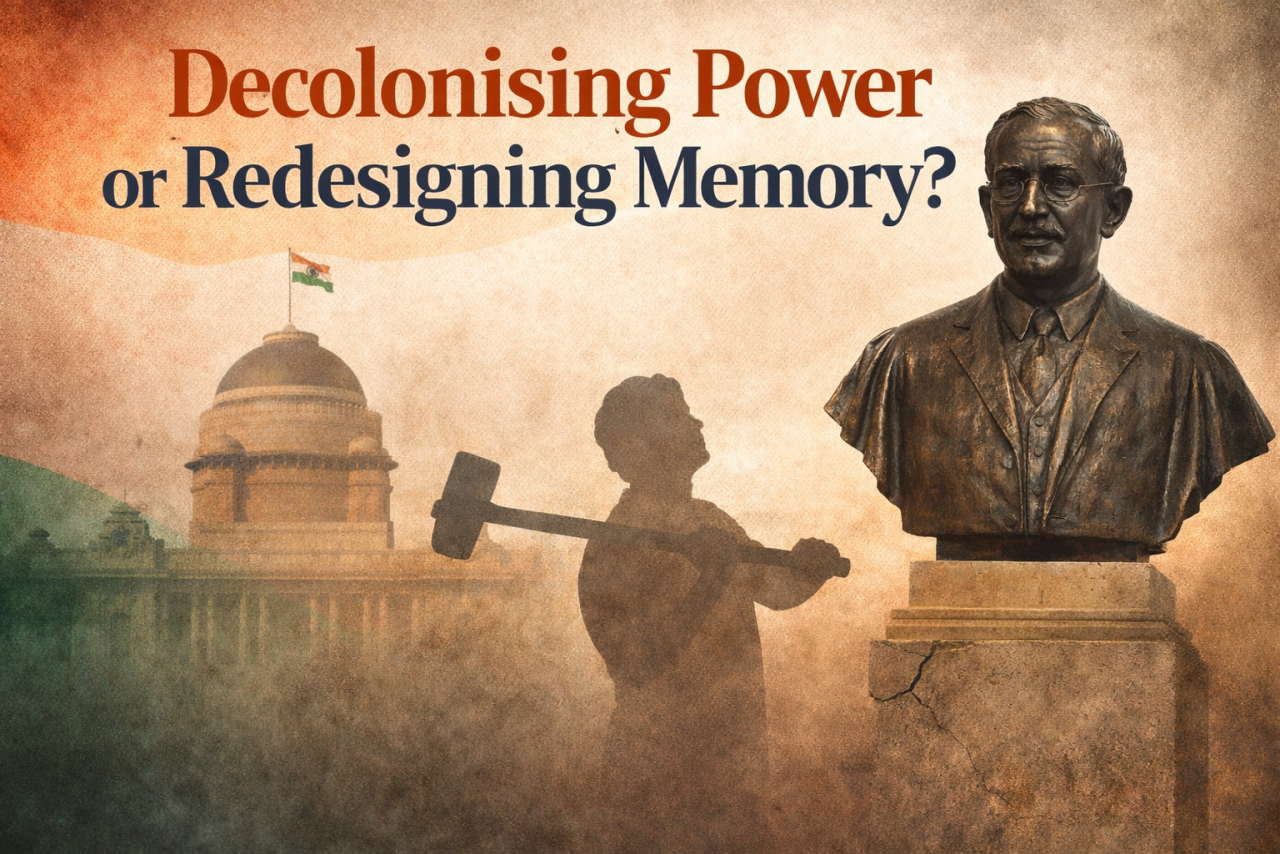
A bust has been moved, but a nation’s memory has been stirred. When the architect of imperial Delhi was shifted from the heart of power to a museum corridor, the question was no longer about stone or bronze—it was about who defines India’s past, and who shapes its sovereign future.
When the bust of Edwin Lutyens was shifted from the complex of Rashtrapati Bhavan to a museum space, the act appeared administrative. A relocation. A curatorial decision. But in a country where symbols carry the weight of centuries, such gestures are rarely small. They are political texts written in stone and bronze.
At stake is not a statue. It is the meaning of sovereignty and the practice of democracy in a post-colonial republic still negotiating its relationship with its past.
The Architecture of Empire
Lutyens was not just an architect. He was the chief designer of imperial New Delhi, commissioned to build a capital that embodied British authority over India. The sweeping boulevards, domed structures, and axial planning were expressions of imperial permanence. They were meant to signal control.
Independent India inherited that architecture. Instead of demolishing it, the republic repurposed it. The Viceroy’s House became Rashtrapati Bhavan. Imperial power was transformed into constitutional authority. The same building began to house the President of a democratic republic.
That transformation itself was a profound act of sovereignty.
But sovereignty evolves. The relocation of Lutyens’ bust can be read as another stage in this journey—an attempt to move from inherited symbolism to self-defined narrative. The message appears clear: the republic need not permanently honour the architect of its subjugation in the heart of its highest constitutional office.
Sovereignty as Narrative Control
Political independence was achieved in 1947. Cultural and psychological independence is a slower process.
Sovereignty today is not merely about borders or armed forces. It is also about who shapes public memory. When a nation decides which figures occupy central civic spaces, it is defining its moral hierarchy. Who stands in the corridors of power? Who is relegated to history?
Moving the bust to a museum does not erase Lutyens. It reframes him. In a museum, he becomes an object of study rather than reverence. That distinction matters. Museums contextualize; state spaces symbolically endorse.
Seen this way, the act is not vandalism or erasure. It is curatorial sovereignty.
Yet sovereignty carries another dimension: confidence. A self-assured nation can acknowledge its layered past without anxiety. It can display colonial figures without feeling diminished. The question, therefore, is not whether symbols change. They inevitably do. The question is whether the change emerges from intellectual clarity or political impulse.
Democracy and the Question of Process
If sovereignty is about reclaiming narrative, democracy is about how that reclamation happens.
In a democracy, public spaces belong to citizens. Decisions about national symbols ideally reflect debate, consultation, and transparency. Even when the majority supports symbolic change, democratic culture demands dialogue. History is not a monologue.
Was there widespread public engagement with this decision? Did it invite diverse historical perspectives? Or was it perceived as a top-down administrative shift? These procedural questions matter because democracy is measured not just by electoral legitimacy but by participatory depth.
Democracy also requires comfort with complexity. Figures from the colonial era can simultaneously represent oppression and architectural brilliance. A plural society must be able to hold contradictory truths. Reducing history to moral binaries may energize politics, but it narrows civic imagination.
Global Echoes
India is not alone in confronting its monuments. Across the world, societies are reassessing statues of slave traders, imperial leaders, and controversial historical figures. From city squares in Europe to campuses in America, public memory is being renegotiated.
What distinguishes mature democracies in this process is not whether they remove statues—but how they do so. Public hearings, academic input, and transparent reasoning often accompany such decisions. The goal is not symbolic triumph but historical reckoning.
India’s debate fits within this global moment. It reflects a broader tension between inherited structures and contemporary identity.
Beyond the Bust
Ultimately, the controversy is not about Lutyens. It is about the republic’s evolving self-image.
Is India confident enough to reinterpret its past without anxiety? Can it assert civilizational pride while maintaining democratic openness? Can decolonization proceed without turning into ideological purification?
A republic becomes stronger when sovereignty and democracy reinforce each other. Sovereignty provides the authority to redefine symbols. Democracy ensures that redefinition reflects collective wisdom rather than concentrated power.
Moving a bust is easy. Building a culture that can debate such moves calmly and rigorously is harder.
The stone may have shifted locations. The larger question remains fixed: in redesigning memory, are we expanding the democratic imagination—or narrowing it?
The answer will shape not just monuments, but the moral architecture of the republic itself.















Leave a Comment