
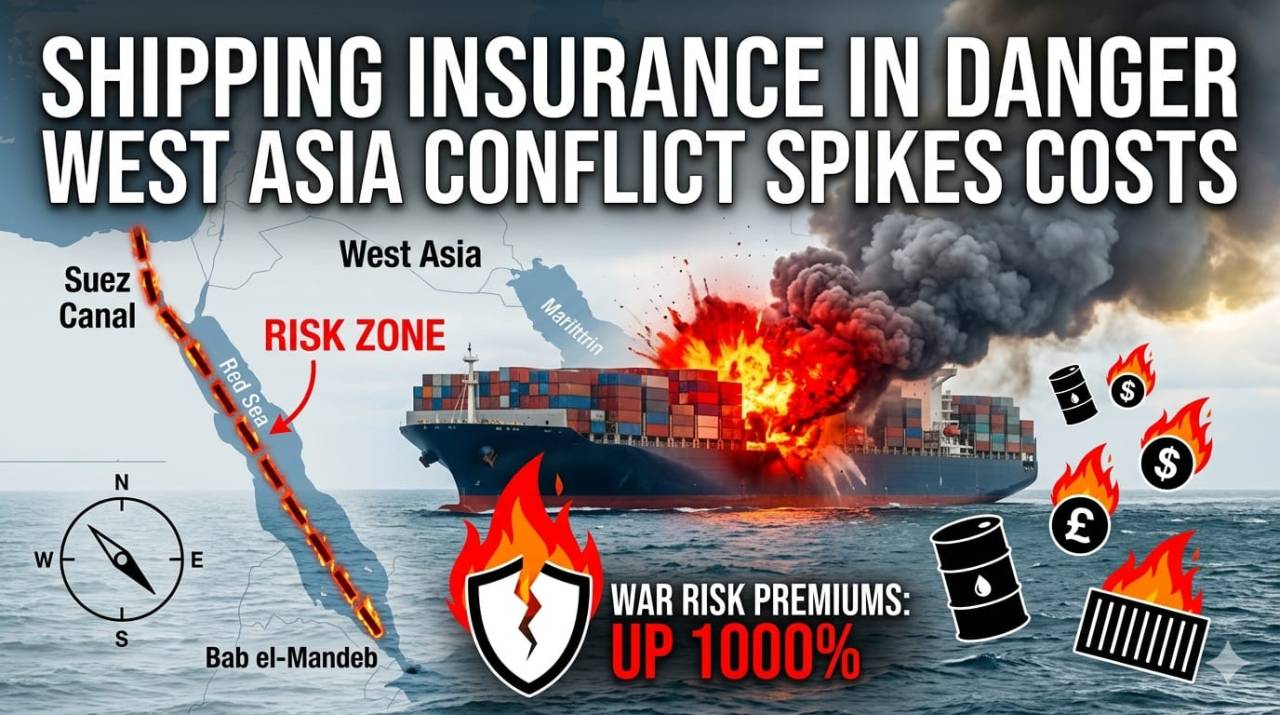
A missile in the Red Sea is no longer just a regional threat. It is quietly raising the cost of everything you buy, as a hidden crisis in shipping insurance begins to ripple through global trade and fuel inflation worldwide.
The vast oceans that connect continents are more than just waterways. They are the backbone of global trade, carrying over 80% of the world’s goods. From oil and grain to electronics and clothing, nearly everything depends on the smooth movement of ships across these routes.
But today, this system is under stress. Rising tensions in West Asia have created a ripple effect across global shipping. While headlines often focus on conflict and security, a quieter but more damaging crisis is unfolding behind the scenes. It is the crisis of shipping insurance, an essential but often overlooked pillar of global trade.
The Basics: What is Shipping Insurance?
Shipping insurance acts as a financial safety net. It protects shipowners and cargo companies against losses from accidents, piracy, or attacks. Under normal conditions, this cost is predictable and manageable.
However, when a region becomes unstable, insurers classify it as a high-risk or war zone. This leads to an additional charge known as a “war risk premium.”
Until recently, ships passing through the Red Sea paid a very small premium, usually between 0.02% and 0.05% of the vessel’s value. That has now changed dramatically.
A Sudden Spike in Risk
As of early 2026, repeated drone and missile threats in key maritime corridors have forced insurers to raise premiums sharply. Rates have jumped to between 0.7% and 1.2%.
This increase may sound small in percentage terms, but the real cost is massive.
For example, a Suezmax tanker valued at $100 million now faces an additional insurance cost of around $1 million for a single seven-day journey through the Red Sea. Just two years ago, this cost was a fraction of that amount.
This is not just an increase. It is a fundamental shift in how risk is priced in global shipping.
The Red Sea Becomes a Chokepoint
The Red Sea, especially the Bab el-Mandeb Strait, is one of the most critical trade routes in the world. It handles about 12% of global trade and nearly 30% of container traffic.
Now, it has become a zone of uncertainty.
Shipping activity through the Suez Canal has dropped sharply. Weekly vessel traffic is down by as much as 60% to 70% compared to 2023 levels.
At the same time, some major insurance providers have started limiting or withdrawing war risk coverage for ships linked to certain countries. This has left shipowners with difficult choices. They can either sail without full insurance, which is extremely risky, or avoid the region altogether.
The Costly Detour Around Africa
To escape the dangers of the Red Sea, many global shipping companies are choosing an alternative route around the Cape of Good Hope at the southern tip of Africa.
This decision comes with its own heavy costs.
The detour adds roughly 3,500 nautical miles to a typical Asia to Europe journey. It also extends travel time by 10 to 14 days.
Fuel consumption rises sharply as a result. Large container ships burn about 150 tons of fuel each day. A longer journey can add around 1,500 tons of fuel usage, costing close to $900,000 per trip at current prices.
These delays also disrupt supply chains that rely on precise timing, especially in industries that depend on just-in-time manufacturing.
Why This Crisis Reaches Your Wallet
At first glance, shipping insurance may seem like a distant concern. In reality, it directly affects everyday life.
Higher insurance and fuel costs increase the overall expense of transporting goods. These costs are eventually passed on to businesses and consumers.
Energy markets are already feeling the pressure. Around 8 million barrels of oil pass through these waters daily. Disruptions have added volatility to global oil prices, contributing to fluctuations in benchmark rates.
The impact goes beyond energy. Economists warn that continued disruption in these shipping routes could raise global inflation by 0.5 to 0.7 percentage points by the end of 2026.
This means higher prices for essential goods, from food to fuel, across markets worldwide.
A Growing Threat to Global Stability
The situation is not just about rising costs. It is about the reliability of the global supply chain.
If insurance becomes too expensive or unavailable, ships may avoid key routes entirely. This could disrupt the flow of critical goods such as grain, oil, and liquefied natural gas.
In response, some countries are exploring new solutions. Governments in nations like India and South Korea are considering sovereign-backed insurance schemes. These are designed to support shipping when private insurers step back.
This shift signals a deeper concern. It shows that the private market alone may no longer be able to handle the scale of risk in certain regions.
Final Take
Shipping insurance is often invisible, but it plays a crucial role in keeping global trade moving. Today, that system is under pressure.
The crisis in West Asia has revealed how quickly risk can spread through the global economy. A disruption at sea does not stay at sea. It travels through supply chains and reaches consumers in the form of higher prices and economic uncertainty.
Until stability returns to key maritime routes, the world will continue to bear the cost. The lesson is clear. In a deeply connected global economy, even distant conflicts can have immediate and widespread consequences.























Leave a Comment