
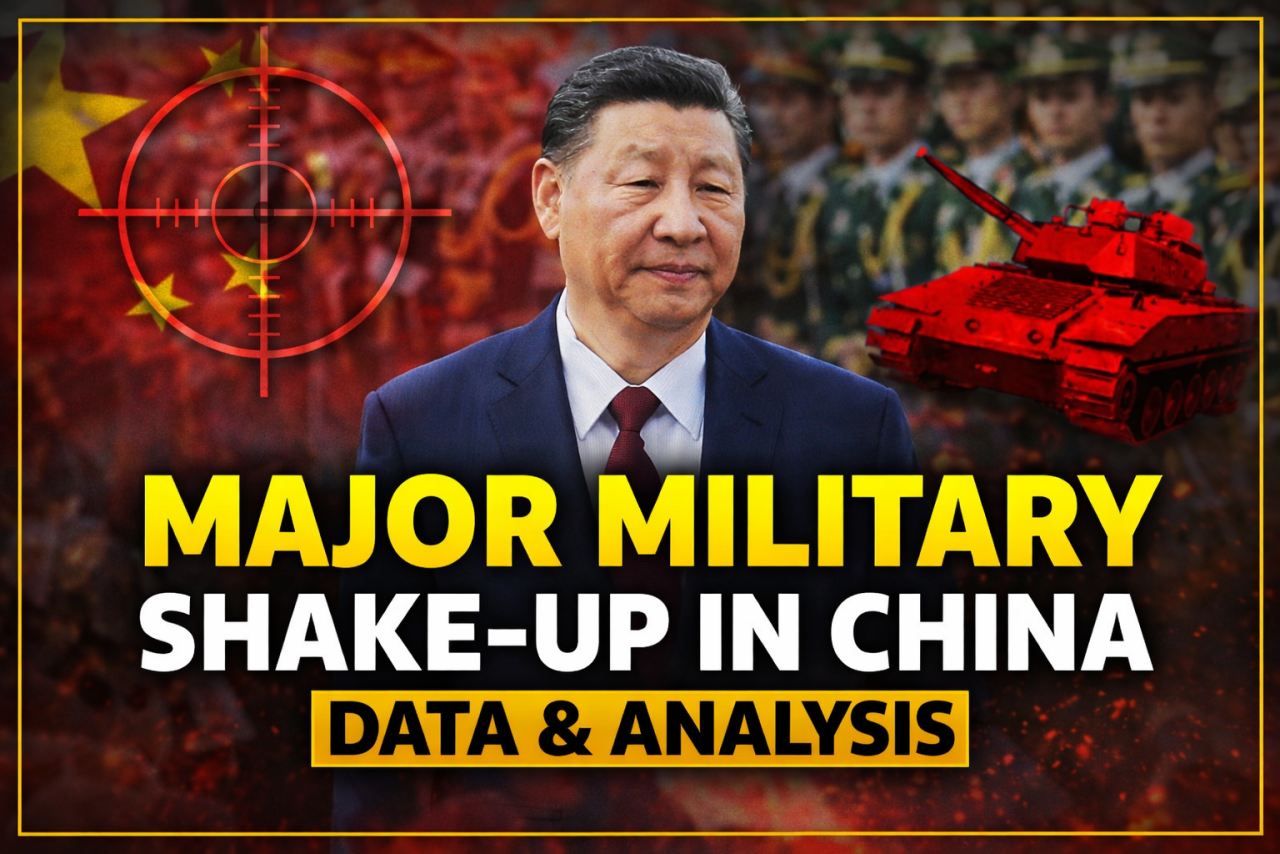
More than a hundred generals have vanished from China’s military ranks in just a few years — and this is not just a corruption crackdown, but a power shift that could redefine the future of Asia’s security landscape.
When a country begins removing its top generals at an accelerating pace, the story is rarely just about corruption. It is about power, control, and the structure of authority itself. Over the past four years, China’s People’s Liberation Army (PLA) has experienced an extraordinary wave of removals, investigations, suspensions, and unexplained disappearances among its senior leadership. The scale of this churn suggests something deeper than routine discipline—it points to a fundamental reordering of the military’s command structure under President Xi Jinping.
At the center of this restructuring is the Central Military Commission (CMC), the supreme authority overseeing China’s armed forces. Unlike in many countries where the military operates as a national institution, China’s armed forces are explicitly controlled by the Communist Party. The long-standing doctrine that “the Party commands the gun” is not symbolic—it defines the political architecture of power. In this framework, loyalty is not simply a virtue; it is a strategic necessity.
The Numbers Tell a Larger Story
Data compiled by the Washington-based Centre for Strategic and International Studies (CSIS) indicates that since early 2022, dozens of generals and lieutenant generals have been officially purged. The confirmed number alone exceeds three dozen. However, when suspected cases, those who have vanished from public duties or key meetings without explanation, are added, the total climbs past one hundred.
The year 2025 marked a sharp spike. It recorded the highest number of cases in the current cycle, making it the most disruptive period in recent military leadership history. Nearly two-thirds of that year’s cases involved senior officers who disappeared from public view before any formal announcement. In China’s opaque political system, absence often signals investigation.
This data pattern is significant. If the purge were purely anti-corruption, one might expect a steady, methodical pace. Instead, the acceleration in 2025 suggests either widening suspicion within the ranks or a deliberate effort to fast-track consolidation.
The Top Has Been Hit the Hardest
The restructuring has not been limited to mid-level commanders. It has cut into the highest levels of authority. Members of the CMC and leaders of critical operational departments have been removed, reassigned, or sidelined. Such moves hollow out institutional continuity.
When top positions are vacated, replacements are often appointed in an acting or interim capacity. This creates a command environment where decision-makers may lack long-term authority. While the outward structure remains intact, the internal balance shifts. Command becomes more centralized around the chairman of the CMC—Xi himself.
The removal of high-profile figures, including senior CMC officials, underscores that rank provides no shield. In fact, proximity to power appears to invite greater scrutiny.
Operational Readiness: Stable Surface, Subtle Strain
Publicly, the PLA continues to conduct drills, naval patrols, and air exercises. Commands facing India have maintained a steady rhythm of activity. Military modernization programs proceed, and defense spending remains robust.
Yet subtle indicators hint at disruption. Observers noted an unusual delay in certain large-scale military responses in 2025 compared to faster mobilizations in 2024. Joint exercises with Russia reportedly declined after leadership turnover in planning departments. Such shifts may reflect the practical consequences of replacing experienced planners and commanders.
Military effectiveness relies not only on equipment but also on trust and institutional memory. When senior officers are removed rapidly, networks of coordination can weaken. Officers may hesitate to take initiative if political missteps carry career-ending consequences.
Political Consolidation or Institutional Vulnerability?
From one perspective, the purge strengthens Xi’s grip on the armed forces. By systematically removing figures linked to previous networks or suspected of divided loyalties, he reshapes the leadership landscape. Promotions increasingly favor those whose careers are closely aligned with his tenure.
This approach reinforces centralized authority. A leadership corps selected for loyalty may act with greater ideological cohesion. In times of crisis, unity at the top can prevent fragmentation.
However, there is a countervailing risk. Excessive emphasis on political reliability may sideline experienced strategists. Fear-driven compliance can suppress honest feedback. In high-stakes environments, such as tensions around Taiwan or the South China Sea, miscalculations often stem not from disloyalty, but from inadequate internal debate.
Why 2025 Became the Peak
The surge in removals during 2025 likely reflects multiple converging pressures. First, ongoing anti-corruption probes may have expanded into deeper institutional layers. Second, intensifying geopolitical rivalry with the United States may have heightened sensitivity to security breaches. Third, internal political timelines—linked to long-term leadership consolidation—may have accelerated the process.
The fact that so many cases involved officers going “missing” rather than being immediately charged suggests investigations are increasingly preventive rather than reactive. The message to the ranks is unmistakable: scrutiny is constant.
The Broader Strategic Context
China’s military modernization has been one of the most ambitious in the world. Advanced missile systems, naval expansion, and aerospace capabilities reflect a long-term strategy to project power regionally and globally. Leadership instability, however, introduces friction into that transformation.
The paradox is striking. The campaign seeks to build a more disciplined and loyal force, yet the churn risks weakening operational continuity. Stability and control are not always synonymous. A tightly controlled hierarchy can appear formidable while internally cautious.
A Defining Pattern of the Era
The ongoing military shake-up reveals more than disciplinary reform—it reveals the governing philosophy of Xi’s era. Control flows downward from the center. Authority is personal as much as institutional. And uncertainty within elite ranks functions as a mechanism of compliance.
Whether this produces a stronger PLA will depend on how effectively new appointees adapt and whether institutional confidence can be restored. If loyalty and competence align, the restructuring could ultimately reinforce China’s strategic ambitions. If fear outpaces trust, however, the costs may surface during moments that demand swift and coordinated action.
For now, the numbers speak clearly. In just a few years, more than a hundred senior officers have been removed, suspended, or disappeared from public roles. This is not a routine reshuffle but a deep structural shift within the military system. Its impact will extend beyond internal command changes, influencing China’s strategic direction and potentially altering the balance of power across Asia in the years to come.














Leave a Comment