
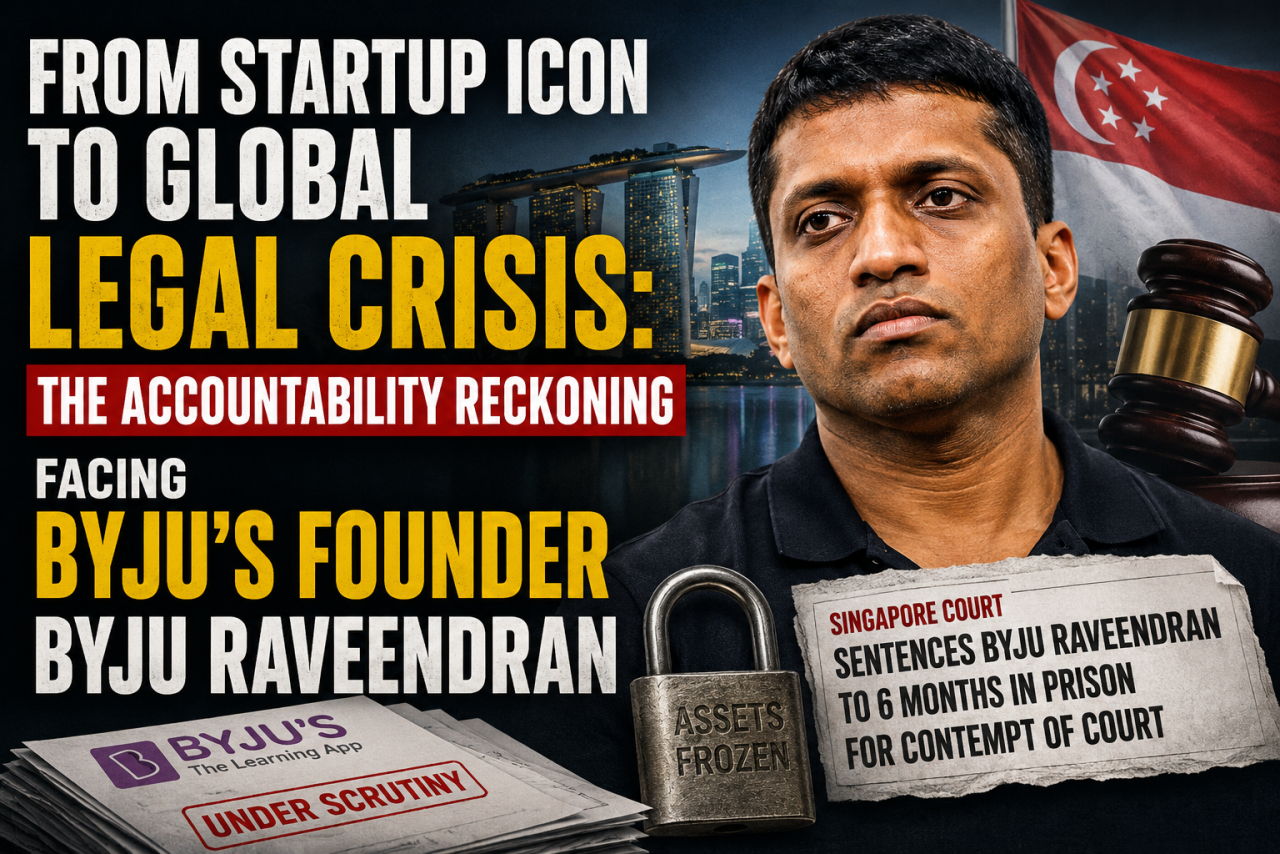
India’s most celebrated edtech unicorn didn’t just collapse financially — it exposed the dangers of growth without accountability.
The dramatic escalation of legal action against BYJU’S founder Byju Raveendran has reached a defining moment. A Singapore court has sentenced the entrepreneur to six months in prison for contempt of court, transforming what was once viewed as a corporate crisis into a far more serious question of personal accountability and legal responsibility.
For India’s startup ecosystem and global investors alike, the development marks a turning point. The rise of BYJU’S was once celebrated as proof that Indian technology firms could dominate global education markets. Today, its collapse is becoming a cautionary tale about unchecked expansion, weak corporate governance, and the limits of founder-driven power.
The case also reflects a broader global shift. Courts and regulators across jurisdictions are increasingly willing to hold startup founders personally accountable when companies fail to meet financial, legal, and governance obligations.
The Singapore Court Order and the Transparency Dispute
The prison sentence stems from an ongoing legal battle over financial disclosures and alleged non-compliance with court directives. The proceedings were initiated by a subsidiary of the Qatar Investment Authority (QIA), one of the major investors that backed BYJU’S during its aggressive expansion phase.
According to court findings, Byju Raveendran repeatedly failed to comply with orders requiring him to disclose details related to his personal assets and ownership structures connected to company-linked entities.
Among the court’s directives were:
- A requirement for Raveendran to surrender before Singapore authorities.
- Payment of legal costs amounting to Singapore Dollar 90,000.
- Full disclosure of ownership details connected to Beeaar Investco Pte, a Singapore-based holding entity associated with the BYJU’S corporate structure.
Legal observers note that contempt rulings resulting in imprisonment are relatively rare in international corporate disputes unless courts believe there has been sustained non-compliance or deliberate disregard for judicial orders.
Two Competing Narratives
The case has quickly evolved into a public battle of narratives between the founder and institutional creditors.
Byju Raveendran’s Defense
Raveendran and his legal team have argued that the ruling relates primarily to procedural delays rather than fraud or financial wrongdoing. They insist the matter concerns timelines linked to disclosure obligations and not the substance of the broader financial disputes surrounding the company.
The founder has also claimed that settlement discussions with lenders and investors were progressing toward resolution. According to his public position, the push for imprisonment represents an unnecessary escalation during sensitive restructuring negotiations.
His defense further argues that no court has formally declared him guilty of fraud or criminal misappropriation.
Creditors and Investors Push Back
Creditors and legal representatives associated with lenders strongly dispute that characterization. They maintain that the contempt ruling reflects repeated failures to cooperate with court-mandated transparency requirements.
For investors, the issue is not merely procedural. It is about whether startup founders can ignore international legal obligations while continuing to operate through complex corporate structures spread across multiple countries.
The dispute has therefore become symbolic of a larger governance problem within high-growth technology firms.
The Global Legal Pressure on BYJU’S
The Singapore proceedings are only one part of a wider international legal crisis surrounding BYJU’S.
In the United States, the company remains locked in litigation linked to a massive 1.2 billion dollar term loan dispute. American lenders have sought explanations regarding the movement of funds through overseas subsidiaries, while US courts have already raised concerns about missing financial documentation.
Meanwhile, in India, BYJU’S continues to face insolvency proceedings, operational challenges, and regulatory scrutiny over alleged violations linked to financial reporting and foreign exchange compliance.
What once appeared to be a temporary cash-flow crisis has now evolved into a multi-country legal confrontation involving courts, investors, lenders, insolvency professionals, and regulators.
The Bigger Lesson for India’s Startup Ecosystem
The collapse of BYJU’S carries lessons that extend far beyond one company or one founder.
The End of “Growth at Any Cost”
During the pandemic-era technology boom, investors rewarded startups that expanded rapidly, acquired users aggressively, and pursued market dominance at extraordinary speed.
BYJU’S became one of the biggest symbols of that model. The company spent heavily on advertising, celebrity endorsements, international acquisitions, and rapid global expansion.
But the strategy depended on constant funding and sustained growth in online learning demand. Once economic conditions tightened and offline education returned, the business model came under immense pressure.
The crisis demonstrates that valuation alone cannot guarantee sustainability. Strong revenue models, financial discipline, and operational transparency remain essential for long-term survival.
Why Corporate Governance Matters
Many startups operate with founder-centric decision-making structures during their early stages. While this can accelerate innovation, problems emerge when companies scale globally without equally strong governance systems.
Independent audits, transparent accounting practices, active board oversight, and compliance with international legal standards are no longer optional for companies managing billions in investor capital.
The BYJU’S crisis highlights what can happen when governance mechanisms fail to evolve alongside growth.
The Consumer Trust Question
Beyond investors and courts, the controversy has also reopened public debate around the company’s aggressive sales practices.
Over the years, BYJU’S faced criticism for targeting middle-class families with expensive educational packages often tied to long-term financing arrangements. Consumer complaints regarding refund delays and high-pressure sales tactics added to the company’s reputational troubles even before its financial collapse intensified.
The episode serves as a reminder that companies operating in sensitive sectors like education must balance commercial ambition with ethical responsibility.
A Defining Moment for Startup Accountability
Byju Raveendran is expected to challenge the Singapore ruling and pursue legal remedies. However, regardless of the outcome of appeals, the damage to the company’s image and investor confidence appears profound.
The rise of BYJU’S once represented the optimism of India’s startup revolution. Its current crisis now represents the risks of unchecked expansion and weak accountability structures.
For founders across the global technology industry, the message emerging from this case is becoming increasingly clear: billion-dollar valuations may create influence and visibility, but they do not place entrepreneurs above financial scrutiny, legal obligations, or the rule of law.
The dramatic escalation of legal action against BYJU’S founder Byju Raveendran has reached a defining moment. A Singapore court has sentenced the entrepreneur to six months in prison for contempt of court, transforming what was once viewed as a corporate crisis into a far more serious question of personal accountability and legal responsibility.
For India’s startup ecosystem and global investors alike, the development marks a turning point. The rise of BYJU’S was once celebrated as proof that Indian technology firms could dominate global education markets. Today, its collapse is becoming a cautionary tale about unchecked expansion, weak corporate governance, and the limits of founder-driven power.
The case also reflects a broader global shift. Courts and regulators across jurisdictions are increasingly willing to hold startup founders personally accountable when companies fail to meet financial, legal, and governance obligations.
The Singapore Court Order and the Transparency Dispute
The prison sentence stems from an ongoing legal battle over financial disclosures and alleged non-compliance with court directives. The proceedings were initiated by a subsidiary of the Qatar Investment Authority (QIA), one of the major investors that backed BYJU’S during its aggressive expansion phase.
According to court findings, Byju Raveendran repeatedly failed to comply with orders requiring him to disclose details related to his personal assets and ownership structures connected to company-linked entities.
Among the court’s directives were:
- A requirement for Raveendran to surrender before Singapore authorities.
- Payment of legal costs amounting to Singapore Dollar 90,000.
- Full disclosure of ownership details connected to Beeaar Investco Pte, a Singapore-based holding entity associated with the BYJU’S corporate structure.
Legal observers note that contempt rulings resulting in imprisonment are relatively rare in international corporate disputes unless courts believe there has been sustained non-compliance or deliberate disregard for judicial orders.
Two Competing Narratives
The case has quickly evolved into a public battle of narratives between the founder and institutional creditors.
Byju Raveendran’s Defense
Raveendran and his legal team have argued that the ruling relates primarily to procedural delays rather than fraud or financial wrongdoing. They insist the matter concerns timelines linked to disclosure obligations and not the substance of the broader financial disputes surrounding the company.
The founder has also claimed that settlement discussions with lenders and investors were progressing toward resolution. According to his public position, the push for imprisonment represents an unnecessary escalation during sensitive restructuring negotiations.
His defense further argues that no court has formally declared him guilty of fraud or criminal misappropriation.
Creditors and Investors Push Back
Creditors and legal representatives associated with lenders strongly dispute that characterization. They maintain that the contempt ruling reflects repeated failures to cooperate with court-mandated transparency requirements.
For investors, the issue is not merely procedural. It is about whether startup founders can ignore international legal obligations while continuing to operate through complex corporate structures spread across multiple countries.
The dispute has therefore become symbolic of a larger governance problem within high-growth technology firms.
The Global Legal Pressure on BYJU’S
The Singapore proceedings are only one part of a wider international legal crisis surrounding BYJU’S.
In the United States, the company remains locked in litigation linked to a massive 1.2 billion dollar term loan dispute. American lenders have sought explanations regarding the movement of funds through overseas subsidiaries, while US courts have already raised concerns about missing financial documentation.
Meanwhile, in India, BYJU’S continues to face insolvency proceedings, operational challenges, and regulatory scrutiny over alleged violations linked to financial reporting and foreign exchange compliance.
What once appeared to be a temporary cash-flow crisis has now evolved into a multi-country legal confrontation involving courts, investors, lenders, insolvency professionals, and regulators.
The Bigger Lesson for India’s Startup Ecosystem
The collapse of BYJU’S carries lessons that extend far beyond one company or one founder.
The End of “Growth at Any Cost”
During the pandemic-era technology boom, investors rewarded startups that expanded rapidly, acquired users aggressively, and pursued market dominance at extraordinary speed.
BYJU’S became one of the biggest symbols of that model. The company spent heavily on advertising, celebrity endorsements, international acquisitions, and rapid global expansion.
But the strategy depended on constant funding and sustained growth in online learning demand. Once economic conditions tightened and offline education returned, the business model came under immense pressure.
The crisis demonstrates that valuation alone cannot guarantee sustainability. Strong revenue models, financial discipline, and operational transparency remain essential for long-term survival.
Why Corporate Governance Matters
Many startups operate with founder-centric decision-making structures during their early stages. While this can accelerate innovation, problems emerge when companies scale globally without equally strong governance systems.
Independent audits, transparent accounting practices, active board oversight, and compliance with international legal standards are no longer optional for companies managing billions in investor capital.
The BYJU’S crisis highlights what can happen when governance mechanisms fail to evolve alongside growth.
The Consumer Trust Question
Beyond investors and courts, the controversy has also reopened public debate around the company’s aggressive sales practices.
Over the years, BYJU’S faced criticism for targeting middle-class families with expensive educational packages often tied to long-term financing arrangements. Consumer complaints regarding refund delays and high-pressure sales tactics added to the company’s reputational troubles even before its financial collapse intensified.
The episode serves as a reminder that companies operating in sensitive sectors like education must balance commercial ambition with ethical responsibility.
A Defining Moment for Startup Accountability
Byju Raveendran is expected to challenge the Singapore ruling and pursue legal remedies. However, regardless of the outcome of appeals, the damage to the company’s image and investor confidence appears profound.
The rise of BYJU’S once represented the optimism of India’s startup revolution. Its current crisis now represents the risks of unchecked expansion and weak accountability structures.
For founders across the global technology industry, the message emerging from this case is becoming increasingly clear: billion-dollar valuations may create influence and visibility, but they do not place entrepreneurs above financial scrutiny, legal obligations, or the rule of law.

























Leave a Comment