
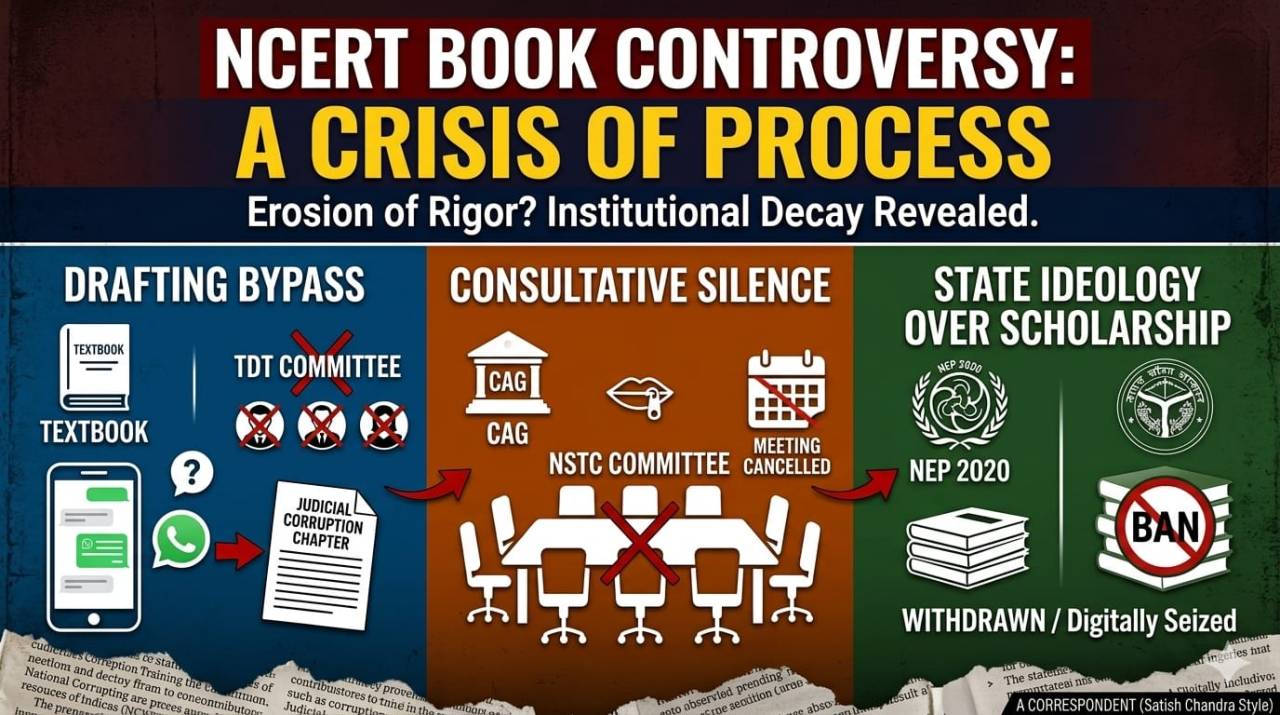
When a national textbook triggers judicial intervention, the issue is no longer a mere editorial lapse—it signals a deeper crisis in how knowledge, institutions, and academic rigor are being shaped in India’s education system.
The recent controversy surrounding the National Council of Educational Research and Training (NCERT) and its now-withdrawn Class 8 social science textbook is not merely an isolated instance of editorial oversight. To a student of history, it serves as a stark reflection of the deepening crisis within our academic institutions—a crisis characterized by the fragmentation of authority, the bypassing of established consultative norms, and a growing disconnect between the state’s ideological aspirations and the rigor of scholarly discipline.
In the historical development of Indian education, the NCERT was envisioned as a bastion of secular, balanced, and scientifically tempered knowledge. However, the events of February 2026, culminating in the Supreme Court’s “blanket ban” on the textbook Exploring Society: India and Beyond, suggest a departure from these foundational ideals. At the heart of the dispute lies Chapter 4, “The Role of the Judiciary in Our Society,” which allegedly presented a skewed narrative of judicial corruption. While the court’s intervention was swift—prompted by what it termed a “calculated move” to undermine the dignity of the judiciary—the historian must look beyond the “offending” text to the systemic breakdown that allowed its publication.
The Breakdown of Consultative Machinery
The three-stage process mandated for the National Curriculum Framework for School Education (NCF-SE) 2023 was designed to ensure multiple layers of scrutiny. In theory, the Textbook Development Team (TDT) drafts the content, the Curricular Area Groups (CAGs) oversee subject-specific nuances, and the National Syllabus and Teaching-Learning Material Committee (NSTC) provides the final academic seal of approval.
Yet, as reports emerge, this hierarchy functioned more as a series of administrative silos than a cohesive intellectual filter. It appears that the draft, chaired by Professor Michel Danino, bypassed the collective deliberation of the 19-member NSTC. Instead of a formal meeting where experts like Manjul Bhargava or Sudha Murty could weigh in, the material was reportedly circulated via digital folders and messaging apps—a casualness that ill befits the gravity of preparing a national curriculum.
Historically, the strength of Indian institutions lay in their ability to synthesize diverse viewpoints through rigorous debate. When “silence” from committee members is interpreted as “clearance,” the democratic spirit of academic inquiry is replaced by a bureaucratic expediency that invites disaster.
The Dilemma of Institutional Autonomy
The Supreme Court’s directive to “disassociate” the authors—including Prof. Danino, Suparna Diwakar, and Alok Prasanna Kumar—from all public-funded curriculum work marks a significant moment in the relationship between the judiciary and the academe. While the court acts as the guardian of constitutional morality, such a sweeping exclusion of academics raises questions about the future of intellectual freedom.
In the medieval period, the stability of the state often depended on the nobility’s adherence to established codes of conduct; in a modern democracy, that stability rests on the independence and integrity of its academic and judicial institutions. When the NCERT tenders an “unconditional and unqualified apology,” it signals not just a mistake, but a total collapse of institutional confidence. The failure to include even a single eminent jurist in a committee drafting a chapter on the judiciary is a lapse that borders on the inexplicable.
Education as a Tool of Statecraft
One cannot view this controversy in isolation from the broader shift towards the National Education Policy (NEP) 2020. Every ruling dispensation seeks to reflect its values within the curriculum; however, when the pursuit of a “rooted” Indian context is not balanced with objective, evidence-based scholarship, the result is often a narrative that satisfies neither the state nor the standards of historical truth.
The withdrawal of over 82,000 copies and the subsequent “digital seizure” of the text is a logistical nightmare, but the intellectual cost is higher. We risk raising a generation on “sanitized” history or, worse, on “polarized” interpretations that lack the nuance required to understand the complexities of a democratic state.
Final Take
The NCERT must return to its roots of collaborative scholarship. The proposed expert committee, which is to include a former judge and an eminent academician, is a necessary corrective, but it must not be a mere reactive measure.
For the historian, the lesson is clear that the institutions are only as strong as the processes they uphold. If the NCERT is to regain its lost prestige, it must move away from the current culture of opacity and administrative shortcuts. Only through a transparent, multi-disciplinary, and truly consultative approach can we hope to provide our children with a curriculum that is both critical and constructive.

















Leave a Comment