
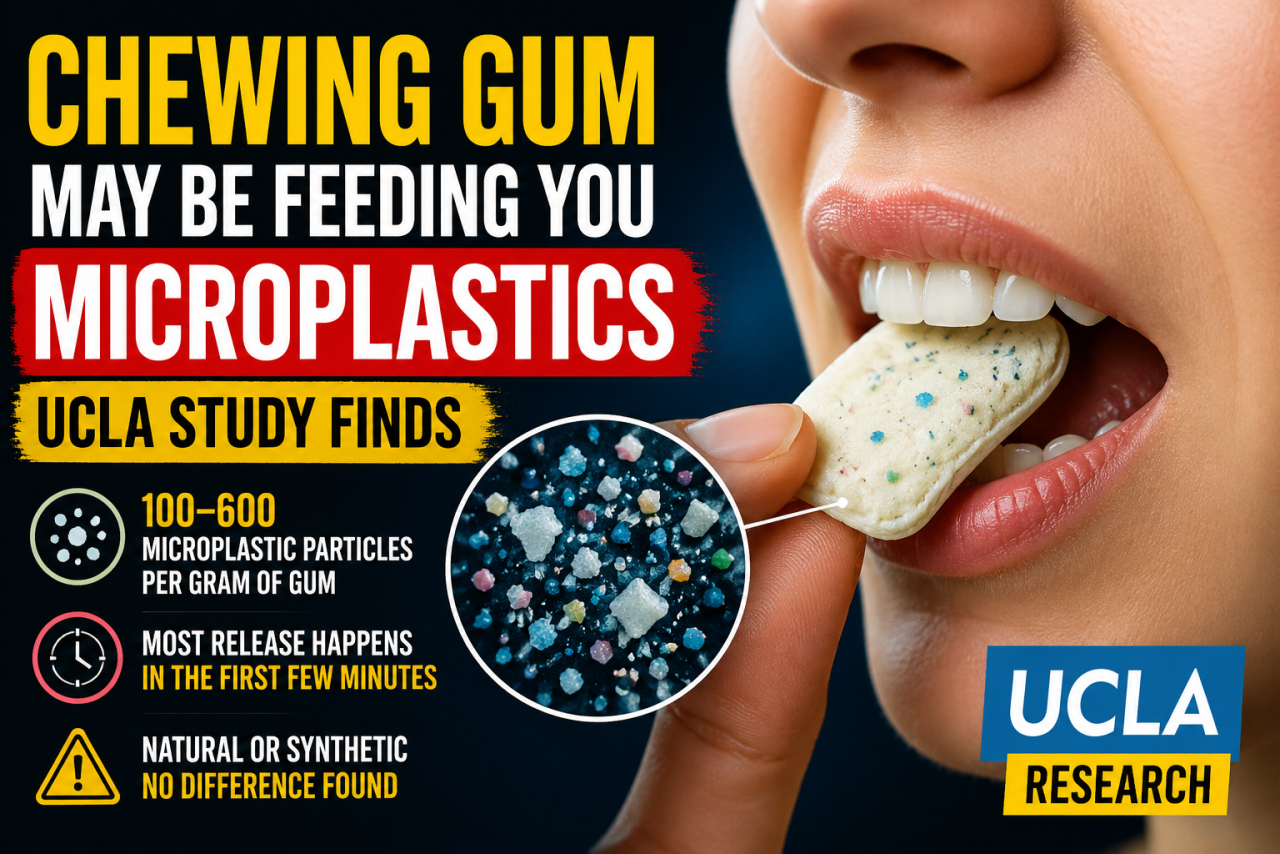
You probably never imagined your chewing gum could be adding thousands of plastic particles to your body. A new UCLA study reveals why even natural gum may not be plastic-free.
The next time you unwrap a stick of gum, you may want to think twice. New research from the University of California, Los Angeles (UCLA) suggests that chewing gum releases hundreds to thousands of microscopic plastic particles directly into human saliva. Surprisingly, the study found little difference between gums marketed as "natural" and those made with synthetic ingredients.
The research was led by Sanjay Mohanty, Associate Professor of Civil and Environmental Engineering at UCLA's Samueli School of Engineering, along with graduate researcher Lisa Lowe. Their findings were presented at the American Chemical Society's Spring 2025 meeting in San Diego.
The team tested 10 commercially available chewing gum brands. Five were synthetic gums made from petroleum-based polymers, while the other five used plant-derived gum bases such as chicle and tree sap.
Natural Does Not Mean Plastic-Free
One of the study's most striking findings challenges a widespread consumer belief. Many people choose natural chewing gum assuming it is free from plastics. However, the researchers found that both natural and synthetic gums released similar amounts of microplastic particles during chewing.
On average, every gram of gum released about 100 microplastic particles, while some samples shed as many as 600 particles per gram. Since a typical stick of gum weighs between two and six grams, chewing a larger piece could release more than 3,000 microplastic particles in a single session.
Over the course of a year, someone who chews around 160 to 180 pieces of gum could potentially ingest nearly 30,000 microplastic particles from chewing gum alone.
Most Plastic Is Released Within Minutes
The researchers observed that the majority of microplastic particles were released during the first few minutes of chewing. Once swallowed, these particles are not broken down by digestive enzymes and instead pass through the digestive system as persistent material.
This means that even a brief chewing session can contribute to a person's overall exposure to microplastics.
An Early Study With Important Limits
The researchers emphasise that this was a pilot study rather than a definitive conclusion. It was designed as an early investigation and has certain limitations.
The analytical equipment used in the study could only detect particles measuring 20 micrometres or larger. Much smaller nanoplastics were beyond the scope of the instruments, meaning the actual number of plastic particles released may be significantly higher than reported.
The research team has acknowledged this limitation and says future studies are needed to measure these smaller particles.
What About Health Risks?
The study does not claim that chewing gum is harmful or that microplastics from gum directly cause disease.
Mohanty has stressed that the purpose of the research is not to create unnecessary fear. Scientists still lack definitive evidence on how microplastics affect human health because controlled human studies remain limited.
However, laboratory experiments involving animals and human cells have raised concerns that microplastics may trigger inflammation, cellular damage and other biological effects. While the evidence is not yet conclusive, researchers say it is sufficient to justify further investigation and a cautious approach.
One More Source of Everyday Plastic Exposure
Scientists already estimate that people consume tens of thousands of microplastic particles each year through food, drinking water, beverages, packaging and other everyday products.
Chewing gum now appears to be another previously overlooked source of exposure, despite being consumed by millions of people worldwide every day.
A Simple Way to Reduce Exposure
The researchers suggest one practical habit that could reduce microplastic intake from chewing gum.
Rather than replacing gum with a fresh piece every few minutes, it may be better to chew a single piece for a longer period. Since most of the microplastic particles are released early in the chewing process, repeatedly switching to new pieces increases overall exposure more than continuing with the same piece.
Why This Matters in India
The findings carry particular relevance for India, where chewing gum and mouth fresheners are a common part of daily life, whether after meals, during travel or at work.
The study is not a reason to panic or abandon chewing gum altogether. Instead, it serves as a reminder that labels such as "natural" do not necessarily mean plastic-free, and that ordinary habits can quietly contribute to the microplastics entering our bodies.
As research into plastic exposure continues to grow, one message is becoming increasingly clear. Microplastics are not confined to obvious sources like bottled water or food packaging. Sometimes, they may be hiding in something as ordinary as the next stick of gum you chew.
The next time you unwrap a stick of gum, you may want to think twice. New research from the University of California, Los Angeles (UCLA) suggests that chewing gum releases hundreds to thousands of microscopic plastic particles directly into human saliva. Surprisingly, the study found little difference between gums marketed as "natural" and those made with synthetic ingredients.
The research was led by Sanjay Mohanty, Associate Professor of Civil and Environmental Engineering at UCLA's Samueli School of Engineering, along with graduate researcher Lisa Lowe. Their findings were presented at the American Chemical Society's Spring 2025 meeting in San Diego.
The team tested 10 commercially available chewing gum brands. Five were synthetic gums made from petroleum-based polymers, while the other five used plant-derived gum bases such as chicle and tree sap.
Natural Does Not Mean Plastic-Free
One of the study's most striking findings challenges a widespread consumer belief. Many people choose natural chewing gum assuming it is free from plastics. However, the researchers found that both natural and synthetic gums released similar amounts of microplastic particles during chewing.
On average, every gram of gum released about 100 microplastic particles, while some samples shed as many as 600 particles per gram. Since a typical stick of gum weighs between two and six grams, chewing a larger piece could release more than 3,000 microplastic particles in a single session.
Over the course of a year, someone who chews around 160 to 180 pieces of gum could potentially ingest nearly 30,000 microplastic particles from chewing gum alone.
Most Plastic Is Released Within Minutes
The researchers observed that the majority of microplastic particles were released during the first few minutes of chewing. Once swallowed, these particles are not broken down by digestive enzymes and instead pass through the digestive system as persistent material.
This means that even a brief chewing session can contribute to a person's overall exposure to microplastics.
An Early Study With Important Limits
The researchers emphasise that this was a pilot study rather than a definitive conclusion. It was designed as an early investigation and has certain limitations.
The analytical equipment used in the study could only detect particles measuring 20 micrometres or larger. Much smaller nanoplastics were beyond the scope of the instruments, meaning the actual number of plastic particles released may be significantly higher than reported.
The research team has acknowledged this limitation and says future studies are needed to measure these smaller particles.
What About Health Risks?
The study does not claim that chewing gum is harmful or that microplastics from gum directly cause disease.
Mohanty has stressed that the purpose of the research is not to create unnecessary fear. Scientists still lack definitive evidence on how microplastics affect human health because controlled human studies remain limited.
However, laboratory experiments involving animals and human cells have raised concerns that microplastics may trigger inflammation, cellular damage and other biological effects. While the evidence is not yet conclusive, researchers say it is sufficient to justify further investigation and a cautious approach.
One More Source of Everyday Plastic Exposure
Scientists already estimate that people consume tens of thousands of microplastic particles each year through food, drinking water, beverages, packaging and other everyday products.
Chewing gum now appears to be another previously overlooked source of exposure, despite being consumed by millions of people worldwide every day.
A Simple Way to Reduce Exposure
The researchers suggest one practical habit that could reduce microplastic intake from chewing gum.
Rather than replacing gum with a fresh piece every few minutes, it may be better to chew a single piece for a longer period. Since most of the microplastic particles are released early in the chewing process, repeatedly switching to new pieces increases overall exposure more than continuing with the same piece.
Why This Matters in India
The findings carry particular relevance for India, where chewing gum and mouth fresheners are a common part of daily life, whether after meals, during travel or at work.
The study is not a reason to panic or abandon chewing gum altogether. Instead, it serves as a reminder that labels such as "natural" do not necessarily mean plastic-free, and that ordinary habits can quietly contribute to the microplastics entering our bodies.
As research into plastic exposure continues to grow, one message is becoming increasingly clear. Microplastics are not confined to obvious sources like bottled water or food packaging. Sometimes, they may be hiding in something as ordinary as the next stick of gum you chew.





















Leave a Comment