
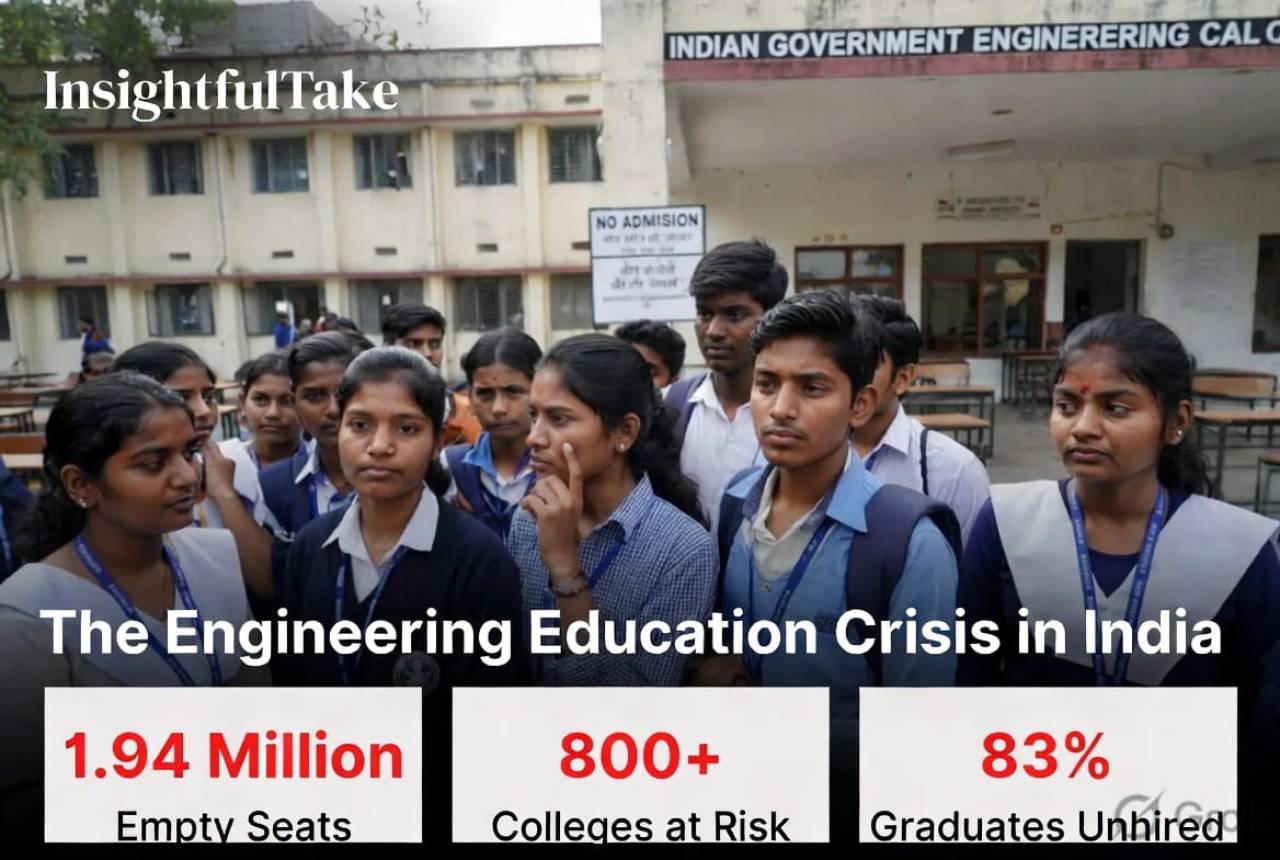
Nearly two million engineering seats have gone vacant while thousands of graduates remain unemployed. Is India's engineering education system producing degrees faster than careers?
India has one of the largest higher education systems in the world. Every year, lakhs of students join engineering colleges with the hope of securing good jobs in technology, manufacturing, and other sectors. However, recent data point to serious structural problems in the system. Many engineering seats remain vacant, several colleges are shutting down, and a significant number of graduates struggle to find suitable employment.
According to available data, about 1.94 million engineering seats remained vacant in recent years. The All India Council for Technical Education (AICTE), the country's technical education regulator, reports that nearly 30 percent of seats across more than 3,000 institutions go unfilled every year. Between the 2019-20 and 2023-24 academic sessions, close to 2 million seats remained vacant. This means thousands of available seats go unused despite colleges having the capacity to admit students.
One of the clearest signs of the crisis is the closure of institutions. In the 2025-26 academic year, AICTE ordered the progressive closure of 58 engineering and technical colleges. Uttar Pradesh and Maharashtra recorded the highest number of closures, with 12 institutions each. Under progressive closure, colleges are not permitted to admit new first-year students, although existing students are allowed to complete their courses. Over the past several years, more than 50 engineering colleges have closed in a single academic year on multiple occasions. Some reports also indicate that hundreds of institutions have either shut down or are facing severe financial and academic difficulties, with nearly 800 colleges considered vulnerable. Many private engineering colleges are finding it increasingly difficult to sustain operations because of declining admissions.
Several factors explain why engineering seats remain vacant. Students and parents are gradually losing confidence in traditional engineering programmes because many graduates fail to secure satisfactory employment. The cost of earning a four-year engineering degree often runs into several lakhs of rupees, while employment outcomes remain uncertain for a large section of graduates. As a result, many students now prefer medicine, data science, management, or even non-technical courses that appear to offer better career prospects. In some states, more than half of the engineering seats remain unfilled. Colleges located in smaller towns and those with weak teaching standards or poor placement records have been affected the most.
Graduate employability is another major concern. Different studies present slightly different estimates, but the overall picture remains troubling. One report suggests that only about 71 percent of engineering graduates possess the basic skills required by employers. At the same time, the 2024 Unstop Talent Report found that nearly 83 percent of engineering graduates did not receive either a job offer or an internship. Placement rates in many institutions remain below 50 percent. Even among those who find employment, many work in positions unrelated to their engineering education or receive salaries that do not justify the investment made in their studies.
The reasons behind low employability are well known. Many engineering colleges continue to follow outdated curricula that do not match current industry requirements. Students receive substantial theoretical instruction but limited exposure to practical training, live projects, internships, and emerging technologies such as artificial intelligence, machine learning, and modern software development tools. Faculty shortages, inadequate laboratory infrastructure, and weak industry partnerships further reduce the quality of education. Consequently, many graduates complete their degrees without developing the practical skills, technical competence, and problem-solving abilities expected by employers.
These challenges affect not only students but also the broader economy. India produces around 1.5 million engineering graduates every year. When a large share of these graduates remains unemployed or underemployed, the country loses valuable human capital, while students and their families bear significant financial costs. Many families take educational loans in the hope of better career opportunities. When those expectations are not fulfilled, financial hardship and mental stress often follow. Youth unemployment continues to remain a significant concern, and engineering graduates are not immune to this trend.
The government and AICTE have introduced several measures to improve the situation. They have restricted approvals for new engineering colleges, reduced seat capacity in some institutions, and placed greater emphasis on improving educational quality. Skill development programmes and stronger industry partnerships are also receiving increased attention. Premier institutions such as the Indian Institutes of Technology and the National Institutes of Technology continue to produce highly skilled graduates who enjoy strong employment prospects. However, the much larger network of average engineering colleges still requires substantial reforms.
The rapid expansion of engineering education over the past two decades has not been matched by improvements in quality. Rising numbers of vacant seats, college closures, and weak employment outcomes indicate that meaningful reforms are urgently needed. Engineering institutions must modernise their curricula, strengthen practical learning, improve faculty quality, and build closer partnerships with industry. Students should make informed decisions while choosing courses and continuously develop additional technical and professional skills. At the policy level, the number of engineering seats should be aligned with labour market demand, with greater emphasis placed on educational outcomes rather than expansion alone.
Without these improvements, India's ambition of building a strong and globally competitive technical workforce will remain difficult to achieve. The coming years will determine whether the country's engineering education system can successfully address these long-standing structural challenges.
India has one of the largest higher education systems in the world. Every year, lakhs of students join engineering colleges with the hope of securing good jobs in technology, manufacturing, and other sectors. However, recent data point to serious structural problems in the system. Many engineering seats remain vacant, several colleges are shutting down, and a significant number of graduates struggle to find suitable employment.
According to available data, about 1.94 million engineering seats remained vacant in recent years. The All India Council for Technical Education (AICTE), the country's technical education regulator, reports that nearly 30 percent of seats across more than 3,000 institutions go unfilled every year. Between the 2019-20 and 2023-24 academic sessions, close to 2 million seats remained vacant. This means thousands of available seats go unused despite colleges having the capacity to admit students.
One of the clearest signs of the crisis is the closure of institutions. In the 2025-26 academic year, AICTE ordered the progressive closure of 58 engineering and technical colleges. Uttar Pradesh and Maharashtra recorded the highest number of closures, with 12 institutions each. Under progressive closure, colleges are not permitted to admit new first-year students, although existing students are allowed to complete their courses. Over the past several years, more than 50 engineering colleges have closed in a single academic year on multiple occasions. Some reports also indicate that hundreds of institutions have either shut down or are facing severe financial and academic difficulties, with nearly 800 colleges considered vulnerable. Many private engineering colleges are finding it increasingly difficult to sustain operations because of declining admissions.
Several factors explain why engineering seats remain vacant. Students and parents are gradually losing confidence in traditional engineering programmes because many graduates fail to secure satisfactory employment. The cost of earning a four-year engineering degree often runs into several lakhs of rupees, while employment outcomes remain uncertain for a large section of graduates. As a result, many students now prefer medicine, data science, management, or even non-technical courses that appear to offer better career prospects. In some states, more than half of the engineering seats remain unfilled. Colleges located in smaller towns and those with weak teaching standards or poor placement records have been affected the most.
Graduate employability is another major concern. Different studies present slightly different estimates, but the overall picture remains troubling. One report suggests that only about 71 percent of engineering graduates possess the basic skills required by employers. At the same time, the 2024 Unstop Talent Report found that nearly 83 percent of engineering graduates did not receive either a job offer or an internship. Placement rates in many institutions remain below 50 percent. Even among those who find employment, many work in positions unrelated to their engineering education or receive salaries that do not justify the investment made in their studies.
The reasons behind low employability are well known. Many engineering colleges continue to follow outdated curricula that do not match current industry requirements. Students receive substantial theoretical instruction but limited exposure to practical training, live projects, internships, and emerging technologies such as artificial intelligence, machine learning, and modern software development tools. Faculty shortages, inadequate laboratory infrastructure, and weak industry partnerships further reduce the quality of education. Consequently, many graduates complete their degrees without developing the practical skills, technical competence, and problem-solving abilities expected by employers.
These challenges affect not only students but also the broader economy. India produces around 1.5 million engineering graduates every year. When a large share of these graduates remains unemployed or underemployed, the country loses valuable human capital, while students and their families bear significant financial costs. Many families take educational loans in the hope of better career opportunities. When those expectations are not fulfilled, financial hardship and mental stress often follow. Youth unemployment continues to remain a significant concern, and engineering graduates are not immune to this trend.
The government and AICTE have introduced several measures to improve the situation. They have restricted approvals for new engineering colleges, reduced seat capacity in some institutions, and placed greater emphasis on improving educational quality. Skill development programmes and stronger industry partnerships are also receiving increased attention. Premier institutions such as the Indian Institutes of Technology and the National Institutes of Technology continue to produce highly skilled graduates who enjoy strong employment prospects. However, the much larger network of average engineering colleges still requires substantial reforms.
The rapid expansion of engineering education over the past two decades has not been matched by improvements in quality. Rising numbers of vacant seats, college closures, and weak employment outcomes indicate that meaningful reforms are urgently needed. Engineering institutions must modernise their curricula, strengthen practical learning, improve faculty quality, and build closer partnerships with industry. Students should make informed decisions while choosing courses and continuously develop additional technical and professional skills. At the policy level, the number of engineering seats should be aligned with labour market demand, with greater emphasis placed on educational outcomes rather than expansion alone.
Without these improvements, India's ambition of building a strong and globally competitive technical workforce will remain difficult to achieve. The coming years will determine whether the country's engineering education system can successfully address these long-standing structural challenges.



























Leave a Comment