
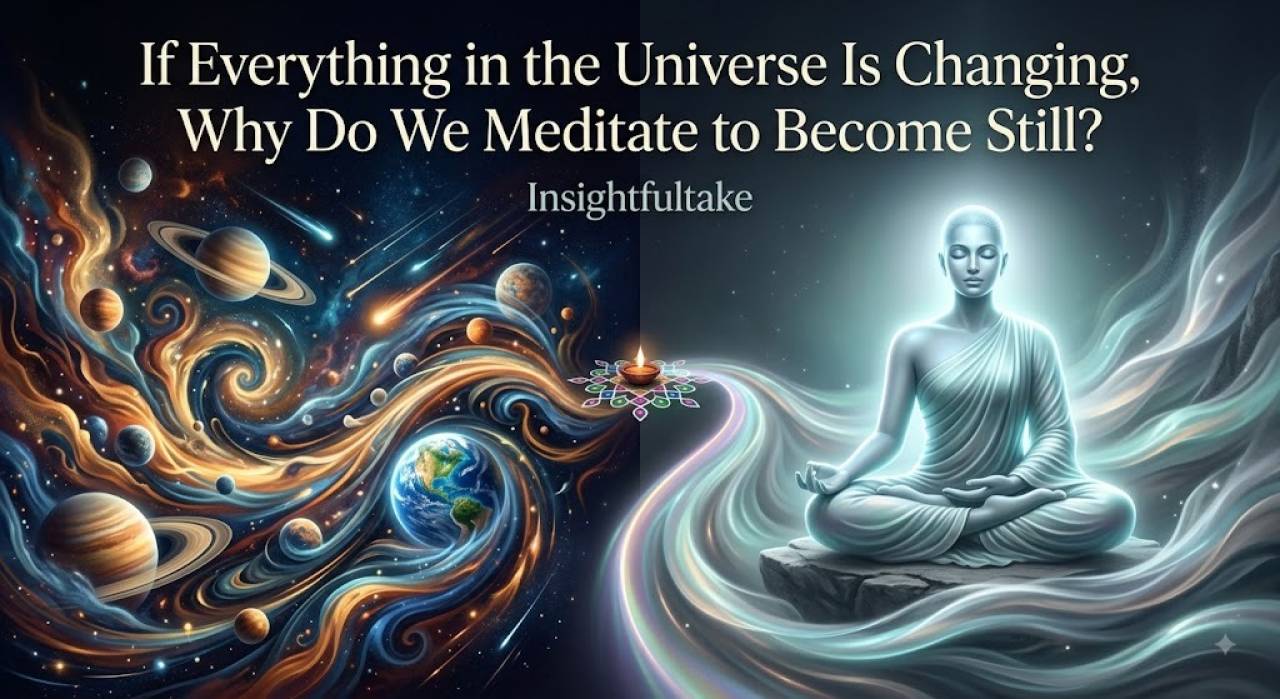
If nothing in the universe is truly still, why does meditation ask us to become still? Is meditation resisting change, or teaching us to witness it?
There is something deeply paradoxical about meditation.
We sit down, close our eyes, control our breathing and try to become still. We are told to quiet the mind, withdraw from distractions and remain present in silence.
But look closely at the universe around us and a very different picture emerges.
Nothing appears to be still.
The Earth is rotating on its axis and revolving around the Sun. The Sun itself is moving through the Milky Way. Galaxies are moving, stars are being born and dying, and the universe itself is expanding. On a much smaller scale, our bodies are equally dynamic. Cells are continuously being created, damaged, repaired and replaced. Blood circulates, neurons fire, hormones fluctuate and billions of biochemical reactions take place inside us every moment.
Even the apparently solid chair on which we sit is, at the microscopic level, a restless world of particles in motion.
If change is not an exception but the fundamental condition of existence, then what exactly are we doing when we meditate?
Are we trying to achieve something that nature itself does not permit?
The question becomes even more interesting when meditation is presented as a spiritual journey towards stillness.
Science Does Not Know a Static Universe
One of the most basic lessons of modern science is that nature is a process rather than a frozen photograph.
Classical physics showed us that objects move according to definite laws. Modern physics went much further. Matter and energy are constantly interacting. At the quantum level, the picture becomes even more dynamic and probabilistic. Biology tells us that living organisms survive precisely because they continuously exchange matter and energy with their surroundings.
Life itself is movement.
Stop the movement of the heart and life stops. Stop respiration and consciousness soon disappears. Stop cellular metabolism and the organism dies.
In that sense, absolute physical stillness is not a characteristic of life. It is much closer to death.
So when meditation tells us to "be still", it cannot sensibly mean that we should stop the processes that constitute our existence.
The Earth will continue to rotate whether we meditate or not.
Our cells will continue their biological activities.
Our heart will continue beating.
The universe will continue expanding.
Meditation cannot suspend any of this.
And perhaps it was never supposed to.
The Difference Between Physical Stillness and Mental Stillness
This is where the apparent conflict between meditation and science begins to dissolve.
Meditation does not necessarily ask us to stop movement. It asks us to stop being constantly carried away by every movement of the mind.
That is a very different proposition.
Thoughts can be moving rapidly while we remain aware of them. Emotions can arise without immediately controlling our behaviour. The body can continue functioning while attention becomes quieter.
Imagine sitting beside a river.
The river continues flowing.
You do not ask the river to stop.
You simply stop running after every wave.
Perhaps meditation is something similar.
The world continues changing, but the meditator attempts to develop a stable awareness from which that change can be observed.
This distinction is crucial.
Meditation, therefore, need not contradict the scientific understanding of a dynamic universe. Instead, it can be understood as an experiment in how consciousness relates to change.
But Here Comes the Deeper Philosophical Problem
There is, however, a legitimate criticism of certain interpretations of meditation.
If meditation is presented as a way of escaping change, escaping desire, escaping emotions, escaping worldly life or reaching some permanently unchanging state, then the philosophical problem becomes much more serious.
Because what is the thing that supposedly remains unchanged?
The human body certainly does not.
The brain does not.
Thoughts do not.
Emotions do not.
Memories change.
Relationships change.
Societies change.
Nature changes.
Even our sense of identity changes throughout life.
The child who once inhabited our body is biologically and psychologically very different from the adult sitting here today. Yet we continue to call both of them "me".
Perhaps the desire for an absolutely permanent self is itself an attempt to resist the fundamental condition of existence.
And this is where meditation can come into conflict not with science itself, but with a particular metaphysical interpretation of meditation.
Interestingly, Spiritualism Has Its Own Theory of Change
There is another irony here.
Some people assume that spirituality means finding something permanent behind a changing world.
But several ancient spiritual traditions, particularly Buddhist thought, have made impermanence one of their central insights.
Everything arises.
Everything changes.
Everything passes.
The body changes. Feelings change. thoughts change. Relationships change. Circumstances change.
From this perspective, meditation is not an attempt to stop change. It is an attempt to see change without resistance.
That makes meditation almost the opposite of what its critics sometimes assume.
The meditator is not necessarily saying, "I want the world to become still."
The deeper statement may be, "I want to become still enough to see the world changing."
That is a considerably more sophisticated proposition.
Stillness May Actually Mean Freedom From Resistance
Perhaps the word "stillness" itself creates the confusion.
Stillness does not necessarily mean inactivity.
A person can sit motionless while experiencing enormous activity inside the mind.
Another person can be physically active while experiencing extraordinary mental clarity.
A surgeon operating on a patient, a musician playing an instrument or a scientist concentrating on an experiment may be physically active but mentally collected.
Stillness, therefore, may be better understood as non-reactivity rather than immobility.
The world throws thousands of stimuli at us every day.
A sound appears.
A thought appears.
An insult appears.
A desire appears.
A memory appears.
An anxiety appears.
The ordinary mind immediately reacts.
Meditation attempts to create a small space between the occurrence and the reaction.
That space can be psychologically powerful.
And there is nothing inherently unscientific about training attention or observing one's thoughts.
The Real Contradiction May Be Somewhere Else
The real contradiction appears when we turn meditation into an absolute doctrine.
If someone says, "Everything in existence is changing, therefore meditation is the practice of escaping change," the criticism deserves attention.
But if meditation means, "Everything is changing, therefore let me sit quietly and observe this change without being psychologically destroyed by it," then the contradiction disappears.
In fact, the second interpretation may be remarkably compatible with scientific thinking.
Science teaches us to observe nature rather than impose our wishes upon it.
Meditation, at its best, can teach us to observe our inner nature without immediately imposing our desires upon it.
Science observes the changing external world.
Meditation observes the changing internal world.
Neither observation requires the observed phenomenon to become static.
Perhaps Meditation Is Not About Becoming Still
Maybe the phrase should never have been "become still."
Perhaps it should have been:
Become still enough to see movement clearly.
That changes everything.
The Earth does not need to stop rotating for us to understand its movement.
The ocean does not need to stop flowing for us to understand a wave.
A forest does not need to stop growing for us to appreciate its life.
Likewise, the mind does not need to stop producing thoughts for us to understand how thoughts arise and disappear.
Meditation, in its most intellectually defensible form, may therefore not be a rejection of the dynamic universe.
It may be an attempt to develop a stable vantage point from which the dynamic universe, including the universe within our own minds, can be witnessed.
And there is a final paradox.
Perhaps the greatest form of stillness is not the absence of movement.
Perhaps it is the absence of our desperate demand that movement should stop.
The universe moves.
The Earth turns.
The body ages.
Cells change.
Thoughts arise.
Emotions pass.
People enter our lives and leave them.
Nothing asks our permission.
Meditation may not be the art of stopping this great movement.
It may simply be the art of sitting quietly enough to finally notice it.
There is something deeply paradoxical about meditation.
We sit down, close our eyes, control our breathing and try to become still. We are told to quiet the mind, withdraw from distractions and remain present in silence.
But look closely at the universe around us and a very different picture emerges.
Nothing appears to be still.
The Earth is rotating on its axis and revolving around the Sun. The Sun itself is moving through the Milky Way. Galaxies are moving, stars are being born and dying, and the universe itself is expanding. On a much smaller scale, our bodies are equally dynamic. Cells are continuously being created, damaged, repaired and replaced. Blood circulates, neurons fire, hormones fluctuate and billions of biochemical reactions take place inside us every moment.
Even the apparently solid chair on which we sit is, at the microscopic level, a restless world of particles in motion.
If change is not an exception but the fundamental condition of existence, then what exactly are we doing when we meditate?
Are we trying to achieve something that nature itself does not permit?
The question becomes even more interesting when meditation is presented as a spiritual journey towards stillness.
Science Does Not Know a Static Universe
One of the most basic lessons of modern science is that nature is a process rather than a frozen photograph.
Classical physics showed us that objects move according to definite laws. Modern physics went much further. Matter and energy are constantly interacting. At the quantum level, the picture becomes even more dynamic and probabilistic. Biology tells us that living organisms survive precisely because they continuously exchange matter and energy with their surroundings.
Life itself is movement.
Stop the movement of the heart and life stops. Stop respiration and consciousness soon disappears. Stop cellular metabolism and the organism dies.
In that sense, absolute physical stillness is not a characteristic of life. It is much closer to death.
So when meditation tells us to "be still", it cannot sensibly mean that we should stop the processes that constitute our existence.
The Earth will continue to rotate whether we meditate or not.
Our cells will continue their biological activities.
Our heart will continue beating.
The universe will continue expanding.
Meditation cannot suspend any of this.
And perhaps it was never supposed to.
The Difference Between Physical Stillness and Mental Stillness
This is where the apparent conflict between meditation and science begins to dissolve.
Meditation does not necessarily ask us to stop movement. It asks us to stop being constantly carried away by every movement of the mind.
That is a very different proposition.
Thoughts can be moving rapidly while we remain aware of them. Emotions can arise without immediately controlling our behaviour. The body can continue functioning while attention becomes quieter.
Imagine sitting beside a river.
The river continues flowing.
You do not ask the river to stop.
You simply stop running after every wave.
Perhaps meditation is something similar.
The world continues changing, but the meditator attempts to develop a stable awareness from which that change can be observed.
This distinction is crucial.
Meditation, therefore, need not contradict the scientific understanding of a dynamic universe. Instead, it can be understood as an experiment in how consciousness relates to change.
But Here Comes the Deeper Philosophical Problem
There is, however, a legitimate criticism of certain interpretations of meditation.
If meditation is presented as a way of escaping change, escaping desire, escaping emotions, escaping worldly life or reaching some permanently unchanging state, then the philosophical problem becomes much more serious.
Because what is the thing that supposedly remains unchanged?
The human body certainly does not.
The brain does not.
Thoughts do not.
Emotions do not.
Memories change.
Relationships change.
Societies change.
Nature changes.
Even our sense of identity changes throughout life.
The child who once inhabited our body is biologically and psychologically very different from the adult sitting here today. Yet we continue to call both of them "me".
Perhaps the desire for an absolutely permanent self is itself an attempt to resist the fundamental condition of existence.
And this is where meditation can come into conflict not with science itself, but with a particular metaphysical interpretation of meditation.
Interestingly, Spiritualism Has Its Own Theory of Change
There is another irony here.
Some people assume that spirituality means finding something permanent behind a changing world.
But several ancient spiritual traditions, particularly Buddhist thought, have made impermanence one of their central insights.
Everything arises.
Everything changes.
Everything passes.
The body changes. Feelings change. thoughts change. Relationships change. Circumstances change.
From this perspective, meditation is not an attempt to stop change. It is an attempt to see change without resistance.
That makes meditation almost the opposite of what its critics sometimes assume.
The meditator is not necessarily saying, "I want the world to become still."
The deeper statement may be, "I want to become still enough to see the world changing."
That is a considerably more sophisticated proposition.
Stillness May Actually Mean Freedom From Resistance
Perhaps the word "stillness" itself creates the confusion.
Stillness does not necessarily mean inactivity.
A person can sit motionless while experiencing enormous activity inside the mind.
Another person can be physically active while experiencing extraordinary mental clarity.
A surgeon operating on a patient, a musician playing an instrument or a scientist concentrating on an experiment may be physically active but mentally collected.
Stillness, therefore, may be better understood as non-reactivity rather than immobility.
The world throws thousands of stimuli at us every day.
A sound appears.
A thought appears.
An insult appears.
A desire appears.
A memory appears.
An anxiety appears.
The ordinary mind immediately reacts.
Meditation attempts to create a small space between the occurrence and the reaction.
That space can be psychologically powerful.
And there is nothing inherently unscientific about training attention or observing one's thoughts.
The Real Contradiction May Be Somewhere Else
The real contradiction appears when we turn meditation into an absolute doctrine.
If someone says, "Everything in existence is changing, therefore meditation is the practice of escaping change," the criticism deserves attention.
But if meditation means, "Everything is changing, therefore let me sit quietly and observe this change without being psychologically destroyed by it," then the contradiction disappears.
In fact, the second interpretation may be remarkably compatible with scientific thinking.
Science teaches us to observe nature rather than impose our wishes upon it.
Meditation, at its best, can teach us to observe our inner nature without immediately imposing our desires upon it.
Science observes the changing external world.
Meditation observes the changing internal world.
Neither observation requires the observed phenomenon to become static.
Perhaps Meditation Is Not About Becoming Still
Maybe the phrase should never have been "become still."
Perhaps it should have been:
Become still enough to see movement clearly.
That changes everything.
The Earth does not need to stop rotating for us to understand its movement.
The ocean does not need to stop flowing for us to understand a wave.
A forest does not need to stop growing for us to appreciate its life.
Likewise, the mind does not need to stop producing thoughts for us to understand how thoughts arise and disappear.
Meditation, in its most intellectually defensible form, may therefore not be a rejection of the dynamic universe.
It may be an attempt to develop a stable vantage point from which the dynamic universe, including the universe within our own minds, can be witnessed.
And there is a final paradox.
Perhaps the greatest form of stillness is not the absence of movement.
Perhaps it is the absence of our desperate demand that movement should stop.
The universe moves.
The Earth turns.
The body ages.
Cells change.
Thoughts arise.
Emotions pass.
People enter our lives and leave them.
Nothing asks our permission.
Meditation may not be the art of stopping this great movement.
It may simply be the art of sitting quietly enough to finally notice it.























Leave a Comment