
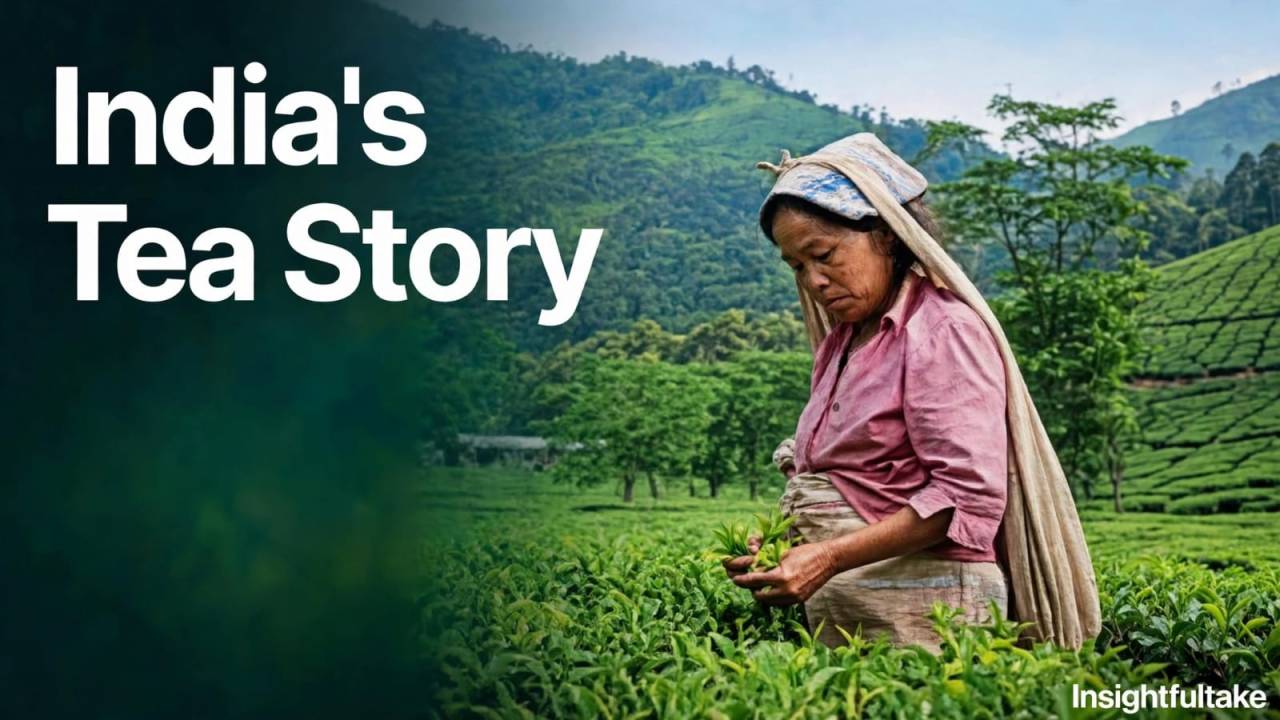
India's tea growers face rising costs and shrinking margins. A proposed Minimum Sustainable Price could reshape the economics of tea cultivation.
A widening gap between rising production costs and stagnant price realisations has pushed India's tea industry to seek a Minimum Sustainable Price (MSP). Five major industry associations have backed a Tea Board of India committee's recommendation, urging the Union Ministry of Commerce to notify the proposed mechanism at the earliest.
The demand reflects a growing financial strain across India's tea sector. Industry estimates suggest that input costs have been rising at an annual compound rate of 10% to 14%, while price realisations have increased by just 2% to 3%.
The difference is becoming increasingly difficult for tea producers to absorb. At these growth rates, production costs could rise by approximately 1.6 to 1.9 times over five years, while price realisations would increase by only 1.1 to 1.2 times.
For an industry dependent on regular labour, agricultural inputs and long-term investment, such a widening gap threatens the economic viability of tea production.
Five Industry Associations Back Minimum Sustainable Price
The proposal has received support from five major industry organisations:
- Indian Tea Association (ITA)
- Tea Association of India (TAI)
- United Planters' Association of Southern India (UPASI)
- Confederation of Indian Small Tea Growers Associations (CISTA)
- Federation of Indian Tea Manufacturers Association (FITMA)
These organisations have jointly urged the Union Ministry of Commerce to notify the proposed Minimum Sustainable Price.
The recommendation follows a committee constituted by the Tea Board of India to examine the financial pressures facing tea producers and explore a mechanism to ensure more sustainable returns.
The proposed intervention seeks to establish a price benchmark that reflects changes in production costs rather than leaving growers entirely exposed to market fluctuations.
What Is the Proposed Minimum Sustainable Price?
The proposed Minimum Sustainable Price should not be confused with the Minimum Support Price (MSP) mechanism used for agricultural commodities such as wheat and paddy.
It is not designed as a government procurement guarantee or an assurance of profits to tea producers.
Instead, the committee has proposed a benchmark linked to a composite index incorporating wage movements and the Consumer Price Index (CPI). Periodic reviews would help keep the benchmark aligned with inflation and changing production costs.
The central idea is to connect price realisations with the expenses involved in producing tea.
Such an index-based mechanism could offer producers greater predictability and reduce the pressure created by a persistent mismatch between input costs and selling prices.
However, its effectiveness would depend on how the benchmark is calculated, reviewed and implemented.
Rising Labour Costs Put Tea Producers Under Pressure
Labour is the biggest component of tea production costs, accounting for approximately 60% of total expenditure.
This makes wage increases particularly significant for tea estates and small growers.
The pressure could intensify as central and state governments notify floor wages under the Code on Wages. Any statutory increase in minimum wages would directly affect production expenses.
Without a corresponding improvement in price realisations, producers would have limited options to absorb the additional burden.
This is why the proposed wage-linked component is particularly important. It would allow the price benchmark to respond to one of the industry's most significant cost drivers.
For tea producers already operating under narrow margins, the relationship between wage increases and selling prices could determine whether their operations remain financially viable.
Why India's Small Tea Growers Have More at Stake
Small tea growers account for nearly 55% of India's total tea production, making their financial position central to the future of the industry.
Unlike large tea estates, many small growers depend on bought-leaf factories for processing their harvest.
They sell freshly plucked green leaves to these factories, which convert them into processed tea for the market.
The arrangement creates a significant bargaining disadvantage. Green tea leaves are perishable, leaving growers with little opportunity to store their produce or wait for better prices.
A Minimum Sustainable Price could provide some relief, but an important question remains: Will the proposed benchmark actually translate into better prices for green leaf?
The distinction matters because a benchmark applicable to processed tea or producers may not automatically improve the amount paid to small growers.
The mechanism must therefore establish how its benefits will reach the farm gate.
Sanjith R. Nair of UPASI has also highlighted the need to account for regional differences in agro-climatic conditions, production practices, productivity and cost structures.
Tea-growing regions do not operate under identical economic conditions. A uniform national benchmark could therefore fail to reflect the actual cost pressures faced by growers in different parts of the country.
Regional calibration will be essential if the proposal is to benefit producers across the industry.
Why Better Prices Matter for the Future of India's Tea Industry
The debate over a Minimum Sustainable Price is not limited to immediate financial relief. It also concerns the industry's ability to invest in its future.
ITA Chairman Suneel Singh Sikand has argued that remunerative returns are essential for replantation and productivity enhancement.
TAI President Shailja Mehta has similarly linked financial viability with modernisation and improvements in quality standards.
Their concerns reflect a larger challenge.
Tea plantations require regular investment in replantation, maintenance, machinery, processing facilities and improved agricultural practices. When earnings remain below production costs, growers often postpone these investments.
Over time, delayed replantation and inadequate maintenance can affect productivity, leaf quality and the competitiveness of Indian tea.
A sustainable pricing mechanism could help create the financial conditions needed for long-term investment.
Without adequate returns, however, even established tea-growing operations may struggle to maintain production standards.
What Tea Growers Should Watch Next
The Minimum Sustainable Price remains a recommendation and has not yet become a notified policy.
As the proposal moves through the government process, growers and their associations should focus on three practical issues.
First, establish actual production costs. Small growers should maintain detailed records of expenditure on plucking labour, agricultural inputs, transportation and other operational expenses. Reliable cost data will strengthen their case for a realistic price benchmark.
Second, examine how the benchmark will affect green leaf prices. Grower associations and cooperatives must seek clarity on whether the proposed mechanism will influence the rates paid by bought-leaf factories.
Third, monitor wage notifications. The implementation of floor wages under the Code on Wages could significantly influence the industry's cost structure in the coming years.
These issues will determine whether the proposed mechanism offers meaningful protection or remains largely an industry-level benchmark.
The Real Test Lies in Implementation
The economic case for a Minimum Sustainable Price is rooted in a widening gap between production costs and price realisations.
When expenses rise by 10% to 14% annually while selling prices increase by only 2% to 3%, the resulting pressure cannot be addressed through operational improvements alone.
The proposal offers a possible framework for linking tea prices with the changing cost of production. But its success will depend on the details: index weights, review frequency, regional adjustments and enforcement.
Most importantly, the mechanism must ensure that small growers, who account for nearly 55% of India's tea production, receive a fair share of its benefits.
For India's tea industry, the question is no longer simply how much tea it can produce. It is whether the people who grow it can earn enough to sustain that production.
A price benchmark that fails to reach the grower will have limited value. The real measure of success will be whether it makes tea cultivation economically sustainable.























Leave a Comment