
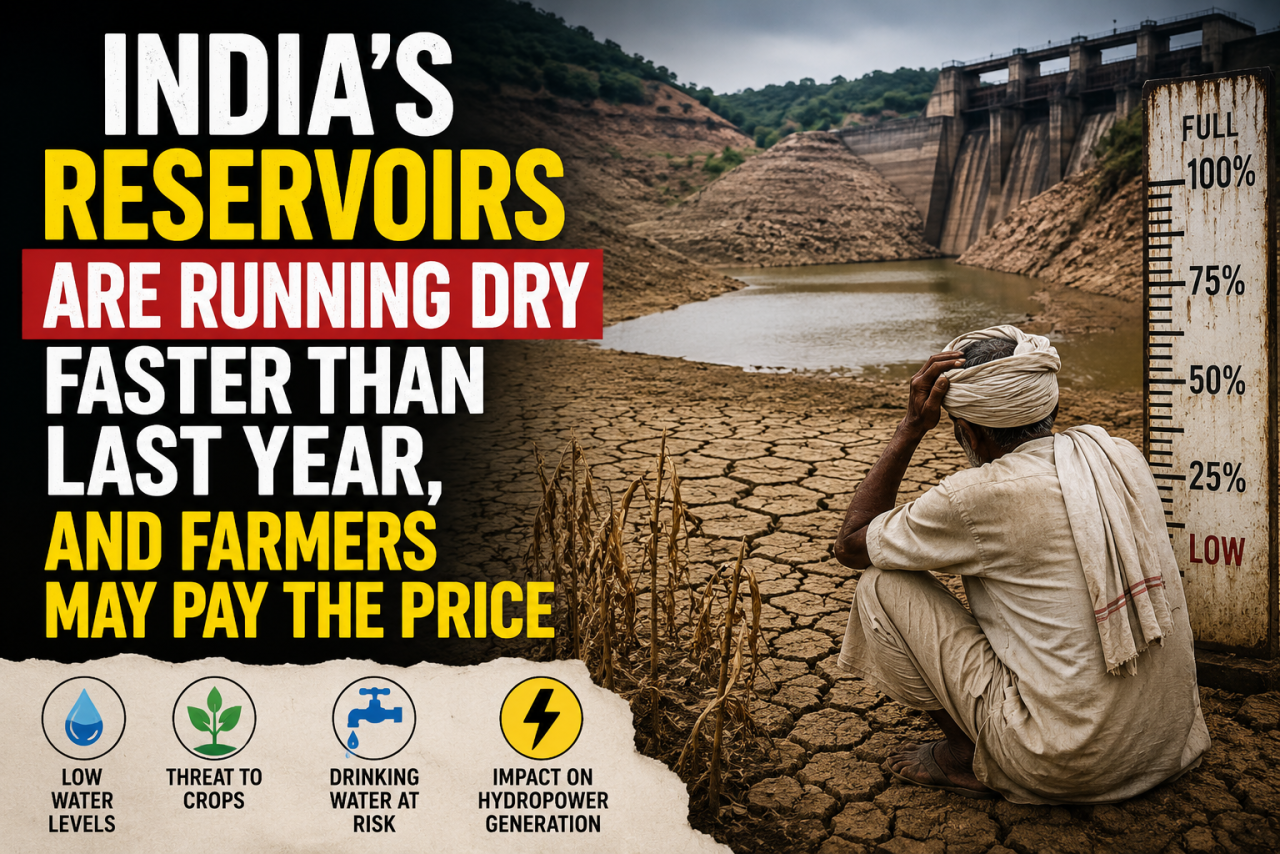
India's reservoirs are filling up much slower than last year. Could this water shortage threaten the next harvest, drinking water supplies, and electricity generation? Here's why the coming weeks of the monsoon are crucial.
India's major reservoirs are holding far less water than they should at this point in the monsoon season, raising concerns about drinking water supplies, crop output, and electricity generation in the months ahead.
According to Central Water Commission data updated till 16 July, the country's major reservoirs, which together have a storage capacity of 183.57 billion cubic metres (bcm), were just 34.5% full. This is well below the levels seen at the same time last year, even though the south-west monsoon has picked up pace across the country after a slow and delayed start.
Looking at the bigger picture, reservoirs monitored by the Commission account for about 71% of India's total estimated live storage capacity of 257.812 bcm. Live storage across these reservoirs currently stands at 83.57 bcm, down sharply from 103.96 bcm during the same period last year. As of end-June, storage had improved only slightly from a low of around 40% full. While rainfall in recent weeks has helped, the recovery has remained uneven.
Southern India Faces the Biggest Water Deficit
The shortfall is not spread equally across the country. The southern region has recorded the widest deficit compared to last year, followed by the eastern region, where rainfall has also remained below normal. The northern and central regions have fared somewhat better, but storage levels there too remain below what is needed to provide a comfortable cushion before the dry season begins.
Why Reservoir Levels Matter for Agriculture
India's agricultural calendar depends heavily on the monsoon.
The kharif crop, sown during the June-to-October rainy season, contributed 53% of the country's total foodgrain production in FY26. However, it is the rabi crop, sown during winter and accounting for 41% of production, that depends largely on water stored in reservoirs during the monsoon.
If reservoirs fail to fill adequately over the next few months, irrigation during the rabi season could suffer, affecting both sowing and crop yields.
Experts Warn of Wider Impact
Madan Sabnavis, Chief Economist at Bank of Baroda, said that lower reservoir levels affect much more than irrigation. They also threaten drinking water supplies and water availability for livestock in rural areas, where communities rely heavily on stored reservoir water once the monsoon begins to withdraw.
Farm policy expert Sudhir Panwar, a former member of the Uttar Pradesh State Planning Commission, warned that reduced water availability during critical crop growth stages could lower yields, particularly for water-intensive crops such as paddy, sugarcane, and cotton.
He added that if reservoir levels do not improve significantly in the coming weeks, the impact could extend well into the next harvest season.
Queries sent to the Jal Shakti Ministry regarding the reservoir shortfall and its likely impact on agricultural production had not received a response as of 20 July.
Hope Still Depends on the Remaining Monsoon
There is still room for improvement.
The south-west monsoon usually continues until September, with withdrawal beginning only in October. Experts caution against drawing firm conclusions too early, noting that reservoir replenishment, especially in southern and eastern India, has been delayed rather than completely derailed.
A strong spell of rainfall over the coming weeks could still help reservoir levels recover closer to normal.
Risks Extend Beyond Farming
Even so, the present shortfall poses significant risks.
Lower reservoir storage threatens not only agriculture and drinking water supplies but also hydropower generation, since many dams serve the dual purpose of irrigation and electricity production.
If water levels remain low for an extended period, the country could face tighter irrigation schedules, reduced electricity generation from hydropower projects, and increased pressure on food prices if crop production declines.
The Next Two Months Are Critical
For now, the focus remains on the remaining weeks of the monsoon.
The rainfall received during August and September will determine whether India's reservoirs can recover sufficiently before the crucial rabi sowing season, making the next two months vital for farmers, water security, and the broader economy.
India's major reservoirs are holding far less water than they should at this point in the monsoon season, raising concerns about drinking water supplies, crop output, and electricity generation in the months ahead.
According to Central Water Commission data updated till 16 July, the country's major reservoirs, which together have a storage capacity of 183.57 billion cubic metres (bcm), were just 34.5% full. This is well below the levels seen at the same time last year, even though the south-west monsoon has picked up pace across the country after a slow and delayed start.
Looking at the bigger picture, reservoirs monitored by the Commission account for about 71% of India's total estimated live storage capacity of 257.812 bcm. Live storage across these reservoirs currently stands at 83.57 bcm, down sharply from 103.96 bcm during the same period last year. As of end-June, storage had improved only slightly from a low of around 40% full. While rainfall in recent weeks has helped, the recovery has remained uneven.
Southern India Faces the Biggest Water Deficit
The shortfall is not spread equally across the country. The southern region has recorded the widest deficit compared to last year, followed by the eastern region, where rainfall has also remained below normal. The northern and central regions have fared somewhat better, but storage levels there too remain below what is needed to provide a comfortable cushion before the dry season begins.
Why Reservoir Levels Matter for Agriculture
India's agricultural calendar depends heavily on the monsoon.
The kharif crop, sown during the June-to-October rainy season, contributed 53% of the country's total foodgrain production in FY26. However, it is the rabi crop, sown during winter and accounting for 41% of production, that depends largely on water stored in reservoirs during the monsoon.
If reservoirs fail to fill adequately over the next few months, irrigation during the rabi season could suffer, affecting both sowing and crop yields.
Experts Warn of Wider Impact
Madan Sabnavis, Chief Economist at Bank of Baroda, said that lower reservoir levels affect much more than irrigation. They also threaten drinking water supplies and water availability for livestock in rural areas, where communities rely heavily on stored reservoir water once the monsoon begins to withdraw.
Farm policy expert Sudhir Panwar, a former member of the Uttar Pradesh State Planning Commission, warned that reduced water availability during critical crop growth stages could lower yields, particularly for water-intensive crops such as paddy, sugarcane, and cotton.
He added that if reservoir levels do not improve significantly in the coming weeks, the impact could extend well into the next harvest season.
Queries sent to the Jal Shakti Ministry regarding the reservoir shortfall and its likely impact on agricultural production had not received a response as of 20 July.
Hope Still Depends on the Remaining Monsoon
There is still room for improvement.
The south-west monsoon usually continues until September, with withdrawal beginning only in October. Experts caution against drawing firm conclusions too early, noting that reservoir replenishment, especially in southern and eastern India, has been delayed rather than completely derailed.
A strong spell of rainfall over the coming weeks could still help reservoir levels recover closer to normal.
Risks Extend Beyond Farming
Even so, the present shortfall poses significant risks.
Lower reservoir storage threatens not only agriculture and drinking water supplies but also hydropower generation, since many dams serve the dual purpose of irrigation and electricity production.
If water levels remain low for an extended period, the country could face tighter irrigation schedules, reduced electricity generation from hydropower projects, and increased pressure on food prices if crop production declines.
The Next Two Months Are Critical
For now, the focus remains on the remaining weeks of the monsoon.
The rainfall received during August and September will determine whether India's reservoirs can recover sufficiently before the crucial rabi sowing season, making the next two months vital for farmers, water security, and the broader economy.























Leave a Comment