
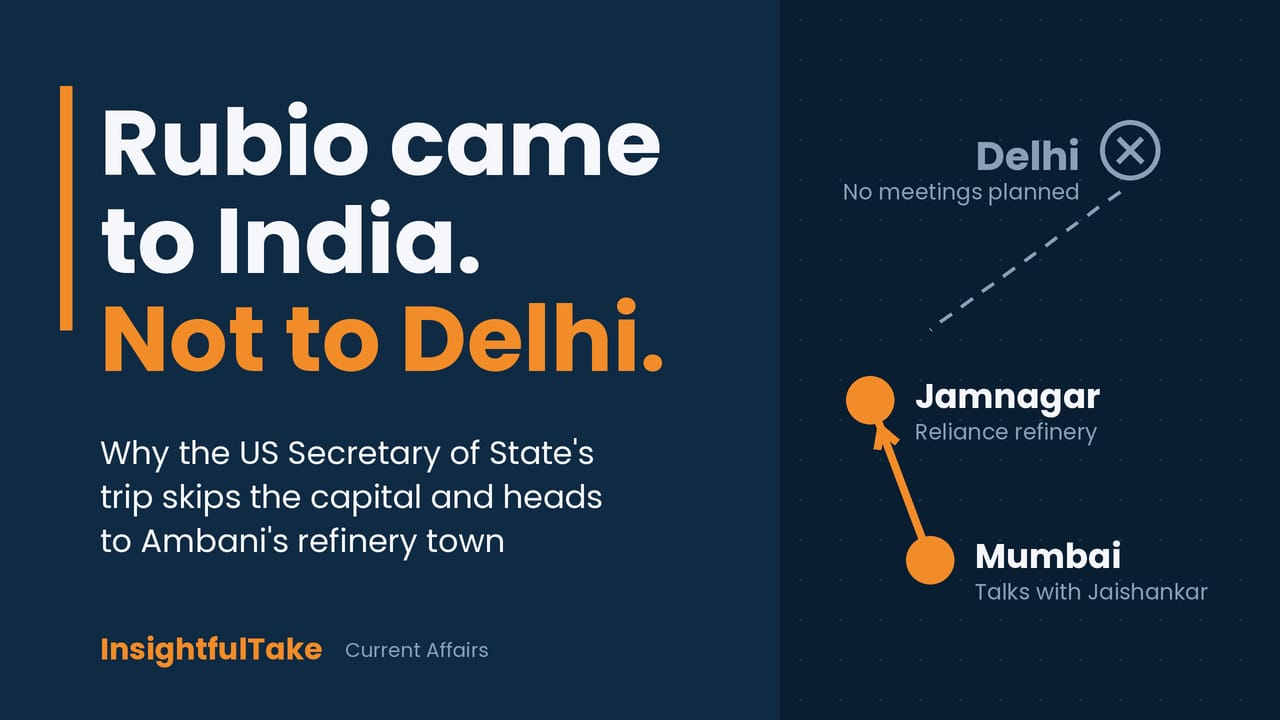
Rubio’s India visit bypasses New Delhi for Mumbai and Gujarat, raising questions about diplomatic protocol, corporate power and India’s bargaining position with Washington.
When a US Secretary of State visits India, the capital is usually the centre of diplomatic activity. This time, Marco Rubio’s schedule takes him elsewhere. The choice of venue, the meetings planned with leading industrialists and the political controversy surrounding the visit raise questions about India’s diplomatic standing and negotiating position.
Delhi Goes to Rubio
Rubio’s October 17–22 visit was reported to be the first trip by a US Secretary of State to India without planned meetings in New Delhi. External Affairs Minister S. Jaishankar was scheduled to meet him in Mumbai on October 20. The outcome of those talks was not yet available when this article was prepared.
The choice of Mumbai was not the only point of contention. US Ambassador Sergio Gor reportedly said Washington expected Jaishankar and other officials from Delhi to travel to Mumbai to meet Rubio. Congress leader Rahul Gandhi responded sharply, saying Rubio had “summoned his employee to Mumbai.” Congress also questioned why the American side had announced Jaishankar’s engagement before India’s own Ministry of External Affairs.
The government’s defence is that such arrangements are not unusual. The Ministry of External Affairs has said India has hosted foreign dignitaries outside Delhi for about a decade. That is true, but there is a difference between choosing an alternative venue and giving the impression that one side is dictating the other’s schedule.
From Mumbai to Ambani’s Turf
After the Mumbai meetings, Rubio was expected to travel to Gujarat. In Jamnagar, he was scheduled to visit the world’s largest single-site refinery, operated by Mukesh Ambani’s Reliance Industries, and attend a reception hosted by the Ambani family.
Reliance has reportedly been preparing an investment in a Texas oil refinery. Rubio was also expected to meet industrialist Gautam Adani and Tata Group chairman N. Chandrasekaran.
The itinerary places India’s foreign minister and some of the country’s most influential business leaders at the centre of the visit. Washington has highlighted energy, trade and investment as key priorities. With fuel prices a concern in the United States ahead of the midterm elections, securing energy and commercial opportunities makes economic sense.
But the commercial logic does not fully answer the diplomatic question: why was New Delhi left out of the planned meetings?
The timing has added another layer to the discussion. Elon Musk recently mocked Ambani as India’s “prime minister” during a dispute over Starlink’s approval in the country. A high-profile American visit that includes a stop at Ambani’s industrial hub may reinforce the perception that corporate power has become as important as official institutions in international dealings with India.
This perception may be politically uncomfortable, even if the itinerary itself does not establish that private interests have taken precedence over government-to-government diplomacy.
The Epstein Shadow
A second controversy has added to the political pressure surrounding the visit. The US Justice Department’s release of more than three million pages of material relating to Jeffrey Epstein included references to Union Minister Hardeep Singh Puri.
Reports have described a relationship spanning several years and meetings at Epstein’s Manhattan townhouse. Congress has claimed there were 62 email exchanges and 14 meetings between 2014 and 2017, and has demanded Puri’s resignation.
Puri has denied any wrongdoing. He has said he met Epstein “three or max four” times as part of an international delegation led by his superior, maintaining that these meetings had nothing to do with Epstein’s criminal activities. He has also argued that the material does not implicate him in any criminal offence.
The distinction matters. A person’s name appearing in documents connected to Epstein does not, by itself, establish involvement in his crimes. The nature of the contact and the available evidence must be assessed separately.
Did Washington use the release to put pressure on New Delhi? Rahul Gandhi has alleged that the United States weaponised the files to secure a trade deal. The theory has gained political attention against the backdrop of steep US tariffs on Indian goods and stalled trade negotiations.
The broader trade dispute is real. The allegation that Washington deliberately used the Epstein material to influence India’s negotiating position, however, requires evidence of its own.
What the Evidence Does Not Show
The Epstein document release was not limited to India. It was a large collection of records involving people from several countries, and its disclosures have triggered political consequences elsewhere, including the resignation of a Slovak official.
The appearance of a name in a bulk release does not automatically mean that the person was targeted by the US government. So far, the available information does not establish that Washington deliberately singled out Puri or India to gain leverage in trade negotiations.
The opposition’s claim remains an allegation, not a proven explanation for the timing of the release.
Likewise, Rubio’s decision to meet Jaishankar in Mumbai does not, by itself, amount to a diplomatic snub. The Indian government is part of the engagement, and the stated agenda includes energy, trade, defence and technology.
The questions worth asking are therefore more specific. Who decided the venue? How were the meetings coordinated? And does the itinerary reflect a mutually agreed diplomatic arrangement or an imbalance in how the two sides approach the relationship?
These questions can be examined without assuming a conspiracy.
The Real Question
Strip away the speculation, and a difficult question remains: why does the US Secretary of State appear to have such influence over the location and public announcement of key engagements, while India is expected to adjust its schedule?
The answer may lie in the balance of economic and strategic leverage. High US tariffs on Indian goods, stalled trade talks and the prospect of additional American measures against countries buying Russian oil have complicated India’s negotiating position. Reports of proposed US legislation threatening tariffs of up to 100% on buyers of Russian oil have added to those concerns.
When economic pressure rises, diplomatic protocol can become more flexible. Governments may accept arrangements they would otherwise resist because the larger negotiations matter more than the symbolism of a venue.
This is the argument made by critics of the visit, and it deserves serious consideration. The government’s counterargument is also straightforward that the diplomacy should be judged by what it delivers, not simply by where meetings take place. If the visit produces meaningful progress on trade, energy, defence and technology, the absence of a meeting in Delhi may matter less.
The final assessment must await the outcomes of the talks. Until then, the visit offers a useful test of India’s claim to strategic autonomy. The issue is not whether an American official meets an Indian minister in Mumbai rather than Delhi. It is whether both countries approach the relationship as equal partners, with the ability to set priorities and negotiate terms without undue pressure.
Diplomatic venues make headlines, but the terms of an agreement reveal where the real power lies.
















Leave a Comment