
A fierce 11th-century goddess carved in Bengal now stands in Singapore, revealing the religious beliefs and artistic brilliance of the Pala era.
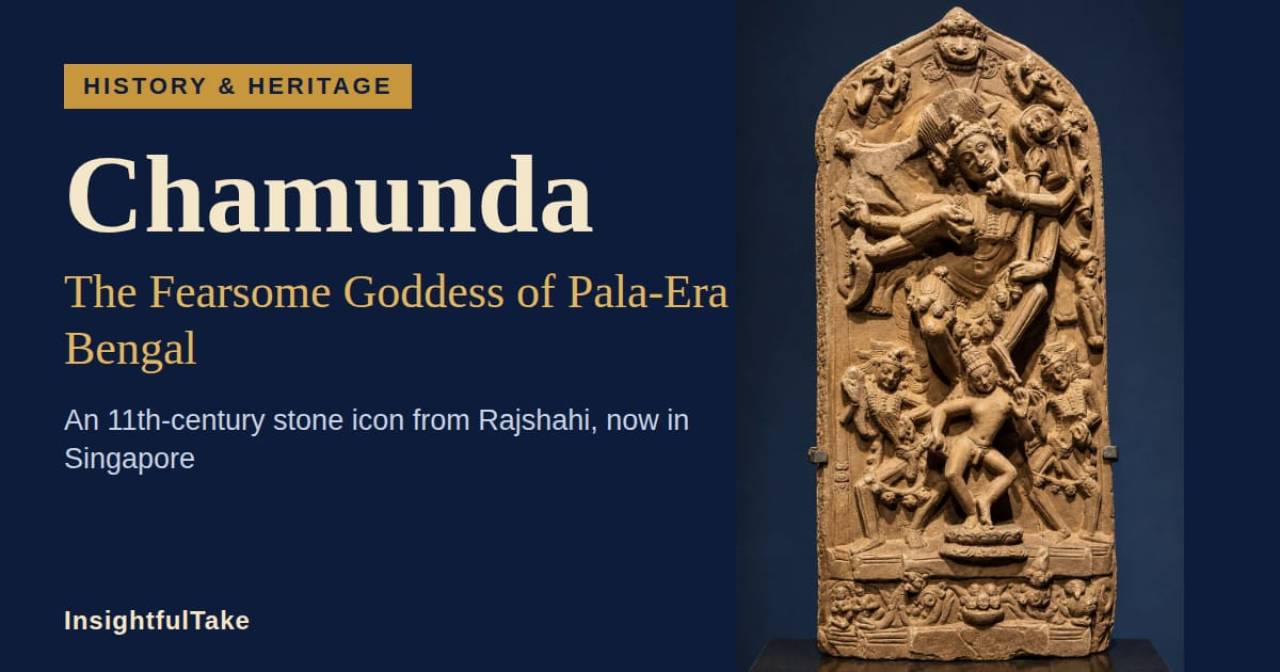
A sandstone-coloured stone slab, about two feet high, stands in a museum gallery in Singapore. Carved into it is a gaunt goddess with a third eye and multiple arms, dancing above a small figure on a lotus. The sculpture depicts Chamunda, a fierce form of the Hindu Goddess, associated with destruction, death and the power to overcome evil.
Singapore’s national collections record a Chamunda stele dating to around the 11th century, traced to the Rajshahi region of present-day Bangladesh, formerly associated with the name Bogra district in the museum’s description. The ten-armed goddess carries weapons associated with both Durga and Shiva. Beneath her are a young male figure and two skeletal attendants.
The sculpture offers a glimpse into the religious imagination and artistic achievements of medieval Bengal, where Hindu and Buddhist traditions flourished alongside one another. It also raises questions about how sacred images travelled across regions and eventually entered museum collections.
The Goddess Born from Rage
Chamunda’s story appears in the Devi Mahatmya, a Sanskrit text celebrating the supreme power of the Goddess. According to the narrative, the demons Chanda and Munda attack the forces of Durga. In response, a dark and terrifying form emerges from the goddess’s forehead and destroys the two demons. Chamunda derives her name from this victory.
Over time, she became associated with the Saptamatrika, or Seven Divine Mothers, and her worship spread across different parts of the Indian subcontinent.
Her artistic representation is deliberately unsettling. Unlike the graceful and richly adorned forms often associated with Hindu goddesses, Chamunda is frequently depicted with an emaciated body, exposed bones, sunken features and a garland of skulls. Her third eye reinforces her divine power, while her weapons signal her ability to destroy forces that threaten the cosmic order.
The Singapore sculpture follows this tradition. Its skeletal appearance and fierce expression convey a deity who stands beyond conventional ideas of beauty and gentleness. Chamunda is associated with death, disease, cremation grounds and the destruction of evil. Her frightening appearance is not simply intended to inspire fear. It expresses her command over forces that human beings often struggle to understand or control.
Why Bengal?
The sculpture belongs to the artistic world of Varendra, a historical region of northern Bengal that became an important centre of sculpture under the Pala dynasty.
The Palas ruled much of eastern India from around the 8th to the 12th centuries. They are widely remembered for their patronage of Buddhism, particularly the great monastic institutions that attracted scholars and religious practitioners from across Asia. Pala artistic traditions travelled far beyond the region, influencing sculpture and religious art in places including Nepal, Tibet and Southeast Asia.
Yet Pala-period art was not limited to Buddhist subjects. Hindu deities associated with Shaiva, Vaishnava and Shakta traditions also occupied an important place in the artistic record. Workshops produced images for different religious communities, drawing on shared materials, techniques and visual conventions.
Chamunda belongs to this wider cultural landscape. Her presence demonstrates how Hindu religious imagery developed within a region celebrated for its Buddhist institutions. The artistic traditions of medieval Bengal were diverse, and their surviving sculptures reveal a complex interaction between religious belief, royal patronage and regional craftsmanship.
The Rajshahi region of present-day Bangladesh continues to preserve this heritage. The Varendra Research Museum in Rajshahi houses a collection of Pala-Sena sculptures, including representations of Chamunda. Such works offer useful comparisons for understanding the composition, iconography and carving techniques found in medieval Bengali art.
Reading the Carving
The sculpture rewards close attention to its details. Chamunda occupies the centre of the slab, her body caught in a dynamic pose. One leg is raised, her hair sweeps backwards, and her multiple arms spread across the upper portion of the composition.
Smaller celestial figures appear around her, while a lion-like face at the top crowns the arrangement. Beneath the goddess, two skeletal male attendants flank the central figure. The smaller figure under her feet completes the scene and reinforces the impression of movement and dominance.
The composition is carefully organised. The central goddess commands attention, while the surrounding figures guide the viewer’s eye from the top of the stele to its base. The arched framework, elaborate ornamentation and layered arrangement of figures are characteristic features found in many sculptures associated with the Pala-Sena artistic tradition.
Despite the wear accumulated over centuries, the carving retains a striking sense of movement. The sculptor has transformed a rigid stone surface into a scene filled with energy, tension and supernatural power.
The contrast between Chamunda’s central position and the skeletal bodies around her is particularly significant. Death is not hidden or softened. Instead, it becomes part of the visual language through which the goddess’s power is expressed.
From Bengal to Singapore
The presence of a medieval Bengali sculpture in Singapore invites a wider look at the historical connections between South and Southeast Asia.
During the 19th century, Singapore was administered as part of the Straits Settlements under British colonial rule, while Calcutta served as the capital of British India for much of that period. The two cities were connected through trade, migration and colonial administration, although these connections alone do not explain how this particular sculpture reached Singapore.
A more direct cultural link emerged in 2015, when Singapore’s Asian Civilisations Museum collaborated with the Indian Museum in Kolkata on an exhibition exploring India’s cultural influence across Asia. The presentation included material from the Pala period, highlighting the importance of eastern India in the development and movement of religious art.
Such institutional collaborations help audiences understand the historical relationships between regions. However, the broader connection between Bengal and Singapore should not be confused with the individual history of the Chamunda stele.
The exact circumstances in which the sculpture left its place of origin remain a separate question. Establishing whether it was removed from a temple, acquired through the art market or transferred through another route requires examination of the museum’s acquisition documents and provenance records. Without that evidence, its journey cannot be reconstructed with certainty.
Why Chamunda Still Matters
Chamunda continues to be worshipped in different parts of India, with traditions and shrines associated with her found across several regions. Her image remains an important part of Shakta worship, in which the Goddess is understood as a supreme source of power.
In a museum, the sculpture serves another purpose. It is evidence of the artistic and religious life of medieval Bengal, preserving ideas about divine power, mortality and protection in a form that has survived for nearly a thousand years.
Its significance also lies in what it reveals about the Pala-era artistic world. The same broad cultural environment that supported influential Buddhist institutions also produced powerful Hindu images. The sculpture challenges any simplistic division of medieval Bengal into separate religious or artistic worlds.
Chamunda’s fearsome appearance carries a deeper message. In her iconography, destruction and protection are not necessarily opposites. The power to confront death, defeat evil and overcome terrifying forces can itself become a source of divine reassurance.
Today, behind the glass of a Singapore museum, the goddess remains a compelling link to Bengal’s past. Her gaunt body, raised leg and outstretched arms preserve the vision of an artist who understood that divine power did not always need to appear beautiful or gentle.
Sometimes, it was meant to be feared. And sometimes, that very fear was the source of its promise of protection.
















Leave a Comment