
Are your life choices truly your own, or have family, society and social media quietly made them for you?
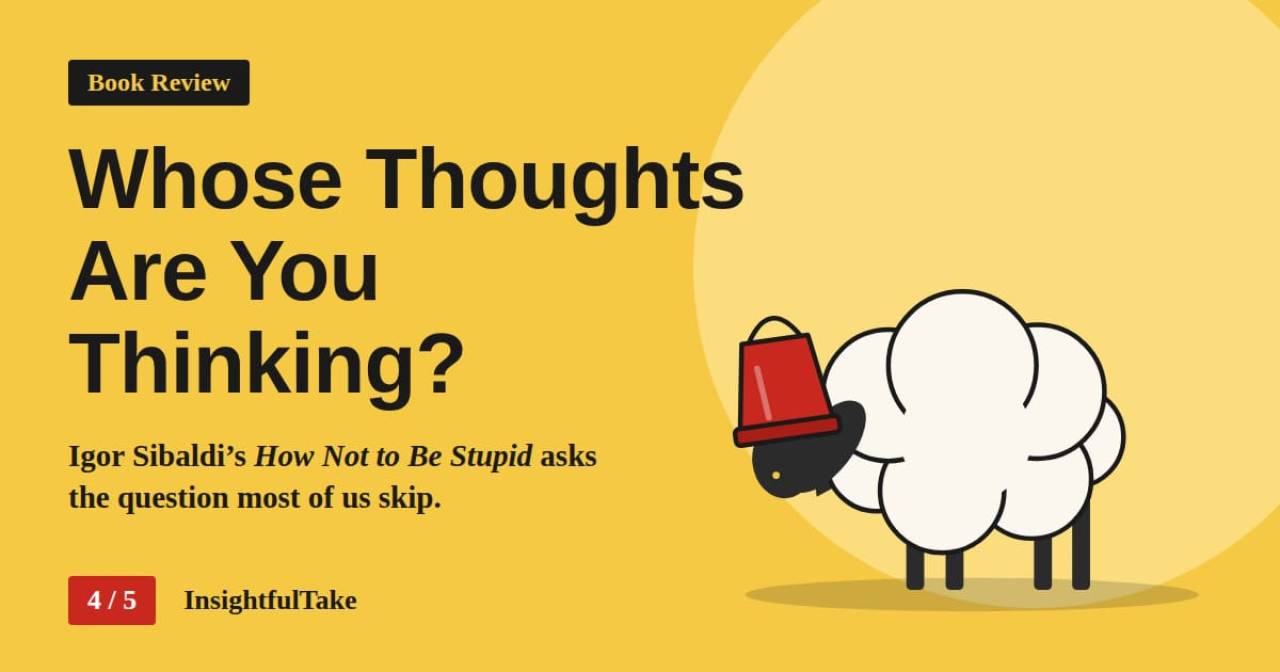
Most people judge a book by its cover and sometimes regret it. This one is different because its cover tells you much of what you need to know. A sheep stands in a field with a bucket stuck on its head. It cannot see where it is going, but it keeps walking anyway.
That sheep is the point of Igor Sibaldi's How Not to Be Stupid: The Transformative Power of Independent Thinking.
What the Book Is About
The title sounds like an insult, but Sibaldi does not treat stupidity as a lack of intelligence. Clever people can be stupid in the way he means. For him, stupidity is letting other people do your thinking. It is believing things because everyone around you believes them and following familiar paths simply because they are expected of you.
The subtitle, The Transformative Power of Independent Thinking, points towards the alternative. Sibaldi wants readers to stop, look around and make their own decisions rather than accept ideas without examining them.
The argument is simple, but its implications can be uncomfortable. Intelligence alone does not guarantee independent thought. A person may be well educated, professionally successful and socially respected while still living by beliefs they have never questioned.
The Problem of Borrowed Beliefs
Think about how many of your choices you have genuinely made for yourself. Your career, your idea of success, when to marry, what to buy and what to fear. Many of these ideas may have come from parents, teachers, relatives and, more recently, social media.
Nobody necessarily forced these beliefs on you. They arrived early, became familiar and settled into your thinking before you had the chance to examine them.
This matters in a country like India, where family and society often have a strong influence on personal decisions. Advice usually comes from people who care about us, which makes questioning it difficult. Parents want their children to be secure. Relatives have opinions about careers and marriage. Society has its own definition of a respectable life.
Yet good intentions do not always lead to the right decisions for an individual.
A person can reach the age of 35 and realise that much of their life has been planned by committee. They have followed the expected path without asking whether it suits their abilities, ambitions or happiness.
Sibaldi's approach encourages readers to ask a difficult but useful question: Whose idea was this in the first place?
A Different Way to Think About Success
Most self-help books encourage readers to work harder, remain disciplined and keep moving towards their goals. Sibaldi's argument asks us to pause before doing any of that.
Consider a person climbing a ladder. Effort and determination help them move upwards. But if the ladder is leaning against the wrong wall, hard work will only take them further away from where they want to be.
The point is not to dismiss ambition or discipline. It is to examine the assumptions behind our ambitions before investing years in them.
Are we pursuing a career because it interests us or because it earns social approval? Do we want something because it matters to us or because people around us consider it desirable? Have we chosen our goals, or have we simply inherited them?
These questions can change how we understand success. They shift the focus from achieving what others admire to deciding what is genuinely worth achieving.
The Sheep in the Age of Social Media
The book's central argument feels particularly relevant in an age of endless opinions. We scroll through hundreds of views every day, from political debates and viral trends to lifestyle advice and confident declarations from strangers.
It can feel as though we are constantly thinking. Often, however, we are simply choosing which crowd to join.
A popular opinion can seem convincing because thousands of people share it. A repeated claim can begin to sound like a fact. A forceful argument can win our attention without earning our agreement through evidence.
Sibaldi's message offers a useful distinction: agreeing with a loud group is not the same as thinking independently.
The sheep today may not be following a shepherd. It may be following a social media feed.
This does not mean that every popular opinion is wrong or that independent thinkers must disagree with the majority. It means that agreement should follow examination, not replace it. We need to consider evidence, recognise our biases and remain willing to change our minds.
What Works in the Book
The book's greatest strength is the clarity of its central message. Readers do not need a background in philosophy to understand why independent thinking matters. The sheep with the bucket provides an image that is easy to remember and difficult to ignore.
Its appeal also extends across generations. A student choosing a degree, a young professional considering a career change and a parent deciding how to raise a child may all find reasons to question their assumptions.
The direct tone is another strength. Rather than simply flattering readers or promising an easy route to personal transformation, the book presents independent thinking as a skill that requires effort.
That is an important distinction. Thinking for yourself is not a declaration of independence that can be made once and forgotten. It requires regular attention to the ideas we accept, the people we trust and the reasons behind our decisions.
Where the Book Could Do Better
Some readers may want more practical guidance. The book is stronger at encouraging questions than at providing a step-by-step method for answering them. Those who prefer exercises, checklists or structured techniques may feel that the difficult work has been left to them.
Some ideas also recur throughout the discussion. Repetition can reinforce the central message, but it may slow the pace for readers who have already understood the argument.
There is another point worth considering. The instruction to think independently can easily become an excuse to reject everything other people say. That would be another form of unthinking behaviour.
Advice from experienced people is not automatically a trap. Tradition is not necessarily wrong, and disagreement does not automatically make someone original. Independent thinking requires judgement, not reflexive opposition.
The real objective is to understand why we believe what we believe, examine the reasons supporting those beliefs and decide whether they deserve to remain part of our lives.
Who Should Read It?
How Not to Be Stupid is particularly relevant to people approaching a turning point in life. Students choosing a field of study, professionals reconsidering their careers and individuals questioning familiar expectations may find its central argument useful.
It may also appeal to readers who feel that life has become a series of obligations without a clear understanding of why they accepted them.
The book does not promise to resolve every personal dilemma. Its value lies in encouraging readers to examine the assumptions that shape their choices before making their next move.
Final Take
How Not to Be Stupid does not hand readers a ready-made set of answers. It is the part of its strength. Instead, it offers a question worth asking about the decisions that shape our lives: Is this my own thought, or did I simply pick it up along the way?
The question may challenge beliefs inherited from family, habits reinforced by society and opinions absorbed from the digital world. It may also reveal that some of the ideas we have accepted are sound and deserve to stay.
The point is not to reject everything we have been taught. It is to make our choices consciously rather than allow familiarity, pressure or popularity to make them for us.
If the book encourages readers to reconsider even three or four important decisions, it will have served a purpose.
Sometimes, the first step towards a more independent life is simply to take the bucket off your head.
And discover that the field looks different from out there.
Most people judge a book by its cover and sometimes regret it. This one is different because its cover tells you much of what you need to know. A sheep stands in a field with a bucket stuck on its head. It cannot see where it is going, but it keeps walking anyway.
That sheep is the point of Igor Sibaldi's How Not to Be Stupid: The Transformative Power of Independent Thinking.
What the Book Is About
The title sounds like an insult, but Sibaldi does not treat stupidity as a lack of intelligence. Clever people can be stupid in the way he means. For him, stupidity is letting other people do your thinking. It is believing things because everyone around you believes them and following familiar paths simply because they are expected of you.
The subtitle, The Transformative Power of Independent Thinking, points towards the alternative. Sibaldi wants readers to stop, look around and make their own decisions rather than accept ideas without examining them.
The argument is simple, but its implications can be uncomfortable. Intelligence alone does not guarantee independent thought. A person may be well educated, professionally successful and socially respected while still living by beliefs they have never questioned.
The Problem of Borrowed Beliefs
Think about how many of your choices you have genuinely made for yourself. Your career, your idea of success, when to marry, what to buy and what to fear. Many of these ideas may have come from parents, teachers, relatives and, more recently, social media.
Nobody necessarily forced these beliefs on you. They arrived early, became familiar and settled into your thinking before you had the chance to examine them.
This matters in a country like India, where family and society often have a strong influence on personal decisions. Advice usually comes from people who care about us, which makes questioning it difficult. Parents want their children to be secure. Relatives have opinions about careers and marriage. Society has its own definition of a respectable life.
Yet good intentions do not always lead to the right decisions for an individual.
A person can reach the age of 35 and realise that much of their life has been planned by committee. They have followed the expected path without asking whether it suits their abilities, ambitions or happiness.
Sibaldi's approach encourages readers to ask a difficult but useful question: Whose idea was this in the first place?
A Different Way to Think About Success
Most self-help books encourage readers to work harder, remain disciplined and keep moving towards their goals. Sibaldi's argument asks us to pause before doing any of that.
Consider a person climbing a ladder. Effort and determination help them move upwards. But if the ladder is leaning against the wrong wall, hard work will only take them further away from where they want to be.
The point is not to dismiss ambition or discipline. It is to examine the assumptions behind our ambitions before investing years in them.
Are we pursuing a career because it interests us or because it earns social approval? Do we want something because it matters to us or because people around us consider it desirable? Have we chosen our goals, or have we simply inherited them?
These questions can change how we understand success. They shift the focus from achieving what others admire to deciding what is genuinely worth achieving.
The Sheep in the Age of Social Media
The book's central argument feels particularly relevant in an age of endless opinions. We scroll through hundreds of views every day, from political debates and viral trends to lifestyle advice and confident declarations from strangers.
It can feel as though we are constantly thinking. Often, however, we are simply choosing which crowd to join.
A popular opinion can seem convincing because thousands of people share it. A repeated claim can begin to sound like a fact. A forceful argument can win our attention without earning our agreement through evidence.
Sibaldi's message offers a useful distinction: agreeing with a loud group is not the same as thinking independently.
The sheep today may not be following a shepherd. It may be following a social media feed.
This does not mean that every popular opinion is wrong or that independent thinkers must disagree with the majority. It means that agreement should follow examination, not replace it. We need to consider evidence, recognise our biases and remain willing to change our minds.
What Works in the Book
The book's greatest strength is the clarity of its central message. Readers do not need a background in philosophy to understand why independent thinking matters. The sheep with the bucket provides an image that is easy to remember and difficult to ignore.
Its appeal also extends across generations. A student choosing a degree, a young professional considering a career change and a parent deciding how to raise a child may all find reasons to question their assumptions.
The direct tone is another strength. Rather than simply flattering readers or promising an easy route to personal transformation, the book presents independent thinking as a skill that requires effort.
That is an important distinction. Thinking for yourself is not a declaration of independence that can be made once and forgotten. It requires regular attention to the ideas we accept, the people we trust and the reasons behind our decisions.
Where the Book Could Do Better
Some readers may want more practical guidance. The book is stronger at encouraging questions than at providing a step-by-step method for answering them. Those who prefer exercises, checklists or structured techniques may feel that the difficult work has been left to them.
Some ideas also recur throughout the discussion. Repetition can reinforce the central message, but it may slow the pace for readers who have already understood the argument.
There is another point worth considering. The instruction to think independently can easily become an excuse to reject everything other people say. That would be another form of unthinking behaviour.
Advice from experienced people is not automatically a trap. Tradition is not necessarily wrong, and disagreement does not automatically make someone original. Independent thinking requires judgement, not reflexive opposition.
The real objective is to understand why we believe what we believe, examine the reasons supporting those beliefs and decide whether they deserve to remain part of our lives.
Who Should Read It?
How Not to Be Stupid is particularly relevant to people approaching a turning point in life. Students choosing a field of study, professionals reconsidering their careers and individuals questioning familiar expectations may find its central argument useful.
It may also appeal to readers who feel that life has become a series of obligations without a clear understanding of why they accepted them.
The book does not promise to resolve every personal dilemma. Its value lies in encouraging readers to examine the assumptions that shape their choices before making their next move.
Final Take
How Not to Be Stupid does not hand readers a ready-made set of answers. It is the part of its strength. Instead, it offers a question worth asking about the decisions that shape our lives: Is this my own thought, or did I simply pick it up along the way?
The question may challenge beliefs inherited from family, habits reinforced by society and opinions absorbed from the digital world. It may also reveal that some of the ideas we have accepted are sound and deserve to stay.
The point is not to reject everything we have been taught. It is to make our choices consciously rather than allow familiarity, pressure or popularity to make them for us.
If the book encourages readers to reconsider even three or four important decisions, it will have served a purpose.
Sometimes, the first step towards a more independent life is simply to take the bucket off your head.
And discover that the field looks different from out there.








Leave a Comment