
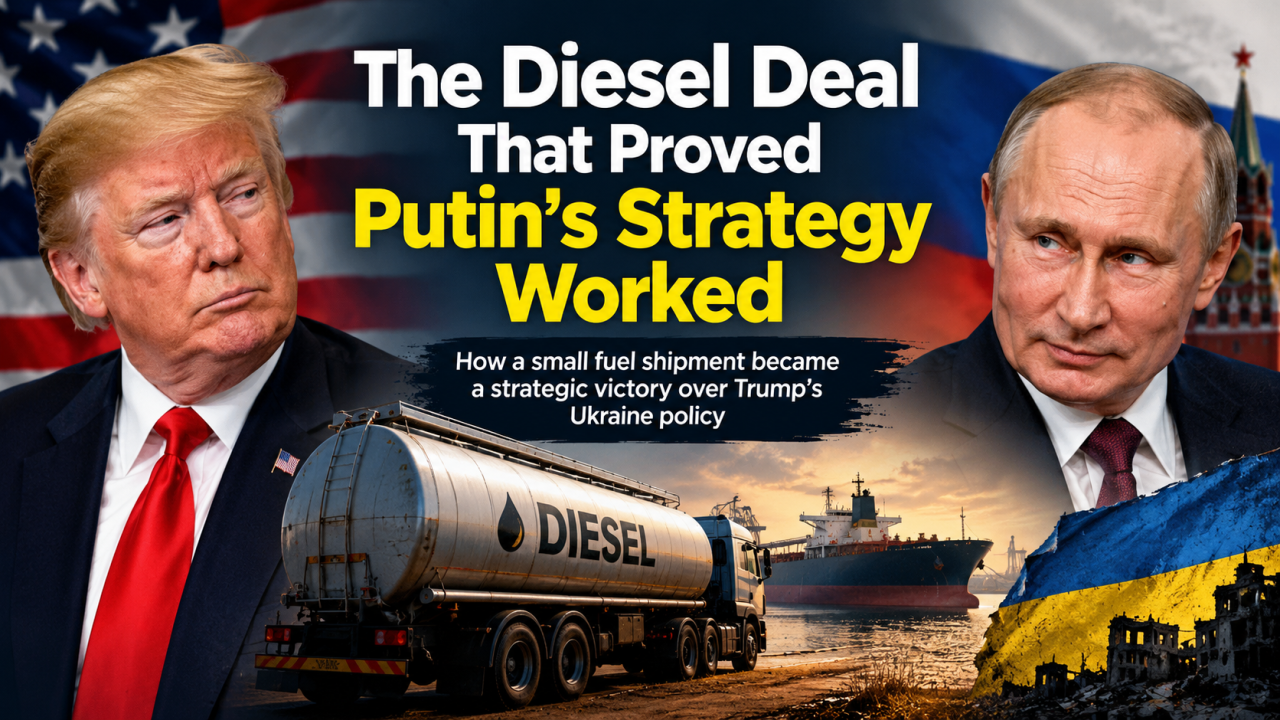
How a small fuel shipment became a strategic victory over Trump’s Ukraine policy.
In October 2026, the United States did something that would once have seemed unthinkable: it became a customer for Russian oil. President Donald Trump announced a deal with Vladimir Putin for Russia to supply hundreds of thousands of tonnes of diesel to the United States and global markets. The stated reason was straightforward. American diesel prices had surged past $6 a gallon amid the Trump administration’s war with Iran, putting pressure on farmers and truckers just weeks before the midterm elections.
But the deeper story is not about fuel prices. It is about how Putin, through patience and a calculated reading of his American counterpart, achieved what sanctions and battlefield stalemate could not: weakening Western unity, sidelining Ukraine in negotiations over its future, and securing a direct place at the table with Washington.
A Small Deal With an Outsized Signal
The volumes involved were remarkably small. The initial 300,000 tonnes would cover roughly half a day of US diesel consumption. Even the full promised deliveries would amount to only a few days’ supply. Energy analysts were nearly unanimous that the deal would not significantly affect prices.
The symbolism, however, was enormous.
Just weeks earlier, the United States had passed the Lindsey O. Graham Sanctioning Russia and Iran Act, a sweeping measure empowering the president to impose tariffs of up to 100% on countries buying Russian oil. Trump had signed the legislation with considerable fanfare. Yet Washington was now preparing to buy the very product its policy had sought to restrict.
CNN described the agreement as a wedge driven into the heart of the Western alliance. India, which had faced threats of secondary sanctions for purchasing Russian crude, called the move blatant hypocrisy.
The deal also triggered resistance within Trump's own party. Four Republican senators joined three Democrats in a joint statement demanding that the agreement be reversed. They pointed to the congressional prohibition on Russian energy imports introduced in 2022.
“The United States should not provide Putin with a financial lifeline while Russia continues to kill Ukrainian civilians,” they argued.
The contradiction was difficult to ignore. Washington had spent years urging other countries to reduce their dependence on Russian energy. Now, faced with domestic economic pressure, the administration appeared willing to make an exception for itself.
The Real Prize: A Peace Plan on Putin’s Terms
The diesel agreement was not an isolated transaction. Days later, The Washington Post reported details of a four-part US peace plan for Ukraine. The proposal would effectively freeze the front lines, give Russia a share of revenues from a new energy pipeline to Europe, and ease sanctions.
According to a US official, the proposal's message to Putin was: “Don’t just end the war with Ukraine. Make an economic and security deal with Europe.”
Ukraine would receive reconstruction funding organised by BlackRock and the World Bank, alongside security guarantees modelled on NATO's Article 5. Russia, meanwhile, would benefit from territorial concessions involving occupied areas and the prospect of renewed access to European energy markets.
The reported conditions also included a demand that Ukraine stop striking Russian oil refineries. Trump had already been pressuring Ukrainian President Volodymyr Zelenskyy on the issue, reportedly telling him that Ukraine could act as it wished but could not target diesel fuel infrastructure.
When Zelenskyy refused to accept the restriction, Trump announced the diesel deal anyway.
The sequence points to the central calculation behind Putin's strategy. He did not necessarily need a decisive battlefield victory. He needed to make the political and economic costs of continuing to support Ukraine appear greater than the costs of reaching an agreement with Moscow.
By exploiting Trump's search for a pre-election economic win and his desire to present himself as a master negotiator, Putin appeared to be transforming Russia's position from international pariah to negotiating partner without surrendering its territorial gains.
The Mask Comes Off
For years, Trump's defenders argued that his warm rhetoric towards Putin did not necessarily translate into a fundamental shift in American policy. The diesel agreement challenged that argument.
As ABC's foreign affairs analysts observed, the mask was off regarding Trump's apparent willingness to side with Russia.
The consequences for Ukraine extended beyond energy policy. Trump publicly called for Zelenskyy's replacement, declaring that it was time for Ukraine to get a new president and suggesting that Kyiv needed a leader capable of making a deal.
He also blamed Ukraine, rather than Russia, for the conflict and for the global fuel crisis that had followed his administration's war with Iran.
Meanwhile, reports emerged that Washington had threatened to cut intelligence sharing and weapons sales to Ukraine if Kyiv refused to comply with American demands.
The resulting imbalance was stark. Russia could potentially gain economic benefits and territorial recognition, while Ukraine faced pressure from the very country that had pledged to support its defence.
If these reported proposals and threats accurately reflected Washington's position, the message to Moscow was unmistakable: American support for Ukraine could become conditional on Kyiv accepting terms that favoured Russia.
Putin’s Long Game
The diesel deal represented the culmination of a strategy Putin had pursued since Trump's return to the White House: flatter the American president, promise a major diplomatic breakthrough, and allow him to weaken his own alliances in pursuit of a political victory.
Trump's former national security adviser John Bolton put the political calculation bluntly: “This is not about Ukraine and Russia. This is about the American election.”
Putin had reasons to believe that Trump's domestic priorities could create opportunities for Moscow. A fuel-price crisis offered the American president a reason to justify an otherwise contradictory energy deal. The promise of a negotiated settlement offered him a chance to claim credit for ending a war. And Trump's ambition to be recognised as a peacemaker made a high-profile agreement politically attractive, even if its terms risked rewarding aggression.
The strategy did not require Putin to persuade Washington that Russia's actions were justified. It required him to persuade Trump that doing business with Moscow was more advantageous than continuing to confront it.
That distinction matters. A diplomatic agreement can be presented as a victory even when its underlying terms favour one side far more than the other.
The Strategic Cost of the Diesel Deal
The diesel shipment may be measured in tonnes. Its potential strategic consequences are measured on a much larger scale.
The first is the credibility of American commitments. If Washington pressures an invaded country to accept territorial concessions while offering economic relief to the aggressor, future allies may question how reliably the United States will stand by them when the political costs rise.
The second is the cohesion of the Western alliance. A policy that demands sacrifices from partners while making exceptions for American economic needs risks undermining the collective pressure that sanctions were designed to create.
The third is Ukraine's future. Any settlement that freezes the conflict or recognises territorial gains made through force could leave Kyiv facing a lasting security threat, even if the agreement is presented as a peace breakthrough.
The full consequences would depend on the final terms, their implementation, and the responses of Ukraine and America's European allies. But the political signal was already significant: a small energy transaction could become a vehicle for a much larger strategic realignment.
Putin did not need the diesel deal to transform Russia's economic fortunes overnight. Its value lay in what it suggested about Washington's priorities and the limits of its willingness to sustain pressure on Moscow.
In October 2026, the United States did something that would once have seemed unthinkable: it became a customer for Russian oil. President Donald Trump announced a deal with Vladimir Putin for Russia to supply hundreds of thousands of tonnes of diesel to the United States and global markets. The stated reason was straightforward. American diesel prices had surged past $6 a gallon amid the Trump administration’s war with Iran, putting pressure on farmers and truckers just weeks before the midterm elections.
But the deeper story is not about fuel prices. It is about how Putin, through patience and a calculated reading of his American counterpart, achieved what sanctions and battlefield stalemate could not: weakening Western unity, sidelining Ukraine in negotiations over its future, and securing a direct place at the table with Washington.
A Small Deal With an Outsized Signal
The volumes involved were remarkably small. The initial 300,000 tonnes would cover roughly half a day of US diesel consumption. Even the full promised deliveries would amount to only a few days’ supply. Energy analysts were nearly unanimous that the deal would not significantly affect prices.
The symbolism, however, was enormous.
Just weeks earlier, the United States had passed the Lindsey O. Graham Sanctioning Russia and Iran Act, a sweeping measure empowering the president to impose tariffs of up to 100% on countries buying Russian oil. Trump had signed the legislation with considerable fanfare. Yet Washington was now preparing to buy the very product its policy had sought to restrict.
CNN described the agreement as a wedge driven into the heart of the Western alliance. India, which had faced threats of secondary sanctions for purchasing Russian crude, called the move blatant hypocrisy.
The deal also triggered resistance within Trump's own party. Four Republican senators joined three Democrats in a joint statement demanding that the agreement be reversed. They pointed to the congressional prohibition on Russian energy imports introduced in 2022.
“The United States should not provide Putin with a financial lifeline while Russia continues to kill Ukrainian civilians,” they argued.
The contradiction was difficult to ignore. Washington had spent years urging other countries to reduce their dependence on Russian energy. Now, faced with domestic economic pressure, the administration appeared willing to make an exception for itself.
The Real Prize: A Peace Plan on Putin’s Terms
The diesel agreement was not an isolated transaction. Days later, The Washington Post reported details of a four-part US peace plan for Ukraine. The proposal would effectively freeze the front lines, give Russia a share of revenues from a new energy pipeline to Europe, and ease sanctions.
According to a US official, the proposal's message to Putin was: “Don’t just end the war with Ukraine. Make an economic and security deal with Europe.”
Ukraine would receive reconstruction funding organised by BlackRock and the World Bank, alongside security guarantees modelled on NATO's Article 5. Russia, meanwhile, would benefit from territorial concessions involving occupied areas and the prospect of renewed access to European energy markets.
The reported conditions also included a demand that Ukraine stop striking Russian oil refineries. Trump had already been pressuring Ukrainian President Volodymyr Zelenskyy on the issue, reportedly telling him that Ukraine could act as it wished but could not target diesel fuel infrastructure.
When Zelenskyy refused to accept the restriction, Trump announced the diesel deal anyway.
The sequence points to the central calculation behind Putin's strategy. He did not necessarily need a decisive battlefield victory. He needed to make the political and economic costs of continuing to support Ukraine appear greater than the costs of reaching an agreement with Moscow.
By exploiting Trump's search for a pre-election economic win and his desire to present himself as a master negotiator, Putin appeared to be transforming Russia's position from international pariah to negotiating partner without surrendering its territorial gains.
The Mask Comes Off
For years, Trump's defenders argued that his warm rhetoric towards Putin did not necessarily translate into a fundamental shift in American policy. The diesel agreement challenged that argument.
As ABC's foreign affairs analysts observed, the mask was off regarding Trump's apparent willingness to side with Russia.
The consequences for Ukraine extended beyond energy policy. Trump publicly called for Zelenskyy's replacement, declaring that it was time for Ukraine to get a new president and suggesting that Kyiv needed a leader capable of making a deal.
He also blamed Ukraine, rather than Russia, for the conflict and for the global fuel crisis that had followed his administration's war with Iran.
Meanwhile, reports emerged that Washington had threatened to cut intelligence sharing and weapons sales to Ukraine if Kyiv refused to comply with American demands.
The resulting imbalance was stark. Russia could potentially gain economic benefits and territorial recognition, while Ukraine faced pressure from the very country that had pledged to support its defence.
If these reported proposals and threats accurately reflected Washington's position, the message to Moscow was unmistakable: American support for Ukraine could become conditional on Kyiv accepting terms that favoured Russia.
Putin’s Long Game
The diesel deal represented the culmination of a strategy Putin had pursued since Trump's return to the White House: flatter the American president, promise a major diplomatic breakthrough, and allow him to weaken his own alliances in pursuit of a political victory.
Trump's former national security adviser John Bolton put the political calculation bluntly: “This is not about Ukraine and Russia. This is about the American election.”
Putin had reasons to believe that Trump's domestic priorities could create opportunities for Moscow. A fuel-price crisis offered the American president a reason to justify an otherwise contradictory energy deal. The promise of a negotiated settlement offered him a chance to claim credit for ending a war. And Trump's ambition to be recognised as a peacemaker made a high-profile agreement politically attractive, even if its terms risked rewarding aggression.
The strategy did not require Putin to persuade Washington that Russia's actions were justified. It required him to persuade Trump that doing business with Moscow was more advantageous than continuing to confront it.
That distinction matters. A diplomatic agreement can be presented as a victory even when its underlying terms favour one side far more than the other.
The Strategic Cost of the Diesel Deal
The diesel shipment may be measured in tonnes. Its potential strategic consequences are measured on a much larger scale.
The first is the credibility of American commitments. If Washington pressures an invaded country to accept territorial concessions while offering economic relief to the aggressor, future allies may question how reliably the United States will stand by them when the political costs rise.
The second is the cohesion of the Western alliance. A policy that demands sacrifices from partners while making exceptions for American economic needs risks undermining the collective pressure that sanctions were designed to create.
The third is Ukraine's future. Any settlement that freezes the conflict or recognises territorial gains made through force could leave Kyiv facing a lasting security threat, even if the agreement is presented as a peace breakthrough.
The full consequences would depend on the final terms, their implementation, and the responses of Ukraine and America's European allies. But the political signal was already significant: a small energy transaction could become a vehicle for a much larger strategic realignment.
Putin did not need the diesel deal to transform Russia's economic fortunes overnight. Its value lay in what it suggested about Washington's priorities and the limits of its willingness to sustain pressure on Moscow.

















Leave a Comment