
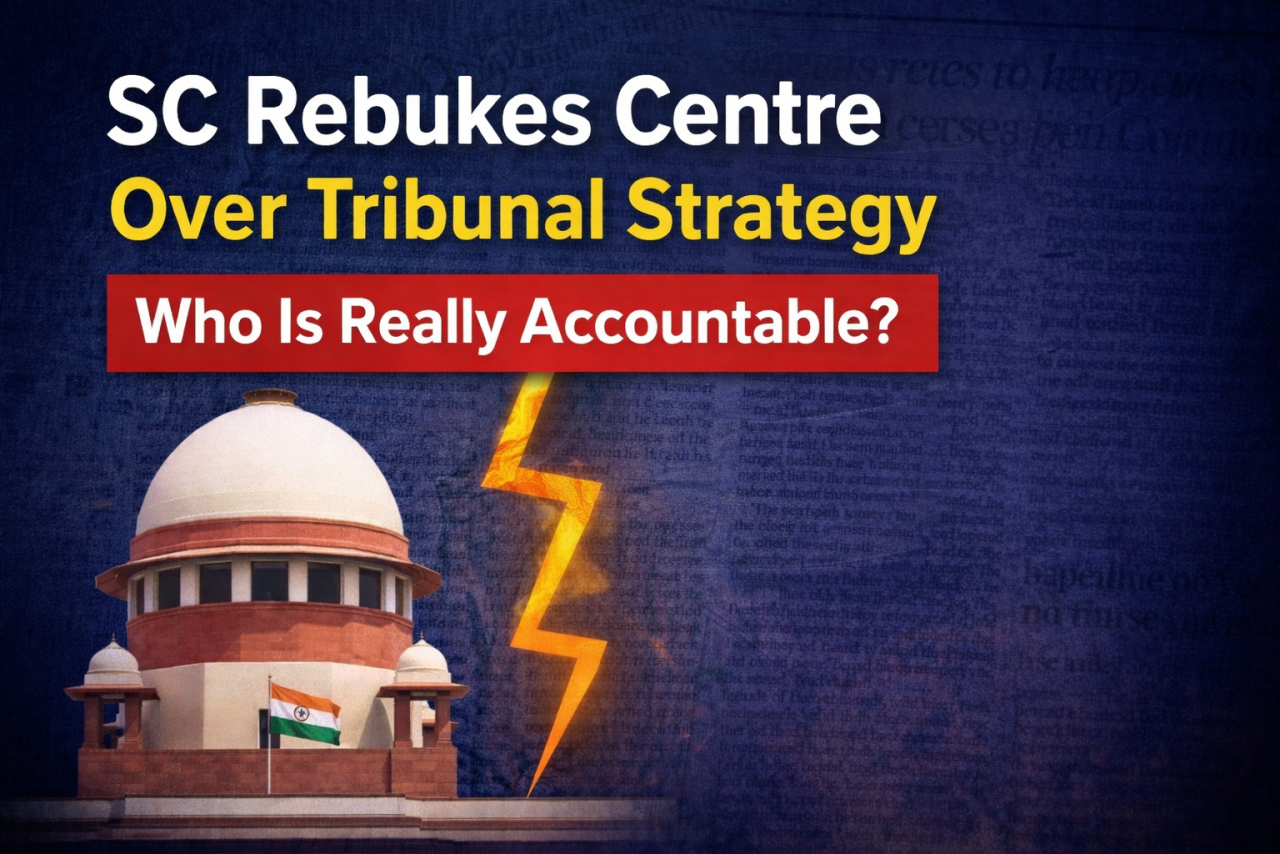
If tribunals are the Centre’s creation, why is the judiciary left cleaning up the fallout?
The Supreme Court’s recent observations on tribunals have done more than criticise administrative lapses — they have exposed a deeper institutional fault line between the judiciary and the Union government. What was introduced as a reform to ease the burden on High Courts is now being questioned as a structural experiment that has complicated the justice delivery system and, in the Court’s words, created a “mess.”
Tribunals were originally conceived as specialised adjudicatory bodies to handle disputes in areas like taxation, service matters, corporate regulation and environmental law. The stated goal was efficiency and to divert technical cases away from High Courts so that constitutional courts could focus on core judicial work. On paper, it sounded like rational reform.
But the Supreme Court’s sharp remarks suggest that the implementation tells a different story.
The Court openly stated that tribunals are the Centre’s creation and have become its “headache,” while turning into a “liability” for the judiciary because of the kinds of orders they pass. This observation is significant. It signals that although tribunals function under a legislative and executive framework, their shortcomings eventually land before constitutional courts — which must review, correct and sometimes overhaul their decisions.
In effect, the burden that was meant to be reduced is returning in amplified form.
A key concern repeatedly raised by the Court relates to judicial independence. In earlier rulings, including the Madras Bar Association cases, provisions dealing with tenure, appointment mechanisms and eligibility criteria were struck down for undermining independence. The judiciary made it clear that adjudicatory bodies performing judicial functions cannot be structured in a way that gives excessive control to the executive.
Yet similar provisions resurfaced in subsequent legislation. The perception that invalidated clauses were “repackaged” has deepened the impression that constitutional boundaries are being tested rather than respected. When Parliament re-enacts frameworks that echo previously struck-down provisions, it creates an impression of institutional pushback.
Beyond structure, the Court flagged operational dysfunction. It referred to instances where technical members allegedly did not write judgments, leaving judicial members to carry the responsibility. Remarks about work being effectively “outsourced” underscore concerns about accountability and seriousness in adjudication.
If tribunal orders lack clarity, reasoning or consistency, litigants naturally approach High Courts and the Supreme Court. This defeats the very purpose of creating specialised bodies. Instead of decongesting the system, tribunals risk generating additional layers of litigation.
This is where the larger accountability question emerges.
When tribunal decisions are overturned or criticised, public frustration is often directed broadly at “the courts.” Few citizens distinguish between executive-controlled tribunals and constitutional courts. As a result, systemic flaws in tribunal design can damage the credibility of the judiciary at large. The Supreme Court’s frustration appears rooted in this dynamic — that an executive-designed mechanism is creating reputational and administrative strain on constitutional courts.
The Court’s pointed remark — “what a mess you have created” — is not casual language. It reflects concern that the Centre’s anxiety to keep certain categories of cases away from High Courts may have overshadowed constitutional safeguards. If tribunals are designed primarily to divert jurisdiction rather than strengthen adjudication, the system becomes unstable.
There is also a broader separation-of-powers issue at play. Tribunals occupy a hybrid space between executive administration and judicial function. When appointment processes, tenure security and service conditions are influenced by the executive, questions about independence become unavoidable. Judicial functions require insulation from executive pressure, not proximity to it.
It is important to clarify that tribunals themselves are not inherently problematic. Many democracies rely on specialised adjudicatory bodies successfully. The issue lies in how they are structured and how faithfully constitutional principles are embedded into their design.
The Supreme Court’s interim steps — such as allowing members to continue until superannuation or until successors are appointed — appear to be stabilising measures. But they do not address the deeper structural tension between legislative intent and constitutional compliance.
Ultimately, the controversy is not about turf war. It is about responsibility. If tribunals are created, structured and administratively controlled by the executive, accountability for their failures cannot be deflected. When their dysfunction requires judicial correction, the judiciary should not be portrayed as obstructionist or blamed for delays.
The Supreme Court’s rebuke forces a difficult question into the open: who is really accountable when a parallel adjudicatory system falters? If the design originates with the Centre but the consequences fall on constitutional courts, the imbalance becomes evident.
This episode is a reminder that institutional reform must strengthen constitutional safeguards. Judicial independence cannot be diluted under the banner of efficiency. And responsibility for structural flaws cannot be shifted once the consequences begin to surface.
Whether the Centre recalibrates its tribunal strategy or continues to test constitutional limits will shape the next phase of this institutional tension. For now, reforms that undermine accountability ultimately return to the doorstep of the Constitution.

























Leave a Comment