
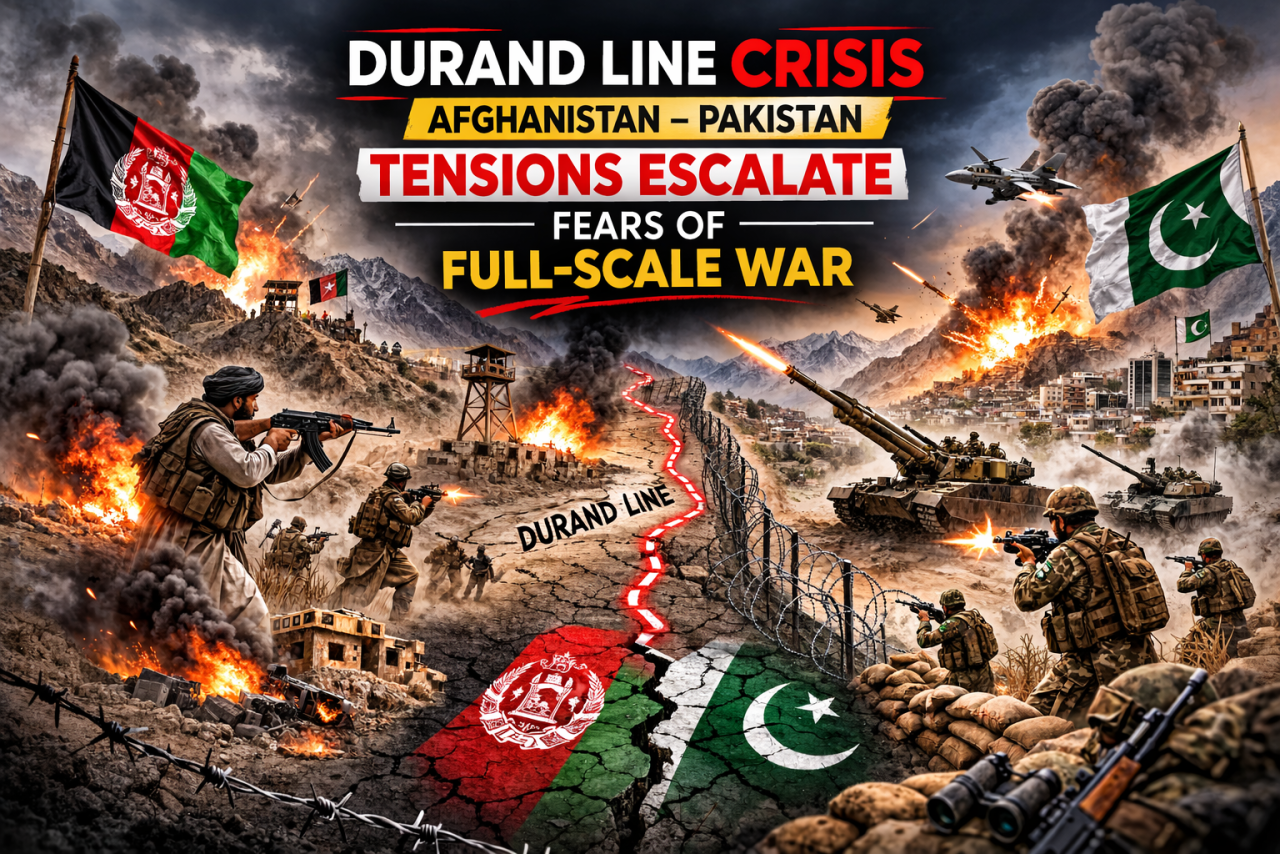
A disputed border, rising airstrikes, and “open war” rhetoric — the Durand Line is fast becoming South Asia’s most dangerous flashpoint.
The rugged mountains along the Durand Line have witnessed decades of tension, but the latest escalation between Afghanistan and Pakistan feels different — sharper, louder, and far more dangerous.
In recent days, cross-border strikes, artillery exchanges, and official statements hinting at “open war” have pushed the region into one of its most volatile moments in years. While both governments stop short of declaring full-scale war, military activity and political rhetoric suggest relations have entered a deeply unstable phase.
A Border That Was Never Settled
Drawn in 1893 during British rule, the Durand Line has long been disputed. Afghanistan has historically refused to formally recognize it as a permanent international border, arguing it divided Pashtun communities. Pakistan, however, considers it a settled and sovereign boundary.
This unresolved historical wound continues to shape modern geopolitics.
For years, Islamabad has accused Kabul of allowing anti-Pakistan militants to operate from Afghan soil — particularly the Tehreek-e-Taliban Pakistan (TTP), which has carried out deadly attacks inside Pakistan. Kabul has denied officially supporting such groups but has struggled to convincingly curb their presence.
After 2021: Hopes That Faded Quickly
When the Taliban returned to power in 2021, there was cautious optimism in parts of Pakistan’s establishment. Some believed ideological alignment might translate into stronger cooperation on security.
That optimism did not last.
TTP attacks inside Pakistan reportedly increased in frequency and scale. Islamabad publicly demanded action. Kabul responded with reassurances — but little visible enforcement. Over time, frustration hardened into military signaling.
Airstrikes, Retaliation, and “Open War” Language
The most recent flare-up has involved reported airstrikes, artillery shelling, and direct clashes along multiple border districts. Pakistani officials have described their actions as defensive operations targeting militant infrastructure threatening their national security.
Afghan authorities, in turn, have condemned the strikes as violations of sovereignty. Taliban officials claim their forces retaliated against Pakistani positions, framing their response as self-defense.
Both sides have released conflicting casualty figures. Independent verification remains difficult due to restricted access and information control. What is clear, however, is that the intensity of the exchanges marks one of the most serious escalations since 2021.
The language has also grown more alarming. References to “open war” from Pakistani leadership reflect how deeply strained the relationship has become.
Civilians Caught in the Middle
Beyond the military statements are ordinary people living along the border — families who have endured decades of instability.
Reports from affected regions describe displacement, fear, and damage to homes and infrastructure. The Durand Line cuts through tribal and ethnic communities that share language, culture, and kinship ties. Every escalation deepens social fractures that already run deep.
A prolonged confrontation would likely trigger fresh refugee flows, disrupt cross-border trade, and strain fragile local economies.
A Dangerous Opportunity for Extremists
Another risk looms in the background: instability creates space for extremist groups to expand.
The Islamic State – Khorasan Province (IS-KP), which opposes both governments, has previously exploited regional insecurity to stage high-profile attacks. A distracted or weakened security environment could offer such groups renewed operational freedom.
In other words, escalation does not just threaten two states — it risks destabilizing a broader region already under pressure.
Why the Region Is Watching Closely
Major regional stakeholders are monitoring the situation carefully. Countries such as China, Iran, and Russia all have strategic interests tied to regional stability, trade corridors, and counterterrorism cooperation.
The United Nations has also urged restraint, emphasizing dialogue over confrontation.
A full-scale conflict would disrupt regional connectivity projects, undermine fragile economic recovery efforts, and create ripple effects across South and Central Asia.
The Bigger Question: Escalation or Engagement?
At its core, this crisis is not new. It is the latest chapter in a long story of mistrust, unresolved borders, militant entanglements, and shifting power balances.
But timing matters. Afghanistan faces economic isolation and humanitarian strain. Pakistan confronts internal security and political challenges. Neither can easily absorb the cost of sustained war.
The question now is whether both sides step back from brinkmanship or allow tactical military exchanges to spiral into something far harder to control.
The Durand Line has long symbolized division. If cooler heads do not prevail, it could once again become the flashpoint that destabilizes an already fragile region.
For now, the world watches — and hopes diplomacy moves faster than artillery.














Leave a Comment