
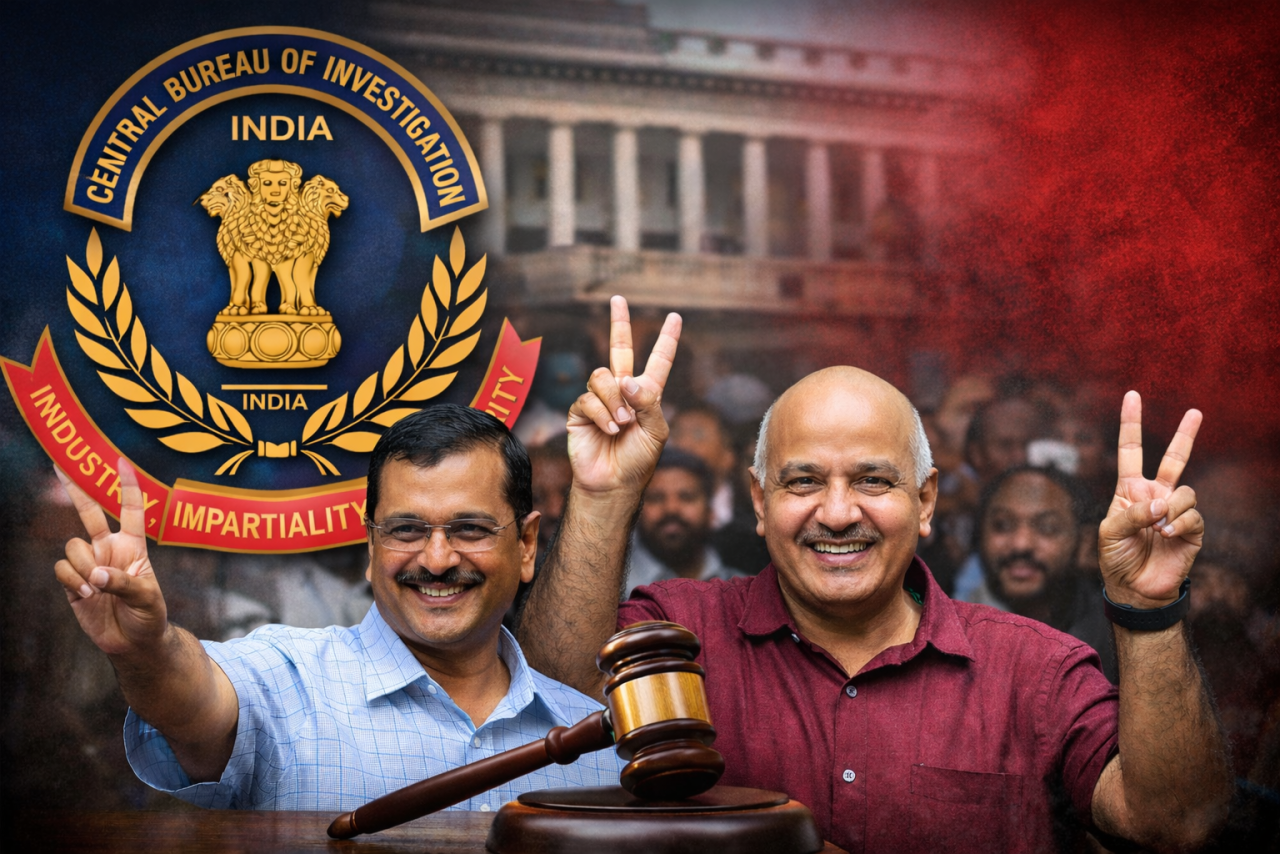
When a corruption case that dominated headlines for years collapses before trial, the story stops being just about politics — and starts becoming a test of investigative power, judicial scrutiny, and the strength of democracy itself.
A special court in New Delhi has dismissed corruption charges against former Delhi Chief Minister Arvind Kejriwal, former Deputy Chief Minister Manish Sisodia, and 21 other accused in the controversial capital excise policy case — a decision that is reverberating far beyond India’s borders.
The ruling, delivered by a Special Court hearing cases filed by the Central Bureau of Investigation (CBI), declined to take cognisance of the agency’s chargesheet, effectively discharging all 23 accused before trial. The court said the material presented did not meet the legal threshold required to proceed, citing gaps, inconsistencies, and lack of sufficient prima facie evidence.
For international observers, the development is significant not only because it involves two of India’s most prominent opposition leaders, but also because it intensifies a long-running debate over the autonomy and accountability of federal investigative agencies in the world’s largest democracy.
What the Case Was About
The investigation centered on Delhi’s 2021–22 excise policy, which overhauled how liquor licenses were issued in the Indian capital. The policy shifted retail sales from government-run outlets to private vendors, a move the Kejriwal administration argued would increase revenue, improve efficiency, and curb black-market practices.
In 2022, the CBI registered a First Information Report (FIR), alleging irregularities in the formulation and implementation of the policy. Shortly afterward, India’s financial crimes agency, the Enforcement Directorate (ED), launched a parallel money-laundering investigation under the Prevention of Money Laundering Act (PMLA).
Investigators alleged that certain liquor distributors received undue advantages and that kickbacks were routed through intermediaries. The ED claimed that proceeds of crime were generated through manipulated licensing rules and cartelisation. Sisodia was described as a key architect of the policy, while Kejriwal was later implicated in supplementary filings as allegedly involved in broader decision-making.
However, according to the court’s order, the evidence presented failed to establish prima facie criminal intent or an overarching conspiracy. The judge observed that serious allegations must be backed by clear documentation, credible witness testimony, and demonstrable financial trails — standards the prosecution, at this stage, did not sufficiently meet.
Political Fallout
The ruling has immediate political implications. The Aam Aadmi Party (AAP), which governed Delhi during the policy’s implementation, has consistently maintained that the case was politically motivated. Party leaders have argued that the prolonged investigation, arrests, and media attention damaged their governance agenda and national expansion plans.
India’s ruling Bharatiya Janata Party (BJP) has denied allegations of political interference, maintaining that investigative agencies function independently and that corruption cases must be pursued irrespective of political affiliation.
The CBI has indicated it may challenge the decision in a higher court, meaning the legal chapter may not yet be closed. Still, the symbolic impact is substantial: one of India’s most publicized corruption probes has been halted at the pre-trial stage.
A Broader Debate on Agency Independence
India’s central investigative framework places the CBI under the administrative control of the central government, while the ED operates under the Finance Ministry. Though legally empowered to act independently, this structural linkage has long fueled allegations from opposition parties that agencies can be used selectively against political rivals.
Such concerns are not unique to India. In many democracies, anti-corruption and financial enforcement bodies report to executive branches, creating potential tension between political authority and investigative neutrality.
Supporters of the agencies argue that corruption cases inevitably involve political figures and that strong enforcement is necessary to maintain public accountability. Critics counter that selective timing, prolonged investigations, and high-profile arrests can influence public perception even before courts weigh evidence.
Judiciary as Institutional Check
India’s judiciary plays a central role in balancing this equation. Courts frequently grant bail, quash proceedings, and scrutinize chargesheets for evidentiary adequacy. The decision to refuse cognisance in this case underscores that investigative conclusions do not automatically translate into prosecutable cases.
For global governance observers, this demonstrates both the power and the limits of India’s federal investigative machinery. Agencies can initiate sweeping probes, but judicial oversight remains decisive in determining whether cases proceed to trial.
Media and Public Perception
For nearly four years, the excise policy case dominated national headlines. Arrests, raids, and official briefings shaped public discourse long before judicial evaluation of the evidence was complete. In politically charged environments, reputational consequences often precede legal conclusions.
This dynamic reflects a broader challenge seen worldwide: corruption allegations can reshape political narratives regardless of final court outcomes.
What It Means for India’s Democracy
The discharge of Kejriwal, Sisodia, and 21 others reinforces two parallel realities. First, federal investigative agencies in India possess expansive powers under anti-corruption and anti-money-laundering laws. Second, those powers remain subject to judicial scrutiny.
For international investors, diplomatic stakeholders, and policy analysts, the case highlights the importance of institutional balance. Effective anti-corruption enforcement must coexist with due process safeguards and transparent evidentiary standards.
Whether this ruling strengthens confidence in India’s democratic institutions or deepens political polarization will depend on the appeals process and broader institutional reforms. For now, the case stands as a significant moment in the ongoing debate over the relationship between law enforcement authority and political power in India.
















Leave a Comment