
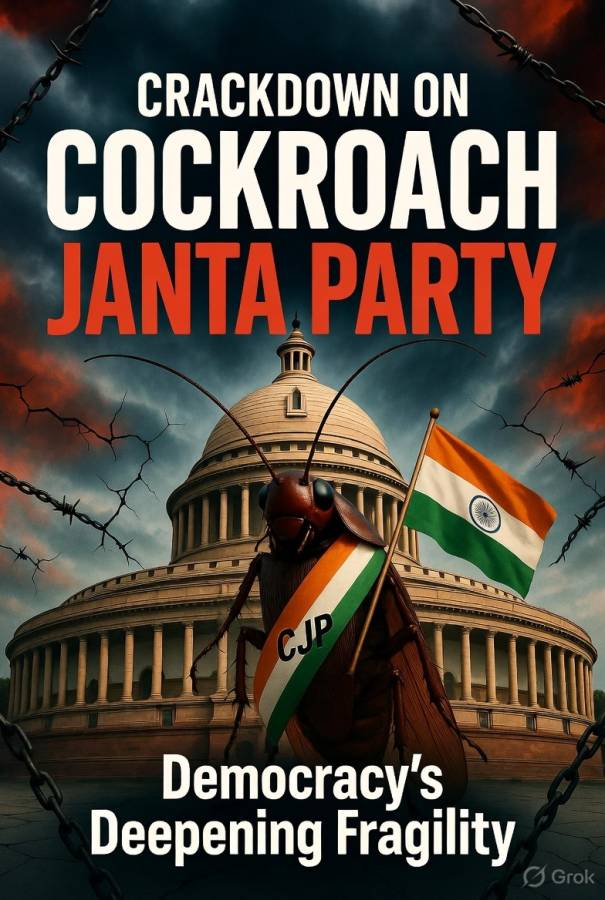
A satirical political movement born from a judicial remark has ignited a wider debate on free speech, state power, and the fragile boundaries of dissent in India’s digital democracy.
In the world's self-proclaimed largest democracy, a satirical political outfit born from a single judicial remark has reportedly faced suppression almost as soon as it emerged. The Cockroach Janta Party (CJP), launched in mid-May 2026 by Abhijeet Dipke following controversial comments by Chief Justice of India Surya Kant, quickly amassed tens of thousands of members and millions of online followers. Its manifesto—demanding everything from reservations for women to curbs on post-retirement perks for judges—tapped into widespread Gen Z frustration over unemployment and institutional elitism. Yet, if reports of government-orchestrated curbs, account closures, and indirect bans hold, they reveal far more about India's ruling establishment than about any "cockroach" threat.
The trigger was CJI Kant's open-court observation equating certain unemployed or activist youth to "cockroaches" who, lacking formal roles, resort to media, social platforms, and RTI activism to "attack everyone." A clarification followed, narrowing it to fraudulent degree-holders, but the damage was done. Within days, the CJP transformed insult into identity. Its rapid virality—surpassing the BJP's Instagram following at one point—exposed raw nerves: youth unemployment hovering at concerning levels despite economic growth narratives, a judiciary perceived as increasingly intertwined with executive comforts, and a political class seen as disconnected from aspirational India.
That a ruling dispensation in Delhi would move swiftly against such a movement—through platform pressures, state-level actions like Maharashtra's reported ban on related content, or broader ecosystem restrictions—should alarm observers of Indian democracy. India, often called the oldest and largest democracy, prides itself on a Constitution guaranteeing freedom of speech, association, and expression. Yet this episode symbolizes a pattern: intolerance for satire that bites too close to power, especially when it mobilizes the young.
Critics will argue the CJP was never a "real" party but a meme-driven protest vehicle. Its name deliberately weaponizes derision; its demands mix serious reform (anti-defection penalties, judicial post-retirement scrutiny) with provocative flair. However, dismissing it ignores history. Satire has long been a pressure valve in democracies—from Jonathan Swift to modern digital movements. Suppressing it does not eliminate grievances; it radicalizes them. By treating a cockroach symbol as a political emergency, authorities signal that even humorous dissent threatens stability. This mirrors broader trends: selective platform moderation, raids on critics, and narratives framing opposition as anti-national or destabilizing.
What does this reveal about the state of Indian democracy? First, a profound insecurity. A government commanding significant parliamentary strength and institutional levers should not fear a fledgling satirical group. The CJP's surge highlights failures in addressing youth despair—education-job mismatches, uneven growth, and perceptions of cronyism—rather than the party itself. When millions embrace "cockroach" as badge of honor, it indicts the system that made the insult resonant.
Second, it underscores the judiciary's vulnerability to public scrutiny. The CJP's call to bar chief justices from post-retirement Rajya Sabha seats directly challenges revolving-door perceptions between bench and legislature. While judges deserve dignity, institutional self-reflection strengthens, not weakens, public trust. Equating critics with vermin, then facing a backlash party, exposes how insulated language from the highest court can erode legitimacy.
Third, and most damningly, it symbolizes democratic backsliding through indirect means. Formal bans on parties are rare and legally fraught in India; softer tactics—coordinated complaints, advertiser pressure, state machinery, or social media deplatforming—achieve similar silencing without overt authoritarian optics. India lectures neighbors like Bangladesh on political bans and due process, yet domestic tolerance appears thinner when the target mocks the establishment.
This is not mere overreach against one viral phenomenon. It fits a longer arc: tightened digital rules, cases against journalists and comedians, and a cultural shift where "unity" often means conformity. The oldest democracy risks becoming performative—elections held regularly, yet the ecosystem for vibrant, contentious debate constricts. Youth, digital natives armed with memes, represent the future electorate. Alienating them through heavy-handed responses to satire risks deeper alienation, underground resentment, or electoral surprises.
Defenders of the government may cite public order, the need to prevent "anarchy," or claim the CJP was hijacked by opposition elements. Some accounts note attempts by established politicians to latch on. Yet history shows bans and curbs breed martyrs. The original Janata Party of 1977 rose from Emergency-era repression; today's "cockroaches" tap similar anti-incumbency under far less dramatic conditions.
India's democracy has weathered worse—Partition, wars, Emergency, coalition instability. Its resilience stems from pluralism, not uniformity. Suppressing the CJP, if confirmed, would symbolize not strength but frailty: an inability to absorb criticism or channel youth energy productively. True democratic maturity lies in engaging ideas, however irreverent, through debate—not deletion.
As the CJP's manifesto circulates and followers multiply, the real test for "Viksit Bharat" is not GDP charts or infrastructure, but whether a cockroach can scuttle freely in the public square. In a nation claiming civilizational depth and democratic exceptionalism, crushing symbolic dissent risks proving the critics right: that power views the restless young not as pillars, but pests to be exterminated. The world watches. History will judge whether India doubled down on control or recommitted to its constitutional promise.
In the world's self-proclaimed largest democracy, a satirical political outfit born from a single judicial remark has reportedly faced suppression almost as soon as it emerged. The Cockroach Janta Party (CJP), launched in mid-May 2026 by Abhijeet Dipke following controversial comments by Chief Justice of India Surya Kant, quickly amassed tens of thousands of members and millions of online followers. Its manifesto—demanding everything from reservations for women to curbs on post-retirement perks for judges—tapped into widespread Gen Z frustration over unemployment and institutional elitism. Yet, if reports of government-orchestrated curbs, account closures, and indirect bans hold, they reveal far more about India's ruling establishment than about any "cockroach" threat.
The trigger was CJI Kant's open-court observation equating certain unemployed or activist youth to "cockroaches" who, lacking formal roles, resort to media, social platforms, and RTI activism to "attack everyone." A clarification followed, narrowing it to fraudulent degree-holders, but the damage was done. Within days, the CJP transformed insult into identity. Its rapid virality—surpassing the BJP's Instagram following at one point—exposed raw nerves: youth unemployment hovering at concerning levels despite economic growth narratives, a judiciary perceived as increasingly intertwined with executive comforts, and a political class seen as disconnected from aspirational India.
That a ruling dispensation in Delhi would move swiftly against such a movement—through platform pressures, state-level actions like Maharashtra's reported ban on related content, or broader ecosystem restrictions—should alarm observers of Indian democracy. India, often called the oldest and largest democracy, prides itself on a Constitution guaranteeing freedom of speech, association, and expression. Yet this episode symbolizes a pattern: intolerance for satire that bites too close to power, especially when it mobilizes the young.
Critics will argue the CJP was never a "real" party but a meme-driven protest vehicle. Its name deliberately weaponizes derision; its demands mix serious reform (anti-defection penalties, judicial post-retirement scrutiny) with provocative flair. However, dismissing it ignores history. Satire has long been a pressure valve in democracies—from Jonathan Swift to modern digital movements. Suppressing it does not eliminate grievances; it radicalizes them. By treating a cockroach symbol as a political emergency, authorities signal that even humorous dissent threatens stability. This mirrors broader trends: selective platform moderation, raids on critics, and narratives framing opposition as anti-national or destabilizing.
What does this reveal about the state of Indian democracy? First, a profound insecurity. A government commanding significant parliamentary strength and institutional levers should not fear a fledgling satirical group. The CJP's surge highlights failures in addressing youth despair—education-job mismatches, uneven growth, and perceptions of cronyism—rather than the party itself. When millions embrace "cockroach" as badge of honor, it indicts the system that made the insult resonant.
Second, it underscores the judiciary's vulnerability to public scrutiny. The CJP's call to bar chief justices from post-retirement Rajya Sabha seats directly challenges revolving-door perceptions between bench and legislature. While judges deserve dignity, institutional self-reflection strengthens, not weakens, public trust. Equating critics with vermin, then facing a backlash party, exposes how insulated language from the highest court can erode legitimacy.
Third, and most damningly, it symbolizes democratic backsliding through indirect means. Formal bans on parties are rare and legally fraught in India; softer tactics—coordinated complaints, advertiser pressure, state machinery, or social media deplatforming—achieve similar silencing without overt authoritarian optics. India lectures neighbors like Bangladesh on political bans and due process, yet domestic tolerance appears thinner when the target mocks the establishment.
This is not mere overreach against one viral phenomenon. It fits a longer arc: tightened digital rules, cases against journalists and comedians, and a cultural shift where "unity" often means conformity. The oldest democracy risks becoming performative—elections held regularly, yet the ecosystem for vibrant, contentious debate constricts. Youth, digital natives armed with memes, represent the future electorate. Alienating them through heavy-handed responses to satire risks deeper alienation, underground resentment, or electoral surprises.
Defenders of the government may cite public order, the need to prevent "anarchy," or claim the CJP was hijacked by opposition elements. Some accounts note attempts by established politicians to latch on. Yet history shows bans and curbs breed martyrs. The original Janata Party of 1977 rose from Emergency-era repression; today's "cockroaches" tap similar anti-incumbency under far less dramatic conditions.
India's democracy has weathered worse—Partition, wars, Emergency, coalition instability. Its resilience stems from pluralism, not uniformity. Suppressing the CJP, if confirmed, would symbolize not strength but frailty: an inability to absorb criticism or channel youth energy productively. True democratic maturity lies in engaging ideas, however irreverent, through debate—not deletion.
As the CJP's manifesto circulates and followers multiply, the real test for "Viksit Bharat" is not GDP charts or infrastructure, but whether a cockroach can scuttle freely in the public square. In a nation claiming civilizational depth and democratic exceptionalism, crushing symbolic dissent risks proving the critics right: that power views the restless young not as pillars, but pests to be exterminated. The world watches. History will judge whether India doubled down on control or recommitted to its constitutional promise.





















Leave a Comment