
The Paradigm Shift: From Hum Do, Hamare Do to Paid Large Families
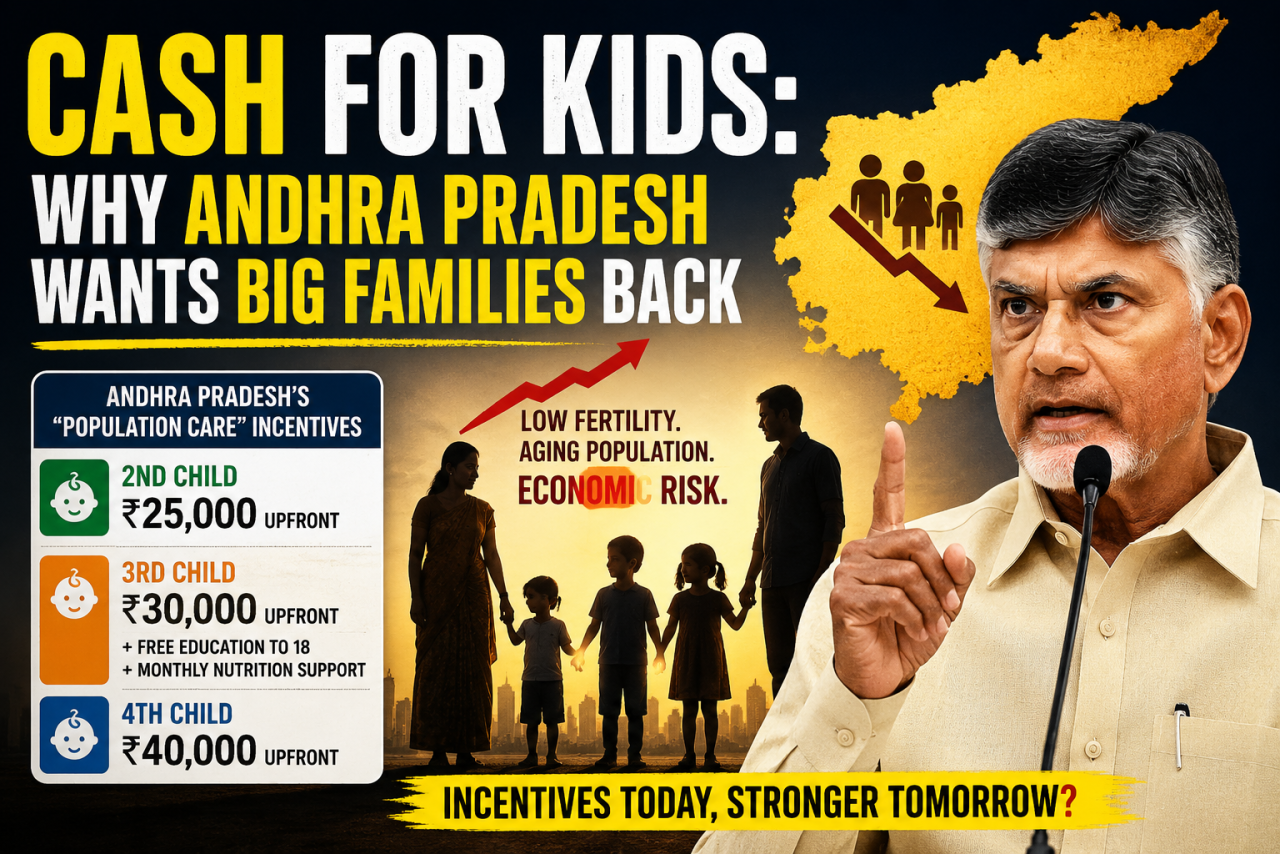
In a striking departure from India’s decades-long focus on population control, N. Chandrababu Naidu has reignited debate around family size and demographic policy. Speaking at a public event in Narasannapeta in Andhra Pradesh’s Srikakulam district, Naidu announced an unconventional proposal under the state’s upcoming Population Management Policy: a cash incentive of ₹30,000 for the birth of a third child and ₹40,000 for a fourth.
The announcement expands on an earlier proposal introduced in March, which outlined a ₹25,000 incentive for a second child along with a broader welfare package. The proposed benefits include ₹1,000 per month in nutritional support for five years, 12 months of parental leave—including two months reserved for fathers—and free education up to the age of 18.
Andhra Pradesh’s Proposed “Population Care” Incentives
Child
Proposed Benefit
Second Child
₹25,000 upfront
Third Child
₹30,000 upfront + free education until age 18 + monthly nutrition support
Fourth Child
₹40,000 upfront
For a country long shaped by the slogan “Hum Do, Hamare Do” (We two, our two), the proposal represents a significant policy reversal. The state is formally reframing the discussion from “family planning” to what draft documents describe as “population care.”
Naidu himself acknowledged the shift, stating that while he once supported strict family planning, changing demographics now require a different approach. In his view, children have increasingly become an economic and social asset.
The Core Data: Why Andhra Pradesh Is Sounding the Alarm
At first glance, encouraging larger families in India may seem contradictory. India remains the world’s most populous country, with more than 1.4 billion people. Concerns over unemployment, infrastructure pressure, and limited resources continue to shape public debate.
Yet the reasoning behind Andhra Pradesh’s move lies in a quieter demographic trend: regional divergence.
While northern states such as Bihar and Uttar Pradesh continue to record relatively higher birth rates, many southern states have entered a period of sub-replacement fertility.
The central measure here is the Total Fertility Rate (TFR)—the average number of children born to a woman over her lifetime. A fertility rate of around 2.1 is considered the replacement level, meaning a population remains stable without large-scale migration.
According to figures cited by the Andhra Pradesh government, several indicators are now raising concern:
Key Demographic Signals
- Fertility decline: Andhra Pradesh’s TFR has reportedly fallen from around 3.0 in 1993 to nearly 1.5 today—well below replacement levels.
- Rise of single-child families: Roughly 58% of families in the state are estimated to have only one child, while comparatively fewer households have two or more children.
- An ageing population: The state’s median age is approximately 32.5 years, noticeably older than the national average of 28.4. Government projections suggest that by 2047, nearly 23% of the population may fall into the elderly category, increasing pressure on healthcare systems, pensions, and welfare spending.
Demographic Snapshot
Metric
Andhra Pradesh
National Average
Current TFR
1.5 (declining)
2.1 (replacement level)
Median Age
32.5 years
28.4 years
Elderly Population by 2047
23% (projected)
Lower relative share
State health secretary Sourabh Gaur has publicly described the situation as similar to the demographic pressures already faced by developed countries: an expanding non-working population supported by a shrinking labour base.
Naidu argues that if the state’s working-age population contracts sharply, it could affect industrial productivity, labour availability, and long-term Gross State Domestic Product (GSDP) growth.
To address this, the government envisions a life-cycle welfare framework organised around themes such as Maatrutvam (Motherhood), Shakti (Empowerment), and Sanjeevani (Healthcare), with ambitions of strengthening both social security and economic growth.
The Macro Analysis: One Country, Two Demographics
Understanding Andhra Pradesh’s logic requires seeing India not as one demographic unit, but as two sharply different demographic systems.
Region
Demographic Trend
Economic Implication
Northern India
Higher fertility rates, younger population, expanding labour force
Pressure on jobs, schools, housing, and public services
Southern India
Lower fertility rates, ageing population, shrinking workforce
Labour shortages, ageing costs, slower growth risks
States such as Kerala, Tamil Nadu, and Andhra Pradesh reached low fertility levels earlier than much of India due to improvements in women’s education, healthcare access, and family planning.
Ironically, that success now presents a different challenge.
Economists and policymakers increasingly warn that southern states could face demographic pressures resembling those in countries such as Japan, Italy, and South Korea, where a shrinking base of taxpayers supports a rapidly growing elderly population.
There is also a political dimension.
India is expected to undergo a major parliamentary delimitation exercise in the future, redistributing seats according to updated population patterns. Southern states fear their success in controlling population growth could reduce their relative representation in Parliament while more populous northern states gain influence.
Seen through that lens, encouraging births becomes not just an economic strategy, but a political calculation tied to long-term representation.
Can Money Buy Babies? The Global Precedent
Although Andhra Pradesh’s motivations may be understandable, the effectiveness of financial incentives remains uncertain.
The East Asian Experience
Despite billions spent on childbirth incentives, subsidised childcare, and family-support programmes, countries such as South Korea and Japan continue to struggle with falling fertility rates. In South Korea, fertility levels have remained among the lowest in the world.
Read more: Japan’s Baby Bust Is a Global Warning Sign the World Can’t Ignore
The European Exception
Some European countries, particularly Nordic nations and France, have managed comparatively stable fertility rates. However, researchers often point out that their success did not rely on one-time cash transfers alone.
Read more: US Fertility Rate Hits Historic Low in 2024 CDC Reports
Instead, they invested heavily in:
- Universal childcare systems
- Long parental leave protections for both parents
- Flexible work arrangements
- Policies supporting work-life balance
Academic literature also remains cautious about the impact of direct financial incentives.
In After the Spike, researchers Dean Spears and Michael Geruso argue that rising living costs and changing aspirations often outweigh short-term financial benefits.
A one-time payment of ₹30,000 or ₹40,000 may help temporarily, but it is unlikely to fundamentally offset the long-term costs of raising and educating additional children in modern India.
Final Take
The proposed Population Management Policy in Andhra Pradesh reflects a deeper transformation underway in India’s demographic story.
At a national level, India still grapples with concerns of scale and overpopulation. But at the regional level, some states are beginning to worry about ageing, shrinking labour pools, and economic slowdown.
Naidu’s shift from population control to “population care” acknowledges a real structural concern in southern India. Yet global experience suggests that money alone rarely changes deeply rooted social behaviour.
If Andhra Pradesh hopes to reverse demographic decline, the challenge may extend far beyond cash incentives. The long-term test will be whether the state can build an ecosystem—through childcare, healthcare, parental support, education, and employment security—that makes larger families both affordable and sustainable.
In a striking departure from India’s decades-long focus on population control, N. Chandrababu Naidu has reignited debate around family size and demographic policy. Speaking at a public event in Narasannapeta in Andhra Pradesh’s Srikakulam district, Naidu announced an unconventional proposal under the state’s upcoming Population Management Policy: a cash incentive of ₹30,000 for the birth of a third child and ₹40,000 for a fourth.
The announcement expands on an earlier proposal introduced in March, which outlined a ₹25,000 incentive for a second child along with a broader welfare package. The proposed benefits include ₹1,000 per month in nutritional support for five years, 12 months of parental leave—including two months reserved for fathers—and free education up to the age of 18.
Andhra Pradesh’s Proposed “Population Care” Incentives
|
Child |
Proposed Benefit |
|
Second Child |
₹25,000 upfront |
|
Third Child |
₹30,000 upfront + free education until age 18 + monthly nutrition support |
|
Fourth Child |
₹40,000 upfront |
For a country long shaped by the slogan “Hum Do, Hamare Do” (We two, our two), the proposal represents a significant policy reversal. The state is formally reframing the discussion from “family planning” to what draft documents describe as “population care.”
Naidu himself acknowledged the shift, stating that while he once supported strict family planning, changing demographics now require a different approach. In his view, children have increasingly become an economic and social asset.
The Core Data: Why Andhra Pradesh Is Sounding the Alarm
At first glance, encouraging larger families in India may seem contradictory. India remains the world’s most populous country, with more than 1.4 billion people. Concerns over unemployment, infrastructure pressure, and limited resources continue to shape public debate.
Yet the reasoning behind Andhra Pradesh’s move lies in a quieter demographic trend: regional divergence.
While northern states such as Bihar and Uttar Pradesh continue to record relatively higher birth rates, many southern states have entered a period of sub-replacement fertility.
The central measure here is the Total Fertility Rate (TFR)—the average number of children born to a woman over her lifetime. A fertility rate of around 2.1 is considered the replacement level, meaning a population remains stable without large-scale migration.
According to figures cited by the Andhra Pradesh government, several indicators are now raising concern:
Key Demographic Signals
- Fertility decline: Andhra Pradesh’s TFR has reportedly fallen from around 3.0 in 1993 to nearly 1.5 today—well below replacement levels.
- Rise of single-child families: Roughly 58% of families in the state are estimated to have only one child, while comparatively fewer households have two or more children.
- An ageing population: The state’s median age is approximately 32.5 years, noticeably older than the national average of 28.4. Government projections suggest that by 2047, nearly 23% of the population may fall into the elderly category, increasing pressure on healthcare systems, pensions, and welfare spending.
Demographic Snapshot
|
Metric |
Andhra Pradesh |
National Average |
|
Current TFR |
1.5 (declining) |
2.1 (replacement level) |
|
Median Age |
32.5 years |
28.4 years |
|
Elderly Population by 2047 |
23% (projected) |
Lower relative share |
State health secretary Sourabh Gaur has publicly described the situation as similar to the demographic pressures already faced by developed countries: an expanding non-working population supported by a shrinking labour base.
Naidu argues that if the state’s working-age population contracts sharply, it could affect industrial productivity, labour availability, and long-term Gross State Domestic Product (GSDP) growth.
To address this, the government envisions a life-cycle welfare framework organised around themes such as Maatrutvam (Motherhood), Shakti (Empowerment), and Sanjeevani (Healthcare), with ambitions of strengthening both social security and economic growth.
The Macro Analysis: One Country, Two Demographics
Understanding Andhra Pradesh’s logic requires seeing India not as one demographic unit, but as two sharply different demographic systems.
|
Region |
Demographic Trend |
Economic Implication |
|
Northern India |
Higher fertility rates, younger population, expanding labour force |
Pressure on jobs, schools, housing, and public services |
|
Southern India |
Lower fertility rates, ageing population, shrinking workforce |
Labour shortages, ageing costs, slower growth risks |
States such as Kerala, Tamil Nadu, and Andhra Pradesh reached low fertility levels earlier than much of India due to improvements in women’s education, healthcare access, and family planning.
Ironically, that success now presents a different challenge.
Economists and policymakers increasingly warn that southern states could face demographic pressures resembling those in countries such as Japan, Italy, and South Korea, where a shrinking base of taxpayers supports a rapidly growing elderly population.
There is also a political dimension.
India is expected to undergo a major parliamentary delimitation exercise in the future, redistributing seats according to updated population patterns. Southern states fear their success in controlling population growth could reduce their relative representation in Parliament while more populous northern states gain influence.
Seen through that lens, encouraging births becomes not just an economic strategy, but a political calculation tied to long-term representation.
Can Money Buy Babies? The Global Precedent
Although Andhra Pradesh’s motivations may be understandable, the effectiveness of financial incentives remains uncertain.
The East Asian Experience
Despite billions spent on childbirth incentives, subsidised childcare, and family-support programmes, countries such as South Korea and Japan continue to struggle with falling fertility rates. In South Korea, fertility levels have remained among the lowest in the world.
Read more: Japan’s Baby Bust Is a Global Warning Sign the World Can’t Ignore
The European Exception
Some European countries, particularly Nordic nations and France, have managed comparatively stable fertility rates. However, researchers often point out that their success did not rely on one-time cash transfers alone.
Read more: US Fertility Rate Hits Historic Low in 2024 CDC Reports
Instead, they invested heavily in:
- Universal childcare systems
- Long parental leave protections for both parents
- Flexible work arrangements
- Policies supporting work-life balance
Academic literature also remains cautious about the impact of direct financial incentives.
In After the Spike, researchers Dean Spears and Michael Geruso argue that rising living costs and changing aspirations often outweigh short-term financial benefits.
A one-time payment of ₹30,000 or ₹40,000 may help temporarily, but it is unlikely to fundamentally offset the long-term costs of raising and educating additional children in modern India.
Final Take
The proposed Population Management Policy in Andhra Pradesh reflects a deeper transformation underway in India’s demographic story.
At a national level, India still grapples with concerns of scale and overpopulation. But at the regional level, some states are beginning to worry about ageing, shrinking labour pools, and economic slowdown.
Naidu’s shift from population control to “population care” acknowledges a real structural concern in southern India. Yet global experience suggests that money alone rarely changes deeply rooted social behaviour.
If Andhra Pradesh hopes to reverse demographic decline, the challenge may extend far beyond cash incentives. The long-term test will be whether the state can build an ecosystem—through childcare, healthcare, parental support, education, and employment security—that makes larger families both affordable and sustainable.


























Leave a Comment