
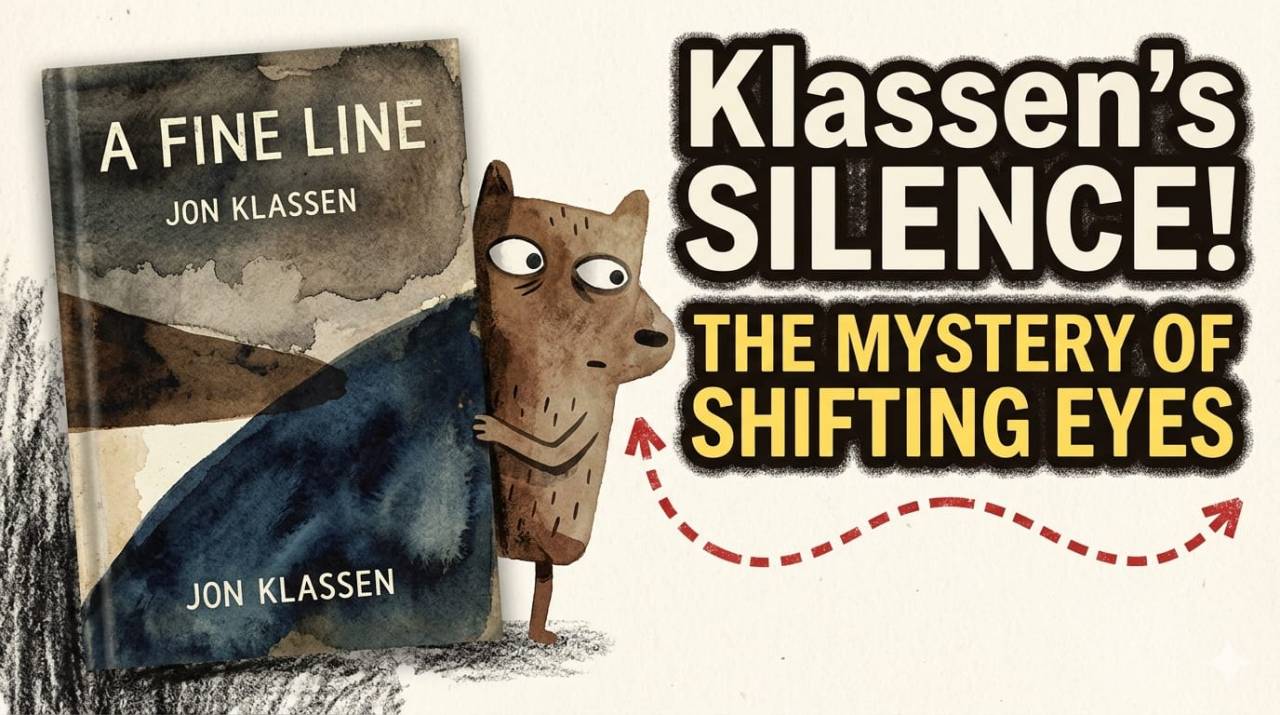
What if the most powerful emotion in a book came not from words—but from where a character’s eyes quietly move? In A Fine Line, Jon Klassen transforms silence into suspense, proving that even the smallest glance can carry enormous emotional weight.
A Fine Line by Jon Klassen is a picture book that relies more on visual storytelling than on lengthy text. The book uses simple dialogue, restrained illustrations, and subtle character expressions to create tension and meaning. Rather than explaining emotions directly, Klassen allows readers to understand the story through body language, eye movement, and silence.
Visual Storytelling Through Expressions
One of the most important features of A Fine Line is the way Klassen uses the eyes of his characters. Their expressions change slightly from page to page, but those small changes communicate important emotions such as guilt, suspicion, nervousness, and fear.
Instead of describing what the characters feel, the illustrations allow readers to interpret emotions for themselves. This approach makes the reading experience more interactive because readers must pay close attention to the details in each scene.
Klassen’s illustrations are also minimal in style. The muted colors and simple backgrounds keep attention focused on the characters and their reactions. The lack of visual clutter strengthens the emotional impact of the story.
Themes of Honesty and Boundaries
The book explores ideas related to honesty, responsibility, and personal boundaries. The title A Fine Line works both as a visual element and as a symbolic idea. The characters repeatedly face situations where they must decide whether to cross moral or emotional boundaries.
Unlike many children’s books, Klassen does not present a simple lesson or a clear moral conclusion. There are no obvious heroes or villains. Instead, the story presents actions and consequences without directly telling readers what to think.
This ambiguity is one of the book’s strongest qualities. Readers are encouraged to form their own interpretations of the characters and their choices.
Simple Language and Dry Humor
The writing style in A Fine Line is very simple. The sentences are short, and the dialogue is calm and understated. This restrained language contrasts with the tension visible in the illustrations.
The humor of the book comes from this contrast. Characters often try to appear innocent even when the illustrations suggest otherwise. Younger readers may enjoy the visual comedy, while older readers may appreciate the subtle psychological tension underneath the story.
Klassen’s background in animation is visible in the pacing of the book. Small pauses, repeated expressions, and careful page turns help build suspense without requiring dramatic action.
Importance as a Picture Book
A Fine Line demonstrates how picture books can communicate complex ideas using limited text. Klassen uses illustrations not as decoration, but as the primary storytelling tool.
The book also respects the intelligence of its audience. Rather than explaining every emotion or lesson, it trusts readers to observe details and interpret meaning independently.
This approach makes the book effective for both children and adults. Younger readers can follow the surface story, while older readers may notice deeper themes related to guilt, anxiety, and social behavior.
Final Take
Jon Klassen’s A Fine Line is a strong example of modern visual storytelling in children’s literature. Through minimal dialogue, careful pacing, and expressive illustrations, the book creates emotional tension without relying on direct explanation.
Its combination of simplicity, ambiguity, and visual detail makes it memorable and thought-provoking. The book shows how silence and subtle expression can communicate more effectively than long descriptions or explicit moral lessons.
A Fine Line by Jon Klassen is a picture book that relies more on visual storytelling than on lengthy text. The book uses simple dialogue, restrained illustrations, and subtle character expressions to create tension and meaning. Rather than explaining emotions directly, Klassen allows readers to understand the story through body language, eye movement, and silence.
Visual Storytelling Through Expressions
One of the most important features of A Fine Line is the way Klassen uses the eyes of his characters. Their expressions change slightly from page to page, but those small changes communicate important emotions such as guilt, suspicion, nervousness, and fear.
Instead of describing what the characters feel, the illustrations allow readers to interpret emotions for themselves. This approach makes the reading experience more interactive because readers must pay close attention to the details in each scene.
Klassen’s illustrations are also minimal in style. The muted colors and simple backgrounds keep attention focused on the characters and their reactions. The lack of visual clutter strengthens the emotional impact of the story.
Themes of Honesty and Boundaries
The book explores ideas related to honesty, responsibility, and personal boundaries. The title A Fine Line works both as a visual element and as a symbolic idea. The characters repeatedly face situations where they must decide whether to cross moral or emotional boundaries.
Unlike many children’s books, Klassen does not present a simple lesson or a clear moral conclusion. There are no obvious heroes or villains. Instead, the story presents actions and consequences without directly telling readers what to think.
This ambiguity is one of the book’s strongest qualities. Readers are encouraged to form their own interpretations of the characters and their choices.
Simple Language and Dry Humor
The writing style in A Fine Line is very simple. The sentences are short, and the dialogue is calm and understated. This restrained language contrasts with the tension visible in the illustrations.
The humor of the book comes from this contrast. Characters often try to appear innocent even when the illustrations suggest otherwise. Younger readers may enjoy the visual comedy, while older readers may appreciate the subtle psychological tension underneath the story.
Klassen’s background in animation is visible in the pacing of the book. Small pauses, repeated expressions, and careful page turns help build suspense without requiring dramatic action.
Importance as a Picture Book
A Fine Line demonstrates how picture books can communicate complex ideas using limited text. Klassen uses illustrations not as decoration, but as the primary storytelling tool.
The book also respects the intelligence of its audience. Rather than explaining every emotion or lesson, it trusts readers to observe details and interpret meaning independently.
This approach makes the book effective for both children and adults. Younger readers can follow the surface story, while older readers may notice deeper themes related to guilt, anxiety, and social behavior.
Final Take
Jon Klassen’s A Fine Line is a strong example of modern visual storytelling in children’s literature. Through minimal dialogue, careful pacing, and expressive illustrations, the book creates emotional tension without relying on direct explanation.
Its combination of simplicity, ambiguity, and visual detail makes it memorable and thought-provoking. The book shows how silence and subtle expression can communicate more effectively than long descriptions or explicit moral lessons.





























Leave a Comment