
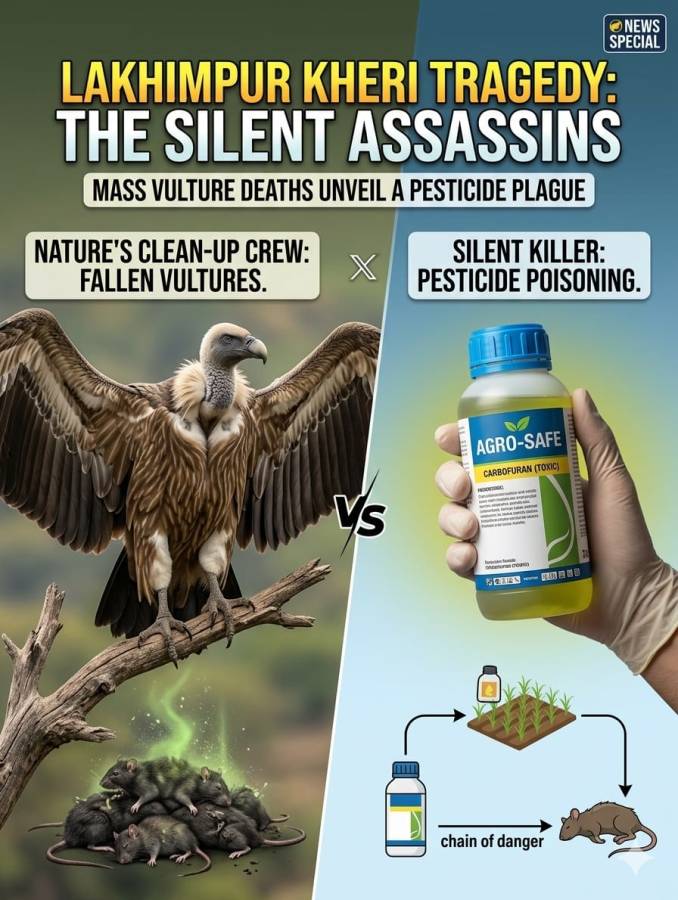
A tragic incident in the Dudhwa buffer zone of Lakhimpur Kheri, Uttar Pradesh, has once again exposed the deadly consequences of toxic pesticides. Twenty-five Himalayan griffon vultures died after consuming poisoned carcasses, while five others were rescued in critical condition. A report by the Indian Veterinary Research Institute (IVRI) confirmed that the birds were poisoned by carbofuran, a highly toxic pesticide commonly known by the brand name “Furadan.”
The incident is not just a wildlife tragedy. It is a warning about how dangerous chemicals move silently through ecosystems, harming animals, contaminating the environment, and ultimately threatening human life.
How the Vultures Died
The poisoning did not occur directly in agricultural fields. Instead, it happened through a process known as secondary poisoning.
According to reports, some villagers attempted to kill stray dogs that had been attacking livestock. They mixed carbofuran with cooked rice and left the poisoned bait in nearby fields. The dogs consumed the food and died shortly afterward.
Vultures, being natural scavengers, later fed on the carcasses of the dead dogs. The poison present in the bodies entered the vultures’ systems almost immediately. Carbofuran acts rapidly on the nervous system, causing paralysis, breathing failure, and death within a short period.
Forest officials managed to rescue five unconscious vultures and provided emergency treatment before releasing them back into the wild. However, the loss of twenty-five endangered birds remains devastating.
Why Vultures Are Essential to Nature
Vultures are often misunderstood because of their appearance and feeding habits, yet they perform one of the most important ecological roles in nature.
These birds act as the environment’s clean-up crew. By consuming carcasses and decaying flesh, vultures prevent the spread of dangerous bacteria and diseases. Their highly acidic digestive systems can destroy harmful pathogens that would otherwise survive in rotting animal remains.
Diseases such as anthrax, rabies, and other bacterial infections can spread rapidly when carcasses remain exposed in open areas. Vultures help stop this cycle naturally and efficiently.
The Himalayan griffon vulture is already classified as an endangered species and receives protection under Schedule I of India’s Wildlife Protection Act. Losing such a large number of birds in a single incident creates a serious ecological imbalance. Without scavengers like vultures, animal carcasses accumulate in the environment, increasing the risk of disease outbreaks and attracting feral animals.
Carbofuran: One of the World’s Deadliest Pesticides
Carbofuran is considered among the most toxic pesticides ever used in agriculture. Even a very small quantity can kill birds, mammals, and humans.
The chemical functions as a neurotoxin. It blocks enzymes necessary for normal nervous system activity, leading to muscle failure, respiratory collapse, and death.
Its dangers extend far beyond a single poisoning incident.
Threat to Wildlife
Birds often mistake pesticide granules for seeds or food particles. In many cases, even one grain of carbofuran can kill a small bird. The poison also remains active inside dead animals, creating a chain reaction that affects scavengers such as vultures, foxes, eagles, and wild dogs.
Risk to Humans
Farmers and agricultural workers handle these chemicals regularly, often without proper protective equipment. Direct exposure can cause headaches, dizziness, blurred vision, nausea, breathing problems, and severe neurological damage. High exposure levels may lead to unconsciousness or death.
Environmental Damage
Rainwater carries pesticide residues into soil, ponds, rivers, and underground water systems. Fish and aquatic organisms absorb these chemicals, allowing toxins to enter the food chain. Humans may later consume contaminated water or poisoned fish.
Researchers have also linked several pesticides to hormone disruption and long-term reproductive problems in both animals and humans.
A Warning That Cannot Be Ignored
The Lakhimpur Kheri tragedy highlights how one reckless action can destroy an entire chain of life. What began as an attempt to eliminate stray dogs ended with the deaths of protected vultures and a serious environmental threat.
Forest authorities have now started awareness campaigns to educate villagers about the dangers of highly toxic pesticides. However, awareness alone may not be enough. Stronger regulation, safer alternatives, and responsible pesticide use are essential to prevent similar disasters in the future.
Pesticides do not remain confined to fields or farms. They travel through water, soil, carcasses, and food chains, silently affecting every living being they touch.
Protecting vultures is not only about saving endangered birds. It is about protecting ecosystems, public health, and the delicate natural balance that sustains human life itself.
























Leave a Comment