
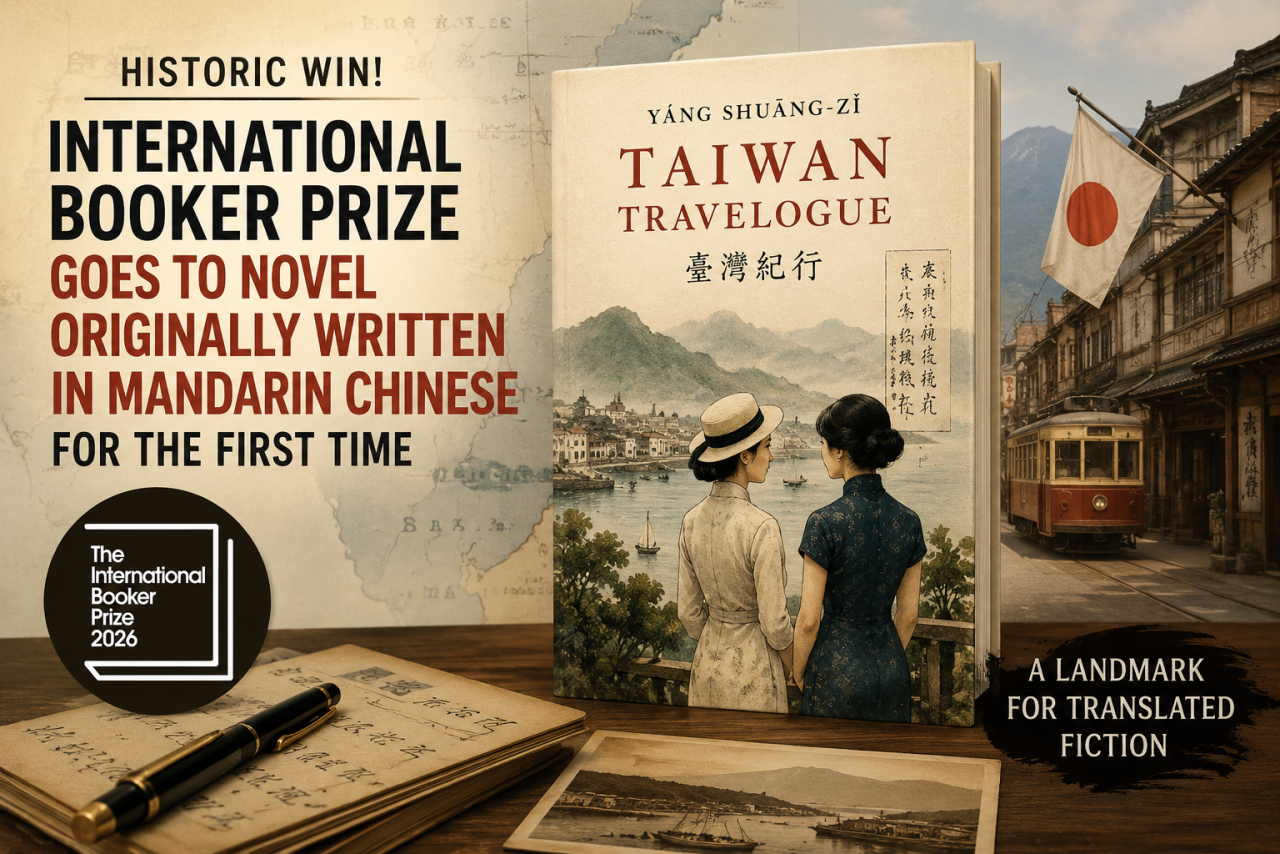
A historic first for global literature: the International Booker Prize has gone to a novel originally written in Mandarin Chinese—reshaping how the world reads, translates, and recognizes fiction.
The 2026 International Booker Prize has been awarded to Taiwan Travelogue, a novel originally written in Mandarin Chinese by Taiwanese author Yáng Shuāng-zǐ and translated into English by Lin King—marking a historic first for Mandarin-language fiction on the prize stage. The win is not only symbolic in literary terms but also signals a broader shift in global publishing: the growing recognition of translated fiction as a central force in contemporary literature.
At its core, Taiwan Travelogue is a novel that resists easy categorisation. It is at once a historical romance, a metafictional experiment, and a postcolonial critique embedded within the textures of everyday life. Set in the 1930s during Japanese colonial rule in Taiwan, the novel constructs a layered narrative that deliberately blurs the line between fiction and translation, authenticity and invention, memory and reconstruction.
A Story That Pretends to Be a Translation
The novel is framed as a rediscovered travel memoir written by a fictional Japanese novelist, Aoyama Chizuko, who journeys through Taiwan. This narrative is then “translated” into Mandarin by another fictional layer of authorship—before being rendered into English by Lin King. This chain of mediation is not decorative; it is the novel’s central intellectual engine.
Rather than offering a straightforward historical account, Yáng uses this structure to question who gets to tell history, and how colonial power shapes even the language in which stories are told. The novel’s structure forces the reader to constantly renegotiate trust: in the narrator, in the translator, and in the archive itself.
Colonial Taiwan Through an Intimate Lens
The plot itself unfolds gently but purposefully. Chizuko’s journey across Taiwan is framed as a culinary and cultural exploration, but it quickly becomes something more complex: a study of desire, power, and dependency. She is accompanied by a Taiwanese interpreter, Chizuru (Chi-chan), whose presence destabilizes the apparent authority of the Japanese visitor.
What begins as a travel narrative gradually transforms into an intimate relationship between the two women—one shaped by imperial privilege, the other by colonial subordination. Their emotional connection is tenderly drawn, but never allowed to escape the political gravity that defines their positions in the colonial hierarchy.
This is where the novel’s strength lies: it refuses to separate intimacy from structure. Love, in Taiwan Travelogue, is never innocent. It is always entangled with power.
A Postcolonial Puzzle, Not a Linear History
Yáng’s novel is deeply aware of the limits of historical storytelling. Instead of presenting Taiwan’s colonial past as a closed chapter, it opens it up as a series of competing narratives. Footnotes, editorial interventions, and fictional afterwords create a fragmented reading experience that mimics archival instability.
The result is a book that behaves less like a traditional novel and more like a literary investigation. Readers are constantly reminded that what they are reading is constructed—yet that construction is precisely the point. The novel asks whether truth is something that can be accessed directly, or only ever approached through layers of interpretation.
Translation as Creative Rewriting
Lin King’s translation plays a crucial role in the book’s success. Rather than smoothing out linguistic complexity, the translation embraces it. The result is an English text that retains a sense of multiplicity—echoing the novel’s multilingual and multicultural origins.
This approach aligns with a broader shift in translated literature, where translators are no longer invisible intermediaries but co-creators of literary meaning. In Taiwan Travelogue, translation is not a bridge to the original; it is part of the original’s architecture.
Why It Won the Booker
The International Booker Prize jury praised the novel’s sophistication and its ability to combine romance with incisive postcolonial critique. That combination is rare: a book that is intellectually dense without becoming emotionally detached, and emotionally engaging without simplifying its political questions.
The novel’s appeal lies in its dual nature. On one level, it is a love story between two women navigating an unequal world. On another, it is an interrogation of how history itself is narrated, translated, and remembered.
A Landmark for Global Fiction
The significance of Taiwan Travelogue extends beyond its plot or formal experimentation. Its victory marks a turning point for Mandarin-language literature on the global stage and reinforces the International Booker’s evolving mission: to foreground translated fiction not as a niche category, but as a core space of literary innovation.
In a year where independent presses and translators once again dominated the shortlist, the win also highlights a quiet but important shift in global reading culture—toward books that are structurally complex, culturally layered, and unwilling to offer easy answers.
Final Reflection
Taiwan Travelogue is not a book that rushes to be understood. It demands patience, rereading, and a willingness to sit with uncertainty. But that uncertainty is precisely its achievement.
By turning translation into both subject and structure, and by embedding a love story within the machinery of empire, Yáng Shuāng-zǐ has written a novel that does not simply tell a story—it questions how stories themselves are made.
The 2026 International Booker Prize has been awarded to Taiwan Travelogue, a novel originally written in Mandarin Chinese by Taiwanese author Yáng Shuāng-zǐ and translated into English by Lin King—marking a historic first for Mandarin-language fiction on the prize stage. The win is not only symbolic in literary terms but also signals a broader shift in global publishing: the growing recognition of translated fiction as a central force in contemporary literature.
At its core, Taiwan Travelogue is a novel that resists easy categorisation. It is at once a historical romance, a metafictional experiment, and a postcolonial critique embedded within the textures of everyday life. Set in the 1930s during Japanese colonial rule in Taiwan, the novel constructs a layered narrative that deliberately blurs the line between fiction and translation, authenticity and invention, memory and reconstruction.
A Story That Pretends to Be a Translation
The novel is framed as a rediscovered travel memoir written by a fictional Japanese novelist, Aoyama Chizuko, who journeys through Taiwan. This narrative is then “translated” into Mandarin by another fictional layer of authorship—before being rendered into English by Lin King. This chain of mediation is not decorative; it is the novel’s central intellectual engine.
Rather than offering a straightforward historical account, Yáng uses this structure to question who gets to tell history, and how colonial power shapes even the language in which stories are told. The novel’s structure forces the reader to constantly renegotiate trust: in the narrator, in the translator, and in the archive itself.
Colonial Taiwan Through an Intimate Lens
The plot itself unfolds gently but purposefully. Chizuko’s journey across Taiwan is framed as a culinary and cultural exploration, but it quickly becomes something more complex: a study of desire, power, and dependency. She is accompanied by a Taiwanese interpreter, Chizuru (Chi-chan), whose presence destabilizes the apparent authority of the Japanese visitor.
What begins as a travel narrative gradually transforms into an intimate relationship between the two women—one shaped by imperial privilege, the other by colonial subordination. Their emotional connection is tenderly drawn, but never allowed to escape the political gravity that defines their positions in the colonial hierarchy.
This is where the novel’s strength lies: it refuses to separate intimacy from structure. Love, in Taiwan Travelogue, is never innocent. It is always entangled with power.
A Postcolonial Puzzle, Not a Linear History
Yáng’s novel is deeply aware of the limits of historical storytelling. Instead of presenting Taiwan’s colonial past as a closed chapter, it opens it up as a series of competing narratives. Footnotes, editorial interventions, and fictional afterwords create a fragmented reading experience that mimics archival instability.
The result is a book that behaves less like a traditional novel and more like a literary investigation. Readers are constantly reminded that what they are reading is constructed—yet that construction is precisely the point. The novel asks whether truth is something that can be accessed directly, or only ever approached through layers of interpretation.
Translation as Creative Rewriting
Lin King’s translation plays a crucial role in the book’s success. Rather than smoothing out linguistic complexity, the translation embraces it. The result is an English text that retains a sense of multiplicity—echoing the novel’s multilingual and multicultural origins.
This approach aligns with a broader shift in translated literature, where translators are no longer invisible intermediaries but co-creators of literary meaning. In Taiwan Travelogue, translation is not a bridge to the original; it is part of the original’s architecture.
Why It Won the Booker
The International Booker Prize jury praised the novel’s sophistication and its ability to combine romance with incisive postcolonial critique. That combination is rare: a book that is intellectually dense without becoming emotionally detached, and emotionally engaging without simplifying its political questions.
The novel’s appeal lies in its dual nature. On one level, it is a love story between two women navigating an unequal world. On another, it is an interrogation of how history itself is narrated, translated, and remembered.
A Landmark for Global Fiction
The significance of Taiwan Travelogue extends beyond its plot or formal experimentation. Its victory marks a turning point for Mandarin-language literature on the global stage and reinforces the International Booker’s evolving mission: to foreground translated fiction not as a niche category, but as a core space of literary innovation.
In a year where independent presses and translators once again dominated the shortlist, the win also highlights a quiet but important shift in global reading culture—toward books that are structurally complex, culturally layered, and unwilling to offer easy answers.
Final Reflection
Taiwan Travelogue is not a book that rushes to be understood. It demands patience, rereading, and a willingness to sit with uncertainty. But that uncertainty is precisely its achievement.
By turning translation into both subject and structure, and by embedding a love story within the machinery of empire, Yáng Shuāng-zǐ has written a novel that does not simply tell a story—it questions how stories themselves are made.

























Leave a Comment