
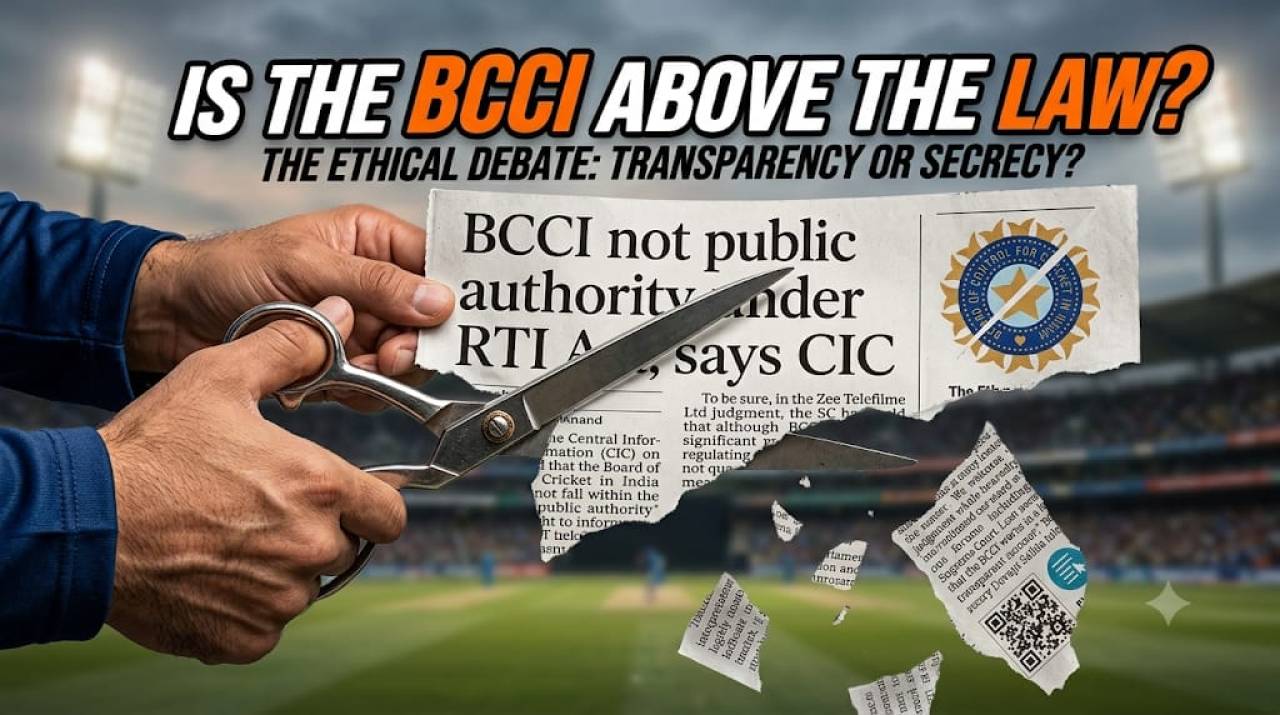
India watches cricket like a religion—but the institution that governs it answers to no one. The latest CIC ruling has once again placed the BCCI beyond RTI scrutiny, reigniting a debate about power, privilege, and public accountability in Indian sport.
For a country where cricket functions less like a sport and more like a shared national emotion, the Board of Control for Cricket in India (BCCI) sits at an unusual crossroads of power and public life. It decides who represents India on the global stage, controls one of the world’s richest sporting ecosystems, and commands attention from hundreds of millions.
Yet it does all this while remaining outside the ambit of the Right to Information (RTI) Act.
A recent ruling by the Central Information Commission (CIC) has reaffirmed that position, stating that the BCCI does not qualify as a “public authority” under Section 2(h) of the RTI Act. The decision effectively shuts the door on citizens seeking official transparency from cricket’s governing body, reversing earlier interpretations that had briefly hinted at greater accountability.
For ordinary fans, the outcome raises a deeper question that goes beyond legal definitions: how does an organisation that represents “India” on jerseys and scoreboards remain legally insulated from answering to the public it symbolically represents?
What the CIC has ruled
The controversy stems from an RTI application filed by a citizen, Geeta Rani, who sought clarity on issues such as the legal authority under which the BCCI selects national teams and how its internal decision-making structures function.
Information Commissioner P.R. Ramesh held that the BCCI does not fall under the RTI framework for three key reasons:
- It was not created by Parliament or the Constitution
- It is registered as a private society under the Tamil Nadu Societies Registration Act
- It does not receive direct government funding and sustains itself through commercial revenue streams such as the IPL, broadcasting rights, and sponsorships
The Commission also cautioned that subjecting the BCCI to government-style transparency norms could interfere with its operational and financial independence.
Legally, the reasoning is consistent with how the RTI Act defines accountability. But it also highlights a growing gap between legal classification and public function.
The larger ethical contradiction
The tension surrounding the BCCI is not new, but it remains unresolved because it sits between two competing realities: legal independence and public representation.
1. The monopoly over national representation
No other private organisation in India exercises the authority to select teams that carry the country’s name, flag, and emotional identity on the global stage. When the Indian cricket team plays, it is not just a franchise—it is the nation in sporting form. This symbolic responsibility creates expectations of public accountability, even if the law does not formally recognise it.
2. Public infrastructure, private control
Although the BCCI is financially self-sufficient, it depends heavily on public systems. State governments provide stadium land, security arrangements involving public police forces, traffic management, and civic infrastructure for matches. Large-scale tournaments often involve significant public expenditure in logistics and administration. This raises a straightforward question: when public resources are routinely used to enable private governance, should transparency not follow?
3. Secrecy versus fairness
The CIC’s argument suggests that administrative autonomy is essential for efficiency and financial stability. However, autonomy without transparency can also create opacity in areas such as selection processes, governance decisions, and financial structuring. In a system followed by millions of stakeholders emotionally and financially invested in the game, trust alone may not be sufficient as a substitute for accountability.
A legal framework built for another kind of institution
At the heart of this issue is the design of the RTI Act itself. The law primarily focuses on ownership, funding, and formal governmental control. It does not fully account for modern hybrid institutions that function like public bodies in practice but operate as private entities in law.
The Supreme Court has previously recognised that the BCCI performs a “public function,” but that recognition alone has not been enough to bring it under statutory transparency obligations.
This creates a structural loophole: an organisation can shape national sporting identity, generate massive public interest, and indirectly rely on state infrastructure while remaining legally outside the framework designed to ensure accountability.
The larger public question
The BCCI’s position is not simply a legal technicality; it reflects a broader governance gap in how India defines accountability in influential non-state institutions.
Cricket in India is sustained by public emotion, time, money, and cultural investment. From packed stadiums to late-night viewership and grassroots aspirations, the game thrives on collective participation. Yet the governing structure that sits at its centre remains insulated from the same public scrutiny that applies to most democratic institutions.
Legally, the CIC ruling closes the debate—for now. But ethically, the discomfort remains. An organisation that carries the nation’s name into stadiums across the world exists in a space where public identity meets private authority.
As long as the Indian cricket team wears the tricolour, the question will continue to surface in different forms: can a body that represents a nation on the field remain beyond the reach of the nation off it?
For a country where cricket functions less like a sport and more like a shared national emotion, the Board of Control for Cricket in India (BCCI) sits at an unusual crossroads of power and public life. It decides who represents India on the global stage, controls one of the world’s richest sporting ecosystems, and commands attention from hundreds of millions.
Yet it does all this while remaining outside the ambit of the Right to Information (RTI) Act.
A recent ruling by the Central Information Commission (CIC) has reaffirmed that position, stating that the BCCI does not qualify as a “public authority” under Section 2(h) of the RTI Act. The decision effectively shuts the door on citizens seeking official transparency from cricket’s governing body, reversing earlier interpretations that had briefly hinted at greater accountability.
For ordinary fans, the outcome raises a deeper question that goes beyond legal definitions: how does an organisation that represents “India” on jerseys and scoreboards remain legally insulated from answering to the public it symbolically represents?
What the CIC has ruled
The controversy stems from an RTI application filed by a citizen, Geeta Rani, who sought clarity on issues such as the legal authority under which the BCCI selects national teams and how its internal decision-making structures function.
Information Commissioner P.R. Ramesh held that the BCCI does not fall under the RTI framework for three key reasons:
- It was not created by Parliament or the Constitution
- It is registered as a private society under the Tamil Nadu Societies Registration Act
- It does not receive direct government funding and sustains itself through commercial revenue streams such as the IPL, broadcasting rights, and sponsorships
The Commission also cautioned that subjecting the BCCI to government-style transparency norms could interfere with its operational and financial independence.
Legally, the reasoning is consistent with how the RTI Act defines accountability. But it also highlights a growing gap between legal classification and public function.
The larger ethical contradiction
The tension surrounding the BCCI is not new, but it remains unresolved because it sits between two competing realities: legal independence and public representation.
1. The monopoly over national representation
No other private organisation in India exercises the authority to select teams that carry the country’s name, flag, and emotional identity on the global stage. When the Indian cricket team plays, it is not just a franchise—it is the nation in sporting form. This symbolic responsibility creates expectations of public accountability, even if the law does not formally recognise it.
2. Public infrastructure, private control
Although the BCCI is financially self-sufficient, it depends heavily on public systems. State governments provide stadium land, security arrangements involving public police forces, traffic management, and civic infrastructure for matches. Large-scale tournaments often involve significant public expenditure in logistics and administration. This raises a straightforward question: when public resources are routinely used to enable private governance, should transparency not follow?
3. Secrecy versus fairness
The CIC’s argument suggests that administrative autonomy is essential for efficiency and financial stability. However, autonomy without transparency can also create opacity in areas such as selection processes, governance decisions, and financial structuring. In a system followed by millions of stakeholders emotionally and financially invested in the game, trust alone may not be sufficient as a substitute for accountability.
A legal framework built for another kind of institution
At the heart of this issue is the design of the RTI Act itself. The law primarily focuses on ownership, funding, and formal governmental control. It does not fully account for modern hybrid institutions that function like public bodies in practice but operate as private entities in law.
The Supreme Court has previously recognised that the BCCI performs a “public function,” but that recognition alone has not been enough to bring it under statutory transparency obligations.
This creates a structural loophole: an organisation can shape national sporting identity, generate massive public interest, and indirectly rely on state infrastructure while remaining legally outside the framework designed to ensure accountability.
The larger public question
The BCCI’s position is not simply a legal technicality; it reflects a broader governance gap in how India defines accountability in influential non-state institutions.
Cricket in India is sustained by public emotion, time, money, and cultural investment. From packed stadiums to late-night viewership and grassroots aspirations, the game thrives on collective participation. Yet the governing structure that sits at its centre remains insulated from the same public scrutiny that applies to most democratic institutions.
Legally, the CIC ruling closes the debate—for now. But ethically, the discomfort remains. An organisation that carries the nation’s name into stadiums across the world exists in a space where public identity meets private authority.
As long as the Indian cricket team wears the tricolour, the question will continue to surface in different forms: can a body that represents a nation on the field remain beyond the reach of the nation off it?



























Leave a Comment