
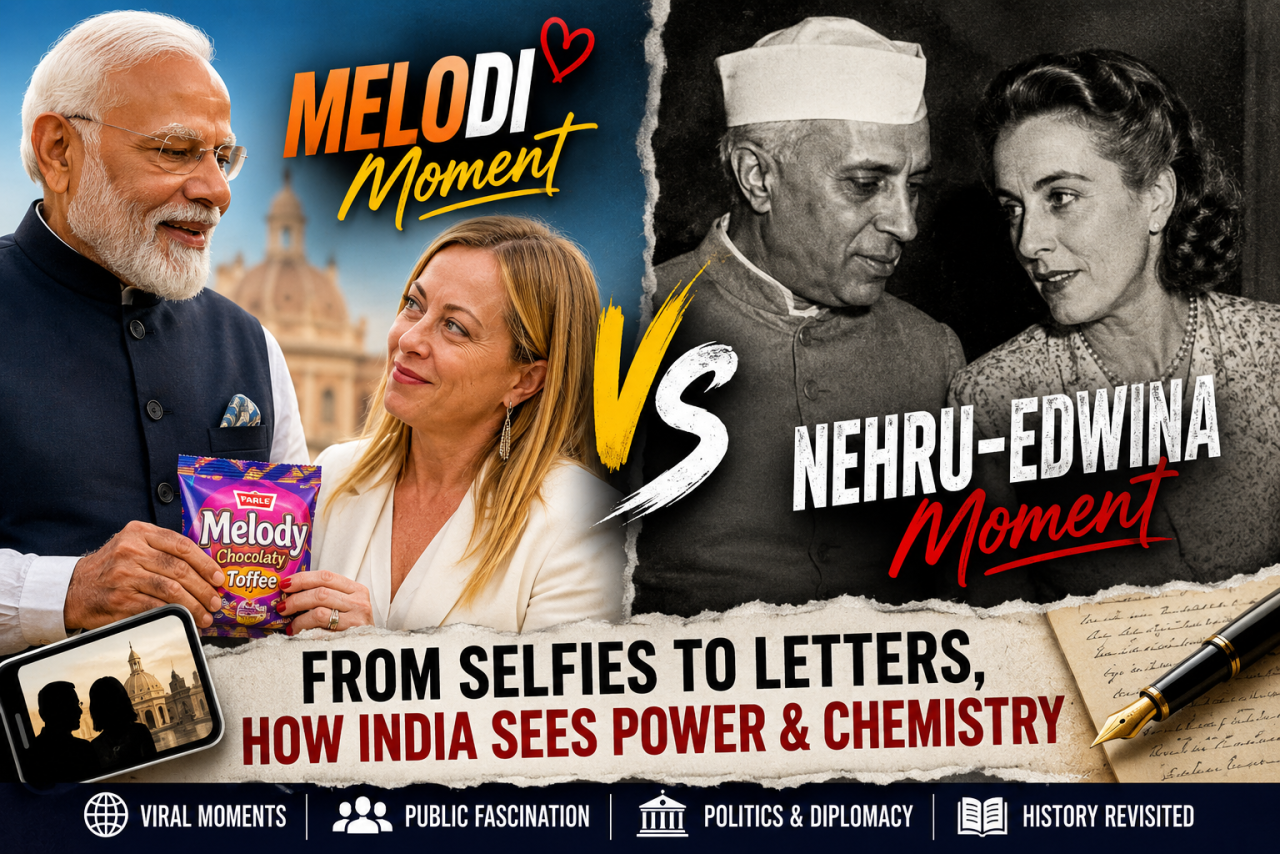
From handwritten letters to viral selfies, India’s political imagination has travelled across centuries — but its fascination with chemistry around power remains unchanged.
When Italian Prime Minister Giorgia Meloni uploaded a smiling video this week thanking Narendra Modi for gifting her Melody chocolates, global diplomacy briefly surrendered itself to internet culture.
Within minutes, “Melodi” — the now-famous fusion of Modi and Meloni — erupted once again across social media timelines. Meme accounts celebrated it like a celebrity crossover. Supporters called it soft diplomacy with charisma. Critics mocked the spectacle. Brands jumped into the conversation. Television debates followed. For a few hours, geopolitics looked less like a strategic summit and more like a scene from a digitally scripted pop-culture universe.
But beyond the humour and hashtags lies a deeper political truth: societies have always been fascinated not merely by leaders, but by the human chemistry surrounding power.
Long before selfies became diplomatic tools, another relationship occupied the imagination of India and Britain alike — the enduring and debated companionship between Jawaharlal Nehru and Edwina Mountbatten.
The comparison is tempting, though imperfect.
One belongs to the age of algorithms. The other emerged from the twilight of empire.
Yet both reveal how public life often extends beyond policy into emotion, symbolism, and storytelling.
The Modi–Meloni dynamic is unmistakably modern. It thrives in the grammar of visual politics. Their interactions at G20 summits and climate conferences have repeatedly gone viral because they combine statecraft with relatability. A smile held for cameras, a casual caption, a playful exchange — these become diplomatic signals in an age where perception travels faster than policy papers.
This is not accidental.
Modern leaders understand that global influence today is shaped not only through military power or trade negotiations, but also through image architecture. In the digital era, diplomacy is increasingly cinematic. Nations now communicate through optics as much as official communiqués.
And Modi, perhaps more effectively than most contemporary leaders, understands the theatre of political imagery.
Meloni does too.
Together, they represent a new kind of leadership performance — ideological, strategic, yet socially consumable. Their interactions resonate especially with younger audiences because they collapse the distance between statesmanship and internet culture. Foreign policy becomes emotionally accessible when wrapped inside humour, aesthetics, and personality.
But history offers a strikingly different picture through Nehru and Edwina.
There were no viral clips in 1947. No trending hashtags. No digital armies manufacturing narratives by the minute. Instead, there were private letters, formal dinners, political crises, and a newly independent India attempting to survive the trauma of Partition.
Edwina Mountbatten arrived in India as the wife of Lord Louis Mountbatten, the last Viceroy of British India. She entered a subcontinent bleeding from communal violence, mass migration, and institutional uncertainty. Amid this historical upheaval, she developed a close and emotionally rich friendship with Nehru.
The nature of that relationship has remained the subject of decades of historical interpretation.
Some biographers portray it as an intellectual companionship rooted in loneliness, admiration, and emotional dependence between two individuals burdened by extraordinary responsibilities. Others interpret it more politically, suggesting that personal proximity may have shaped channels of influence during critical negotiations surrounding Partition and early India–Britain relations.
What survives with certainty are the letters — deeply personal, thoughtful, affectionate, and reflective of unusual closeness.
But unlike today’s “Melodi” phenomenon, the Nehru–Edwina relationship unfolded within the etiquette of elite diplomacy and aristocratic restraint. Public discussion remained muted for years, surfacing mainly through memoirs, biographies, and archival revelations long after Independence.
That contrast reveals something important about the evolution of political culture itself.
The mid-20th century treated power with distance. Leaders were elevated figures, often inaccessible, wrapped in institutional gravitas. Their personal relationships became historical curiosity only after documents emerged.
The 21st century demands immediacy.
Today, the public no longer waits for archives; it consumes political emotion in real time. A diplomatic smile becomes a meme before the summit ends. Social media has transformed leaders into continuously visible personalities rather than distant constitutional figures.
This shift has profoundly altered diplomacy.
Modern geopolitics increasingly rewards leaders who can generate emotional connection alongside strategic influence. Optics are no longer secondary to diplomacy — they are diplomacy. Visual warmth between leaders signals ideological comfort, strategic trust, and public compatibility to global audiences watching online.
That is precisely why “Melodi” matters beyond comedy.
For supporters of Modi, the imagery projects India as confident, admired, and culturally dominant on the world stage. For critics, it risks reducing serious diplomacy into personality branding. But regardless of interpretation, the phenomenon demonstrates how deeply politics today depends upon emotional communication.
Curiously, Nehru faced similar tensions in a different language.
His critics frequently weaponised the Edwina relationship to question judgment and elitism. Admirers dismissed such attacks as voyeuristic distractions from his role in shaping modern India’s democratic institutions and foreign policy architecture.
In both cases, private chemistry became public metaphor.
And perhaps that is inevitable.
Human beings rarely engage with power in purely institutional terms. They search for stories inside governance. They personalise leadership. They interpret gestures emotionally. Nations themselves often construct mythology around leaders not only through speeches and wars, but through relationships, friendships, rivalries, and symbols.
That is why “Melodi” trends across Gen Z timelines while Nehru–Edwina continues to fascinate historians and political observers decades later.
Both narratives exist at the intersection of politics and human curiosity.
But history will ultimately judge these leaders not through memes or whispered romance, but through consequences.
Nehru’s legacy rests upon non-alignment, democratic institution-building, industrial modernisation, and the unresolved shadows of Kashmir and China.
Modi’s legacy will be measured through economic transformation, social cohesion, India’s geopolitical rise, democratic debate, and the shape of the republic he leaves behind.
The viral moments will survive as cultural snapshots of their times.
Yet perhaps the most revealing difference between the two eras is this:
Nehru and Edwina belonged to a world where emotions remained hidden inside letters.
Modi and Meloni belong to a world where emotions become global content instantly.
History changed its medium.
Human fascination with power never changed at all.
When Italian Prime Minister Giorgia Meloni uploaded a smiling video this week thanking Narendra Modi for gifting her Melody chocolates, global diplomacy briefly surrendered itself to internet culture.
Within minutes, “Melodi” — the now-famous fusion of Modi and Meloni — erupted once again across social media timelines. Meme accounts celebrated it like a celebrity crossover. Supporters called it soft diplomacy with charisma. Critics mocked the spectacle. Brands jumped into the conversation. Television debates followed. For a few hours, geopolitics looked less like a strategic summit and more like a scene from a digitally scripted pop-culture universe.
But beyond the humour and hashtags lies a deeper political truth: societies have always been fascinated not merely by leaders, but by the human chemistry surrounding power.
Long before selfies became diplomatic tools, another relationship occupied the imagination of India and Britain alike — the enduring and debated companionship between Jawaharlal Nehru and Edwina Mountbatten.
The comparison is tempting, though imperfect.
One belongs to the age of algorithms. The other emerged from the twilight of empire.
Yet both reveal how public life often extends beyond policy into emotion, symbolism, and storytelling.
The Modi–Meloni dynamic is unmistakably modern. It thrives in the grammar of visual politics. Their interactions at G20 summits and climate conferences have repeatedly gone viral because they combine statecraft with relatability. A smile held for cameras, a casual caption, a playful exchange — these become diplomatic signals in an age where perception travels faster than policy papers.
This is not accidental.
Modern leaders understand that global influence today is shaped not only through military power or trade negotiations, but also through image architecture. In the digital era, diplomacy is increasingly cinematic. Nations now communicate through optics as much as official communiqués.
And Modi, perhaps more effectively than most contemporary leaders, understands the theatre of political imagery.
Meloni does too.
Together, they represent a new kind of leadership performance — ideological, strategic, yet socially consumable. Their interactions resonate especially with younger audiences because they collapse the distance between statesmanship and internet culture. Foreign policy becomes emotionally accessible when wrapped inside humour, aesthetics, and personality.
But history offers a strikingly different picture through Nehru and Edwina.
There were no viral clips in 1947. No trending hashtags. No digital armies manufacturing narratives by the minute. Instead, there were private letters, formal dinners, political crises, and a newly independent India attempting to survive the trauma of Partition.
Edwina Mountbatten arrived in India as the wife of Lord Louis Mountbatten, the last Viceroy of British India. She entered a subcontinent bleeding from communal violence, mass migration, and institutional uncertainty. Amid this historical upheaval, she developed a close and emotionally rich friendship with Nehru.
The nature of that relationship has remained the subject of decades of historical interpretation.
Some biographers portray it as an intellectual companionship rooted in loneliness, admiration, and emotional dependence between two individuals burdened by extraordinary responsibilities. Others interpret it more politically, suggesting that personal proximity may have shaped channels of influence during critical negotiations surrounding Partition and early India–Britain relations.
What survives with certainty are the letters — deeply personal, thoughtful, affectionate, and reflective of unusual closeness.
But unlike today’s “Melodi” phenomenon, the Nehru–Edwina relationship unfolded within the etiquette of elite diplomacy and aristocratic restraint. Public discussion remained muted for years, surfacing mainly through memoirs, biographies, and archival revelations long after Independence.
That contrast reveals something important about the evolution of political culture itself.
The mid-20th century treated power with distance. Leaders were elevated figures, often inaccessible, wrapped in institutional gravitas. Their personal relationships became historical curiosity only after documents emerged.
The 21st century demands immediacy.
Today, the public no longer waits for archives; it consumes political emotion in real time. A diplomatic smile becomes a meme before the summit ends. Social media has transformed leaders into continuously visible personalities rather than distant constitutional figures.
This shift has profoundly altered diplomacy.
Modern geopolitics increasingly rewards leaders who can generate emotional connection alongside strategic influence. Optics are no longer secondary to diplomacy — they are diplomacy. Visual warmth between leaders signals ideological comfort, strategic trust, and public compatibility to global audiences watching online.
That is precisely why “Melodi” matters beyond comedy.
For supporters of Modi, the imagery projects India as confident, admired, and culturally dominant on the world stage. For critics, it risks reducing serious diplomacy into personality branding. But regardless of interpretation, the phenomenon demonstrates how deeply politics today depends upon emotional communication.
Curiously, Nehru faced similar tensions in a different language.
His critics frequently weaponised the Edwina relationship to question judgment and elitism. Admirers dismissed such attacks as voyeuristic distractions from his role in shaping modern India’s democratic institutions and foreign policy architecture.
In both cases, private chemistry became public metaphor.
And perhaps that is inevitable.
Human beings rarely engage with power in purely institutional terms. They search for stories inside governance. They personalise leadership. They interpret gestures emotionally. Nations themselves often construct mythology around leaders not only through speeches and wars, but through relationships, friendships, rivalries, and symbols.
That is why “Melodi” trends across Gen Z timelines while Nehru–Edwina continues to fascinate historians and political observers decades later.
Both narratives exist at the intersection of politics and human curiosity.
But history will ultimately judge these leaders not through memes or whispered romance, but through consequences.
Nehru’s legacy rests upon non-alignment, democratic institution-building, industrial modernisation, and the unresolved shadows of Kashmir and China.
Modi’s legacy will be measured through economic transformation, social cohesion, India’s geopolitical rise, democratic debate, and the shape of the republic he leaves behind.
The viral moments will survive as cultural snapshots of their times.
Yet perhaps the most revealing difference between the two eras is this:
Nehru and Edwina belonged to a world where emotions remained hidden inside letters.
Modi and Meloni belong to a world where emotions become global content instantly.
History changed its medium.
Human fascination with power never changed at all.










Leave a Comment