
Names are never just labels—they are political choices that decide which parts of history a nation remembers, and which it chooses to leave behind.
History shows that towns, cities, roads, and public buildings are not created randomly. They often reflect the political ideas and priorities of the ruling power. Across different periods, rulers have used architecture and urban planning to display authority and shape public memory. The grand monuments of the Delhi Sultanate and the Mughal Empire, as well as the planned cities built during British rule, all demonstrate how governments used public spaces to strengthen their legitimacy.
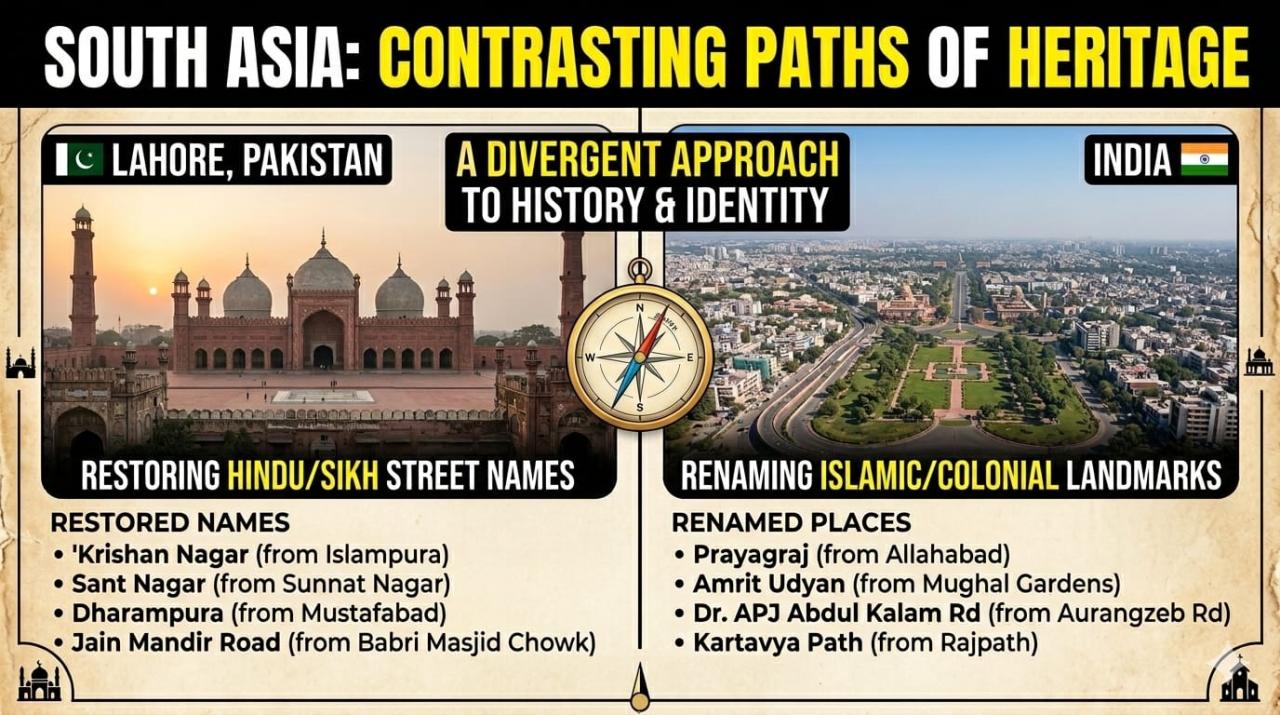
In present-day South Asia, this relationship between politics and public memory can be clearly seen in the naming and renaming of places. The politics of nomenclature—the process of assigning or changing names of roads, cities, and public institutions—has become an important tool for redefining national identity. Interestingly, India and Pakistan have adopted very different approaches in this matter. While India has increasingly changed names linked to its medieval Islamic past, Pakistan has recently begun restoring several pre-Partition Hindu, Sikh, Jain, and colonial-era names in parts of Lahore.
The Restoration of Historical Names in Pakistan’s Punjab
The provincial government of Punjab in Pakistan has recently approved a heritage project known as the “Lahore Heritage Areas Revival.” Under this initiative, several historical streets, roads, and neighborhoods in Lahore are being restored to their older names. The project has received support from political leaders such as Maryam Nawaz and Nawaz Sharif.
After the Partition of 1947, Pakistan adopted policies that aimed to build a national identity strongly connected to Islamic heritage. As a result, many places that reflected the region’s earlier Hindu, Sikh, Jain, or colonial history were renamed. The current restoration project represents a shift from that earlier approach. It seeks to recognize the plural and shared cultural traditions of pre-Partition Punjab, often described as the Ganga-Jamuni tehzeeb.
Changes in Lahore’s Urban Landscape
Some important examples of restored names are listed below:
Present Name
Restored Historical Name
Historical Importance
Islampura
Krishan Nagar
Hindu residential area before Partition
Sunnat Nagar
Sant Nagar
Linked with Sikh and Hindu communities
Mustafabad
Dharampura
Connected with traditional devotional history
Babri Masjid Chowk
Jain Mandir Road
Reflects Jain heritage
Rehman Gali
Ram Gali
Old residential lane
Maulana Zafar Ali Khan Chowk
Lakshmi Chowk
Major cultural and commercial center
Bagh-e-Jinnah
Lawrence Gardens
Colonial-era public garden
Fatima Jinnah Road
Queen’s Road
Important road during British rule
The heritage project also includes plans to restore old sports grounds and a traditional akhara (wrestling arena) at Greater Iqbal Park, formerly known as Minto Park. These places are historically associated with famous sports personalities of undivided India, including Lala Amarnath.
Through these restorations, the authorities are recognizing that Lahore’s history extends beyond the events of 1947 and reflects centuries of shared cultural development.
The Indian Context: Renaming and Cultural Identity
In contrast, India has witnessed a growing trend of renaming cities, roads, and institutions associated with the Mughal or Sultanate period. Supporters of these changes argue that they are necessary to correct historical distortions and revive ancient cultural identities.
Several important examples include:
- Allahabad was renamed Prayagraj to emphasize its ancient religious identity.
- Faizabad became Ayodhya.
- In New Delhi, roads such as Aurangzeb Road were renamed after national figures like A. P. J. Abdul Kalam.
- The Mughal Gardens at Rashtrapati Bhavan were renamed “Amrit Udyan.”
From a sociological perspective, these changes reflect an effort to reshape collective memory. Some political groups consider medieval Islamic rule as a period of foreign domination. Therefore, retaining such names is viewed as inconsistent with the identity of a modern Indian nation rooted in ancient civilization. Renaming is thus seen as a way to create continuity between present-day India and its pre-Islamic cultural traditions.
Political and Ideological Motivations
The different approaches followed by India and Pakistan are closely connected to their domestic politics and international concerns.
In Pakistan, many analysts view the restoration of non-Muslim place names as a strategic attempt to improve the country’s global image. Pakistan has often faced criticism regarding minority rights and religious intolerance. By restoring Hindu, Sikh, and Jain heritage sites, the government may also hope to encourage tourism from Sikh and Hindu communities living abroad.
In India, the renaming process reflects the growing influence of cultural nationalism. It marks a movement away from the idea of a “composite culture,” which leaders such as Jawaharlal Nehru strongly supported. Nehru believed that Indian civilization developed through the coexistence of multiple historical traditions. The present trend, however, places greater emphasis on a more unified and majoritarian interpretation of history.
Final Take: History Beyond Names
The debate over the naming of cities and public spaces demonstrates that history remains deeply connected with politics. Governments often reinterpret the past to support present-day ideological goals.
However, changing names alone cannot erase historical realities. Buildings, monuments, traditions, and cultural practices continue to preserve the memory of earlier periods. The urban structure of Lahore still reflects its Islamic and colonial heritage, just as cities such as Delhi, Agra, and Lucknow continue to carry strong influences from the medieval era.
Ultimately, these contrasting policies in India and Pakistan show how public memory can be shaped by the state, while the physical remains of history continue to challenge simplified national narratives.
History shows that towns, cities, roads, and public buildings are not created randomly. They often reflect the political ideas and priorities of the ruling power. Across different periods, rulers have used architecture and urban planning to display authority and shape public memory. The grand monuments of the Delhi Sultanate and the Mughal Empire, as well as the planned cities built during British rule, all demonstrate how governments used public spaces to strengthen their legitimacy.
In present-day South Asia, this relationship between politics and public memory can be clearly seen in the naming and renaming of places. The politics of nomenclature—the process of assigning or changing names of roads, cities, and public institutions—has become an important tool for redefining national identity. Interestingly, India and Pakistan have adopted very different approaches in this matter. While India has increasingly changed names linked to its medieval Islamic past, Pakistan has recently begun restoring several pre-Partition Hindu, Sikh, Jain, and colonial-era names in parts of Lahore.
The Restoration of Historical Names in Pakistan’s Punjab
The provincial government of Punjab in Pakistan has recently approved a heritage project known as the “Lahore Heritage Areas Revival.” Under this initiative, several historical streets, roads, and neighborhoods in Lahore are being restored to their older names. The project has received support from political leaders such as Maryam Nawaz and Nawaz Sharif.
After the Partition of 1947, Pakistan adopted policies that aimed to build a national identity strongly connected to Islamic heritage. As a result, many places that reflected the region’s earlier Hindu, Sikh, Jain, or colonial history were renamed. The current restoration project represents a shift from that earlier approach. It seeks to recognize the plural and shared cultural traditions of pre-Partition Punjab, often described as the Ganga-Jamuni tehzeeb.
Changes in Lahore’s Urban Landscape
Some important examples of restored names are listed below:
|
Present Name |
Restored Historical Name |
Historical Importance |
|
Islampura |
Krishan Nagar |
Hindu residential area before Partition |
|
Sunnat Nagar |
Sant Nagar |
Linked with Sikh and Hindu communities |
|
Mustafabad |
Dharampura |
Connected with traditional devotional history |
|
Babri Masjid Chowk |
Jain Mandir Road |
Reflects Jain heritage |
|
Rehman Gali |
Ram Gali |
Old residential lane |
|
Maulana Zafar Ali Khan Chowk |
Lakshmi Chowk |
Major cultural and commercial center |
|
Bagh-e-Jinnah |
Lawrence Gardens |
Colonial-era public garden |
|
Fatima Jinnah Road |
Queen’s Road |
Important road during British rule |
The heritage project also includes plans to restore old sports grounds and a traditional akhara (wrestling arena) at Greater Iqbal Park, formerly known as Minto Park. These places are historically associated with famous sports personalities of undivided India, including Lala Amarnath.
Through these restorations, the authorities are recognizing that Lahore’s history extends beyond the events of 1947 and reflects centuries of shared cultural development.
The Indian Context: Renaming and Cultural Identity
In contrast, India has witnessed a growing trend of renaming cities, roads, and institutions associated with the Mughal or Sultanate period. Supporters of these changes argue that they are necessary to correct historical distortions and revive ancient cultural identities.
Several important examples include:
- Allahabad was renamed Prayagraj to emphasize its ancient religious identity.
- Faizabad became Ayodhya.
- In New Delhi, roads such as Aurangzeb Road were renamed after national figures like A. P. J. Abdul Kalam.
- The Mughal Gardens at Rashtrapati Bhavan were renamed “Amrit Udyan.”
From a sociological perspective, these changes reflect an effort to reshape collective memory. Some political groups consider medieval Islamic rule as a period of foreign domination. Therefore, retaining such names is viewed as inconsistent with the identity of a modern Indian nation rooted in ancient civilization. Renaming is thus seen as a way to create continuity between present-day India and its pre-Islamic cultural traditions.
Political and Ideological Motivations
The different approaches followed by India and Pakistan are closely connected to their domestic politics and international concerns.
In Pakistan, many analysts view the restoration of non-Muslim place names as a strategic attempt to improve the country’s global image. Pakistan has often faced criticism regarding minority rights and religious intolerance. By restoring Hindu, Sikh, and Jain heritage sites, the government may also hope to encourage tourism from Sikh and Hindu communities living abroad.
In India, the renaming process reflects the growing influence of cultural nationalism. It marks a movement away from the idea of a “composite culture,” which leaders such as Jawaharlal Nehru strongly supported. Nehru believed that Indian civilization developed through the coexistence of multiple historical traditions. The present trend, however, places greater emphasis on a more unified and majoritarian interpretation of history.
Final Take: History Beyond Names
The debate over the naming of cities and public spaces demonstrates that history remains deeply connected with politics. Governments often reinterpret the past to support present-day ideological goals.
However, changing names alone cannot erase historical realities. Buildings, monuments, traditions, and cultural practices continue to preserve the memory of earlier periods. The urban structure of Lahore still reflects its Islamic and colonial heritage, just as cities such as Delhi, Agra, and Lucknow continue to carry strong influences from the medieval era.
Ultimately, these contrasting policies in India and Pakistan show how public memory can be shaped by the state, while the physical remains of history continue to challenge simplified national narratives.




















Leave a Comment