
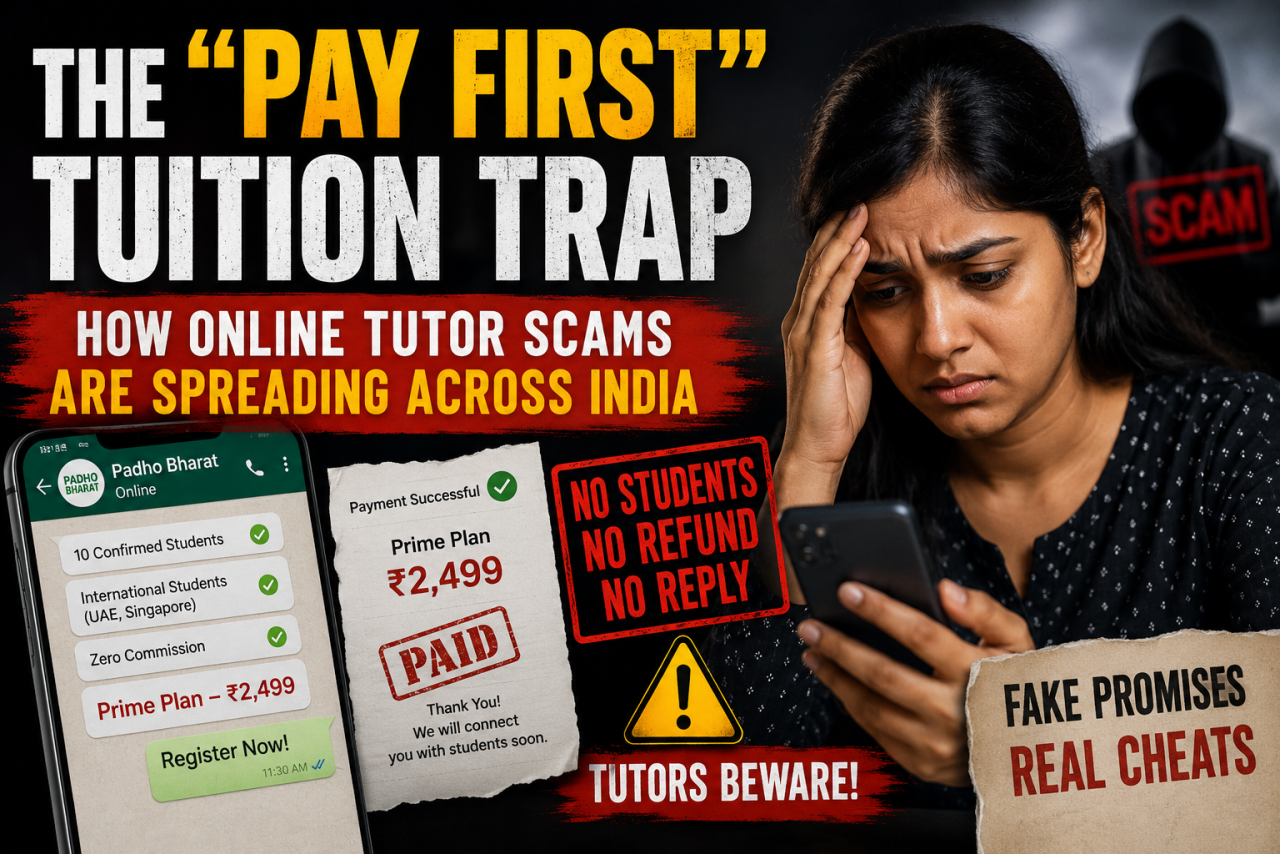
A WhatsApp message promising “guaranteed students” may look like an opportunity for struggling teachers — but for many tutors across India, it allegedly became the beginning of a costly online scam.
India’s online tutoring industry has grown rapidly over the last few years. From school students preparing for board exams to professionals learning new skills, demand for private online teaching has created income opportunities for thousands of tutors across the country. But alongside this boom, another ecosystem is quietly expanding — one built not around students, but around exploiting teachers themselves.
Across Delhi-NCR and several other cities, educators are increasingly reporting experiences with online tutoring agencies that allegedly promise guaranteed students, collect registration fees, and then disappear or stop responding after payment. Among the names now being discussed in tutor communities is “Padho Bharat,” which multiple teachers accuse of operating a misleading “pay first” model.
The allegations point to a growing pattern within India’s unregulated online tutoring market, where freelance educators searching for work are becoming easy targets for digital scams.
How the Model Works
According to several tutors who shared their experiences online and in teaching groups, the process usually begins with a phone call, WhatsApp message, or social media advertisement. The company claims to connect teachers with students in India and abroad and promotes “premium tutor plans” that promise fast onboarding and regular tuition assignments.
Teachers are reportedly asked to pay around ₹2,499 for a “Prime Plan” that includes benefits such as:
- Guaranteed student leads
- International tuition opportunities
- Zero commission on monthly earnings
- Dedicated support managers
- Tutor ID cards and certificates
- Refund guarantees within a limited period
For many tutors, especially fresh graduates, homemakers, part-time teachers, and unemployed youth, the offer appears genuine. The amount is relatively small compared to the income promised, which makes the risk seem manageable.
But according to multiple allegations, communication reportedly changes once payment is completed.
Several tutors claim they never received the promised students. Others allege that support teams stopped responding regularly after payment confirmation. Some say their refund requests were ignored despite earlier assurances.
A common complaint among alleged victims is that the company appeared highly professional during the payment stage but became inaccessible afterward.
Why Teachers Become Easy Targets
Unlike traditional jobs, private tutoring often operates through informal networks. Freelance teachers usually depend on Facebook groups, Telegram channels, WhatsApp communities, and classified websites to find students. In many cases, there is little verification of agencies or recruiters.
Scammers exploit this gap.
The timing also matters. India’s employment crisis has pushed many educated young people toward tutoring as a temporary or full-time source of income. Competitive exam aspirants, postgraduate students, and even experienced teachers increasingly rely on private classes to manage daily expenses.
In such a situation, the promise of “guaranteed students” becomes difficult to ignore.
The mention of international students is another major attraction. Teaching students abroad can offer significantly higher earnings because of currency differences. Fraudulent agencies allegedly use this aspiration to convince tutors that registration fees are part of a professional recruitment process.
Many victims also hesitate to report such incidents publicly because the financial loss appears small compared to larger cybercrimes. This silence allows questionable operations to continue targeting new people.
The Warning Signs Tutors Often Miss
Cyber experts and experienced educators say there are several warning signs teachers should notice before paying any tutoring agency.
- Upfront Registration Fees: Most established tutoring platforms either allow free registration or deduct commission only after classes begin. Demanding payment before assigning any student should raise concerns.
- Guaranteed Students: No legitimate platform can realistically guarantee a fixed number of students within days. Student allocation depends on subject demand, location, timings, and trial sessions.
- Pressure Tactics: Victims often report being told that “limited slots” are available or that offers will expire within hours. Such urgency is commonly used to stop people from researching the company.
- Poor Transparency: Many questionable agencies lack verified office addresses, proper websites, or responsive customer support systems. Some operate mainly through WhatsApp and temporary phone numbers.
- Overly Polished Promises: Professional-looking invoices, digital ID cards, and certificates do not necessarily prove legitimacy. Scammers increasingly use branding and documentation to appear credible.
A Larger Problem Inside India’s EdTech Economy
The controversy surrounding companies like “Padho Bharat” also reflects a larger problem within India’s growing education technology sector.
While major EdTech firms dominate headlines, a parallel market of unverified tutoring agencies has emerged online with very little regulation. Anyone can create social media advertisements, design a basic website, and begin approaching tutors with claims of student availability.
At present, there is no strong nationwide mechanism to verify tutoring agencies or protect freelance educators from misleading recruitment practices. Many tutors work independently without contracts or legal safeguards.
As digital education expands, experts say stronger oversight may become necessary to prevent exploitation within the sector.
What Tutors Should Do Before Paying
Teachers searching for tuition opportunities should take basic precautions before transferring money to any platform or agency.
- Search online reviews and complaints carefully
- Verify whether the business has a registered office and proper customer support
- Speak to existing tutors associated with the platform
- Avoid making rushed payments under pressure
- Preserve screenshots, invoices, and payment records
If fraud is suspected, victims can report the matter through India’s cybercrime portal and also contact their bank or payment provider immediately.
Final Take
India’s online tutoring industry has created genuine opportunities for educators, but it has also opened the door for new forms of exploitation. The allegations surrounding “Padho Bharat” show how easily unemployed or freelance teachers can be targeted through professional-looking promises and upfront-fee models.
For many tutors, the loss is not only financial. It also damages trust in an industry that increasingly operates online.
As more educators enter the digital teaching economy, caution is becoming as important as qualification. In today’s tutoring market, the safest rule may be the simplest one: if a company asks for money before giving work, verify everything before paying.
Read Next: The Tuition Trap: How “Padho Bharat” Is Exploiting Teachers Across Delhi-NCR
India’s online tutoring industry has grown rapidly over the last few years. From school students preparing for board exams to professionals learning new skills, demand for private online teaching has created income opportunities for thousands of tutors across the country. But alongside this boom, another ecosystem is quietly expanding — one built not around students, but around exploiting teachers themselves.
Across Delhi-NCR and several other cities, educators are increasingly reporting experiences with online tutoring agencies that allegedly promise guaranteed students, collect registration fees, and then disappear or stop responding after payment. Among the names now being discussed in tutor communities is “Padho Bharat,” which multiple teachers accuse of operating a misleading “pay first” model.
The allegations point to a growing pattern within India’s unregulated online tutoring market, where freelance educators searching for work are becoming easy targets for digital scams.
How the Model Works
According to several tutors who shared their experiences online and in teaching groups, the process usually begins with a phone call, WhatsApp message, or social media advertisement. The company claims to connect teachers with students in India and abroad and promotes “premium tutor plans” that promise fast onboarding and regular tuition assignments.
Teachers are reportedly asked to pay around ₹2,499 for a “Prime Plan” that includes benefits such as:
- Guaranteed student leads
- International tuition opportunities
- Zero commission on monthly earnings
- Dedicated support managers
- Tutor ID cards and certificates
- Refund guarantees within a limited period
For many tutors, especially fresh graduates, homemakers, part-time teachers, and unemployed youth, the offer appears genuine. The amount is relatively small compared to the income promised, which makes the risk seem manageable.
But according to multiple allegations, communication reportedly changes once payment is completed.
Several tutors claim they never received the promised students. Others allege that support teams stopped responding regularly after payment confirmation. Some say their refund requests were ignored despite earlier assurances.
A common complaint among alleged victims is that the company appeared highly professional during the payment stage but became inaccessible afterward.
Why Teachers Become Easy Targets
Unlike traditional jobs, private tutoring often operates through informal networks. Freelance teachers usually depend on Facebook groups, Telegram channels, WhatsApp communities, and classified websites to find students. In many cases, there is little verification of agencies or recruiters.
Scammers exploit this gap.
The timing also matters. India’s employment crisis has pushed many educated young people toward tutoring as a temporary or full-time source of income. Competitive exam aspirants, postgraduate students, and even experienced teachers increasingly rely on private classes to manage daily expenses.
In such a situation, the promise of “guaranteed students” becomes difficult to ignore.
The mention of international students is another major attraction. Teaching students abroad can offer significantly higher earnings because of currency differences. Fraudulent agencies allegedly use this aspiration to convince tutors that registration fees are part of a professional recruitment process.
Many victims also hesitate to report such incidents publicly because the financial loss appears small compared to larger cybercrimes. This silence allows questionable operations to continue targeting new people.
The Warning Signs Tutors Often Miss
Cyber experts and experienced educators say there are several warning signs teachers should notice before paying any tutoring agency.
- Upfront Registration Fees: Most established tutoring platforms either allow free registration or deduct commission only after classes begin. Demanding payment before assigning any student should raise concerns.
- Guaranteed Students: No legitimate platform can realistically guarantee a fixed number of students within days. Student allocation depends on subject demand, location, timings, and trial sessions.
- Pressure Tactics: Victims often report being told that “limited slots” are available or that offers will expire within hours. Such urgency is commonly used to stop people from researching the company.
- Poor Transparency: Many questionable agencies lack verified office addresses, proper websites, or responsive customer support systems. Some operate mainly through WhatsApp and temporary phone numbers.
- Overly Polished Promises: Professional-looking invoices, digital ID cards, and certificates do not necessarily prove legitimacy. Scammers increasingly use branding and documentation to appear credible.
A Larger Problem Inside India’s EdTech Economy
The controversy surrounding companies like “Padho Bharat” also reflects a larger problem within India’s growing education technology sector.
While major EdTech firms dominate headlines, a parallel market of unverified tutoring agencies has emerged online with very little regulation. Anyone can create social media advertisements, design a basic website, and begin approaching tutors with claims of student availability.
At present, there is no strong nationwide mechanism to verify tutoring agencies or protect freelance educators from misleading recruitment practices. Many tutors work independently without contracts or legal safeguards.
As digital education expands, experts say stronger oversight may become necessary to prevent exploitation within the sector.
What Tutors Should Do Before Paying
Teachers searching for tuition opportunities should take basic precautions before transferring money to any platform or agency.
- Search online reviews and complaints carefully
- Verify whether the business has a registered office and proper customer support
- Speak to existing tutors associated with the platform
- Avoid making rushed payments under pressure
- Preserve screenshots, invoices, and payment records
If fraud is suspected, victims can report the matter through India’s cybercrime portal and also contact their bank or payment provider immediately.
Final Take
India’s online tutoring industry has created genuine opportunities for educators, but it has also opened the door for new forms of exploitation. The allegations surrounding “Padho Bharat” show how easily unemployed or freelance teachers can be targeted through professional-looking promises and upfront-fee models.
For many tutors, the loss is not only financial. It also damages trust in an industry that increasingly operates online.
As more educators enter the digital teaching economy, caution is becoming as important as qualification. In today’s tutoring market, the safest rule may be the simplest one: if a company asks for money before giving work, verify everything before paying.
Read Next: The Tuition Trap: How “Padho Bharat” Is Exploiting Teachers Across Delhi-NCR

























Leave a Comment