
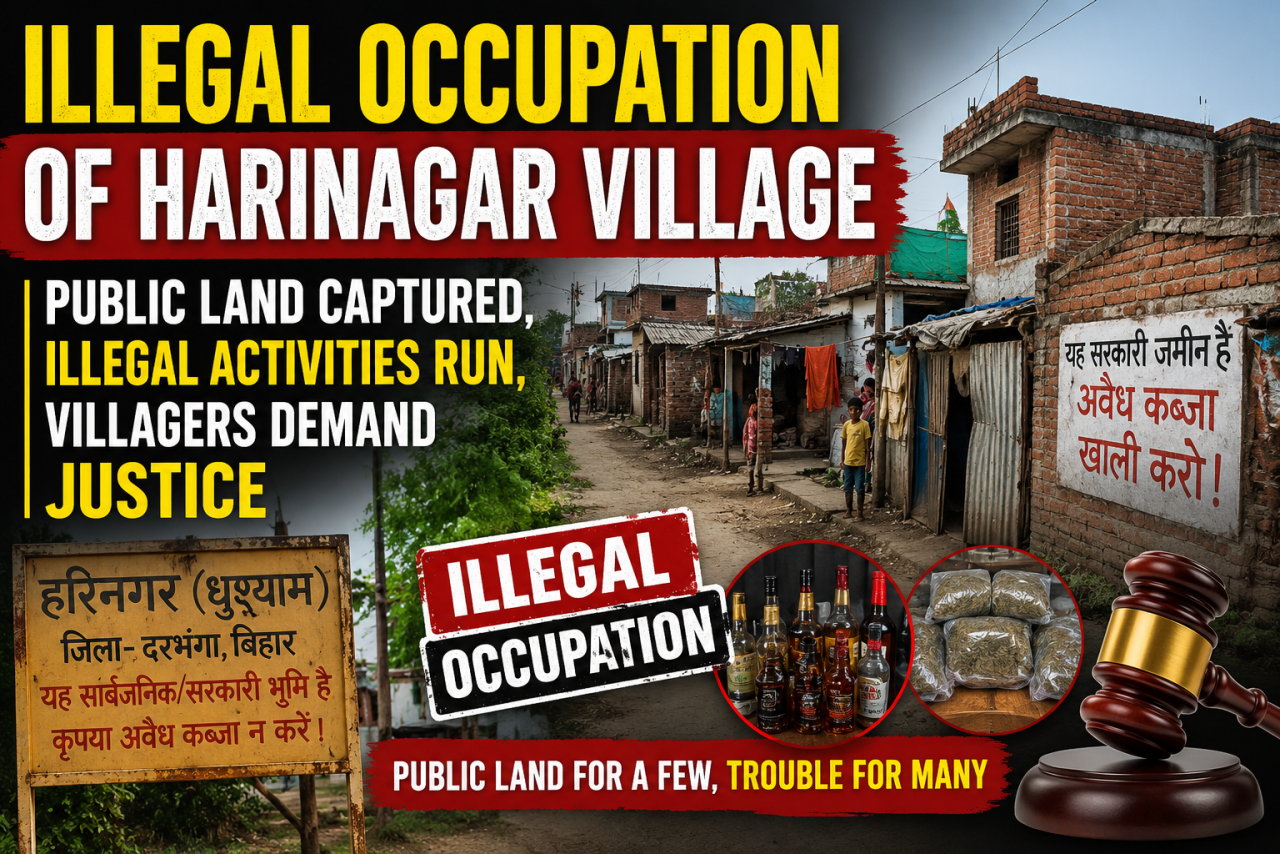
For years, villagers in Bihar’s Dhurshyam claimed that public land remained under illegal occupation while politics and fear kept authorities silent.
Land disputes in rural India are rarely simple legal conflicts. They often involve politics, caste equations, administrative weakness, and the everyday frustration of ordinary villagers. A recent matter before the High Court of Judicature at Patna relating to Harinagar village in Darbhanga district has once again highlighted how illegal occupation of public land can become a long-term source of tension within rural communities.
The case emerged after members of the Paswan community challenged an anti-encroachment action initiated by local authorities under the Bihar Public Land Encroachment Act, 1956. The petitioners sought protection against eviction and demolition, claiming that the houses standing on the land were ancestral dwellings. They also requested the Court to stop the administration from taking coercive action against them.
However, the dispute reflects a much deeper conflict at the village level.
According to many residents of Harinagar village, the land in question had been under illegal occupation for years. Villagers reportedly believed that the encroachment was not merely a matter of shelter, but had gradually become linked to unlawful activities and local political patronage. Allegations circulated within the village that portions of the occupied area were being used for activities such as illegal liquor trade and the sale of narcotic substances like ganja and weed. These allegations contributed to growing resentment among sections of the local population.
For many villagers, the issue was therefore not only about land ownership, but also about law, public order, and the authority of the state.
Across Bihar, public land encroachment has become a serious governance challenge. Government land meant for roads, ponds, schools, grazing fields, and community use is often occupied over time by private individuals or groups. In many cases, administrations hesitate to act because of political pressure, caste mobilization, or fear of local unrest. As a result, encroachments that begin temporarily often become permanent realities.
This situation creates anger among ordinary villagers who feel that the rule of law applies differently to different groups.
In villages, perceptions matter greatly. When local communities believe that illegal occupation continues because of political backing, public trust in institutions weakens. Many residents begin to feel that influential groups can misuse caste identity or political connections to avoid administrative action. Such perceptions deepen social divisions and create a sense of injustice among law-abiding citizens.
The Harinagar dispute appears to reflect this wider rural frustration.
Reports from the village suggest that a significant section of residents supported the administration’s effort to remove the encroachment and reclaim the land. For them, the anti-encroachment drive represented an attempt to restore order after years of inaction. Many villagers reportedly believed that reclaiming public land was necessary for the larger interest of the community.
At the same time, the matter also reveals the sensitive nature of caste politics in Bihar. Land conflicts often quickly become caste conflicts, especially when political actors intervene. Instead of treating encroachment strictly as a legal and administrative issue, political leaders sometimes frame such disputes through the lens of vote-bank politics. This complicates enforcement and weakens neutral governance.
The role of the judiciary in such situations becomes limited but important. In the Patna High Court proceedings, the petitioners eventually sought permission to file their objections before the Circle Officer. The Court granted them liberty to do so and disposed of the petition. The order itself did not declare the encroachment legal or illegal. Instead, it reinforced the procedural principle that affected parties should be allowed to present their side before final action is taken.
Yet the larger debate remains unresolved.
Should long-term illegal occupation automatically gain social legitimacy? Can political protection be allowed to override public ownership? And how should governments balance humanitarian concerns with the need to uphold law and order?
These questions are increasingly relevant across many parts of rural India.
It is true that poverty and weak land documentation often complicate eviction drives. But it is equally true that illegal occupation of public land cannot become a permanent parallel system protected by political influence. If administrations fail to act fairly and firmly, ordinary citizens lose faith in governance. Public resources meant for the community gradually disappear into private control.
The answer lies in consistent and impartial administration. Anti-encroachment laws must be enforced without discrimination, regardless of caste or political affiliation. Illegal activities operating from encroached areas must be investigated seriously. At the same time, authorities should ensure transparency, proper hearings, and humane implementation of the law.
The Harinagar dispute is therefore more than a local land conflict. It reflects the broader struggle between public interest and political protection, between the rule of law and the normalization of illegal occupation. In the long run, rural governance can function effectively only when laws are applied equally and public land remains truly public.
Land disputes in rural India are rarely simple legal conflicts. They often involve politics, caste equations, administrative weakness, and the everyday frustration of ordinary villagers. A recent matter before the High Court of Judicature at Patna relating to Harinagar village in Darbhanga district has once again highlighted how illegal occupation of public land can become a long-term source of tension within rural communities.
The case emerged after members of the Paswan community challenged an anti-encroachment action initiated by local authorities under the Bihar Public Land Encroachment Act, 1956. The petitioners sought protection against eviction and demolition, claiming that the houses standing on the land were ancestral dwellings. They also requested the Court to stop the administration from taking coercive action against them.
However, the dispute reflects a much deeper conflict at the village level.
According to many residents of Harinagar village, the land in question had been under illegal occupation for years. Villagers reportedly believed that the encroachment was not merely a matter of shelter, but had gradually become linked to unlawful activities and local political patronage. Allegations circulated within the village that portions of the occupied area were being used for activities such as illegal liquor trade and the sale of narcotic substances like ganja and weed. These allegations contributed to growing resentment among sections of the local population.
For many villagers, the issue was therefore not only about land ownership, but also about law, public order, and the authority of the state.
Across Bihar, public land encroachment has become a serious governance challenge. Government land meant for roads, ponds, schools, grazing fields, and community use is often occupied over time by private individuals or groups. In many cases, administrations hesitate to act because of political pressure, caste mobilization, or fear of local unrest. As a result, encroachments that begin temporarily often become permanent realities.
This situation creates anger among ordinary villagers who feel that the rule of law applies differently to different groups.
In villages, perceptions matter greatly. When local communities believe that illegal occupation continues because of political backing, public trust in institutions weakens. Many residents begin to feel that influential groups can misuse caste identity or political connections to avoid administrative action. Such perceptions deepen social divisions and create a sense of injustice among law-abiding citizens.
The Harinagar dispute appears to reflect this wider rural frustration.
Reports from the village suggest that a significant section of residents supported the administration’s effort to remove the encroachment and reclaim the land. For them, the anti-encroachment drive represented an attempt to restore order after years of inaction. Many villagers reportedly believed that reclaiming public land was necessary for the larger interest of the community.
At the same time, the matter also reveals the sensitive nature of caste politics in Bihar. Land conflicts often quickly become caste conflicts, especially when political actors intervene. Instead of treating encroachment strictly as a legal and administrative issue, political leaders sometimes frame such disputes through the lens of vote-bank politics. This complicates enforcement and weakens neutral governance.
The role of the judiciary in such situations becomes limited but important. In the Patna High Court proceedings, the petitioners eventually sought permission to file their objections before the Circle Officer. The Court granted them liberty to do so and disposed of the petition. The order itself did not declare the encroachment legal or illegal. Instead, it reinforced the procedural principle that affected parties should be allowed to present their side before final action is taken.
Yet the larger debate remains unresolved.
Should long-term illegal occupation automatically gain social legitimacy? Can political protection be allowed to override public ownership? And how should governments balance humanitarian concerns with the need to uphold law and order?
These questions are increasingly relevant across many parts of rural India.
It is true that poverty and weak land documentation often complicate eviction drives. But it is equally true that illegal occupation of public land cannot become a permanent parallel system protected by political influence. If administrations fail to act fairly and firmly, ordinary citizens lose faith in governance. Public resources meant for the community gradually disappear into private control.
The answer lies in consistent and impartial administration. Anti-encroachment laws must be enforced without discrimination, regardless of caste or political affiliation. Illegal activities operating from encroached areas must be investigated seriously. At the same time, authorities should ensure transparency, proper hearings, and humane implementation of the law.
The Harinagar dispute is therefore more than a local land conflict. It reflects the broader struggle between public interest and political protection, between the rule of law and the normalization of illegal occupation. In the long run, rural governance can function effectively only when laws are applied equally and public land remains truly public.






















Leave a Comment