
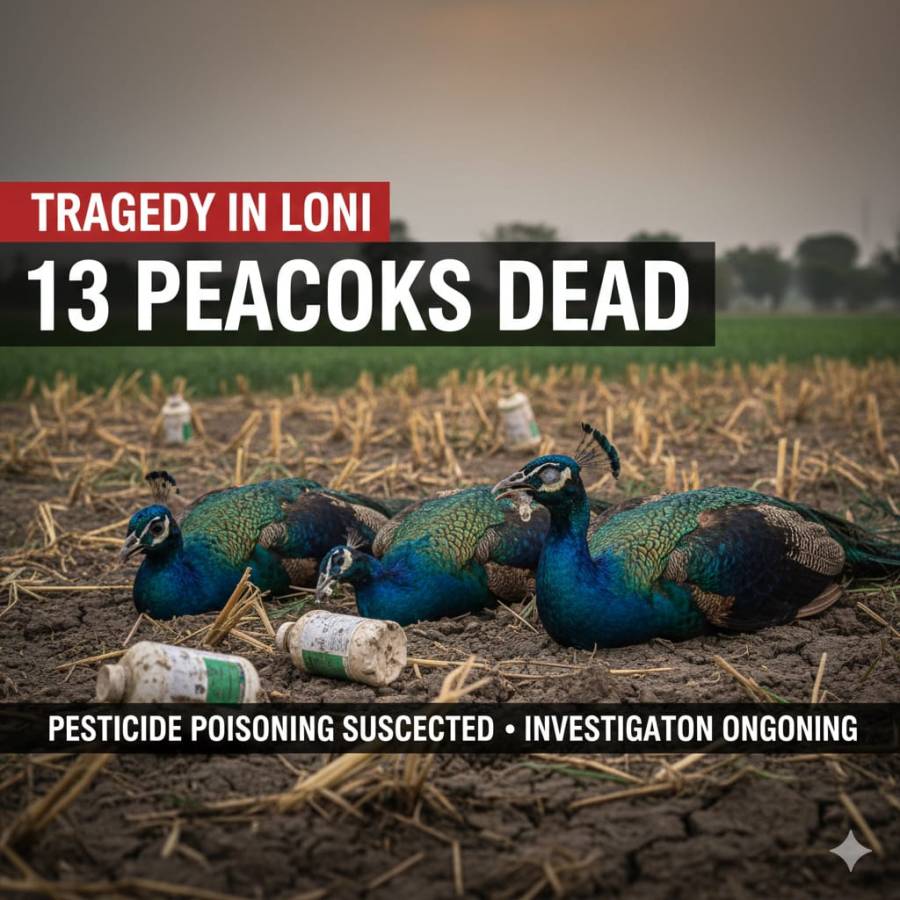
Thirteen peacocks dead in just two days — and the silence over Ghaziabad’s fields is louder than ever. What appears to be routine pesticide spraying may have turned fertile farmland into a toxic trap for India’s national bird, raising urgent questions about how far agricultural practices are pushing the limits of ecological safety.
A suspected case of pesticide overuse has led to the death of 13 peacocks in Paychara village of Ghaziabad, triggering environmental concern and legal action from forest authorities. The incident, which unfolded over two days, has raised serious questions about chemical use in agricultural fields located near sensitive wildlife habitats.
According to a report by Piyush Khandelwal in Hindustan Times, the deaths were first discovered on Monday afternoon when forest department officials found 10 peacocks lying dead in the fields of Paychara, a village in the Loni area. One injured peacock was rescued and rushed for treatment.
By Tuesday morning, the situation worsened. The injured bird succumbed to its condition, and two more carcasses were discovered during a follow-up inspection. With this, the death toll climbed to 13 within 48 hours.
Suspected Cause: Chemical Exposure
Forest officials suspect that excessive use of pesticides in agricultural fields may have poisoned the birds. Paychara village is situated adjacent to the floodplains of the Yamuna River, an area known for fertile soil and intensive farming. While the land supports robust crop production, it also witnesses heavy application of chemical fertilizers and pesticides.
Peacocks frequently forage in open fields for grains and insects. Officials believe the birds may have consumed pesticide-contaminated food or water, leading to poisoning.
Divisional Forest Officer Isha Tiwari confirmed that the farm where pesticide overuse is suspected has been covered to prevent further exposure. The department acted swiftly to ensure that no additional birds or wildlife access the affected patch of land while the investigation continues.
Legal Proceedings Initiated
Since the peacock is India’s national bird and protected under the Wildlife (Protection) Act, authorities have registered a preliminary case against unidentified persons. Officials stated that strict action will follow if negligence or intentional misuse of chemicals is established.
“The peacock under treatment also succumbed on Tuesday morning, and our teams found two more dead birds in the village. Overall, 13 peacocks have died so far in a case suspected to be linked to pesticide overuse,” a forest department official said.
Scientific Examination Underway
To determine the exact cause of death, samples from the deceased birds have been sent for forensic analysis. Additionally, post-mortem examinations and detailed pathological studies will be conducted at the Indian Veterinary Research Institute.
Officials indicated that laboratory reports are expected within a few days. Only after scientific confirmation will the department conclusively establish whether chemical poisoning caused the deaths.
Meanwhile, the forest department has begun spreading awareness among local farmers about the dangers of excessive pesticide use. Authorities emphasized that while pesticides are often used to protect crops from infestation, their misuse can have unintended and devastating ecological consequences.
A Larger Environmental Warning
The incident highlights the fragile balance between agriculture and wildlife conservation. Areas near river floodplains often attract birds and other species, making them particularly vulnerable to chemical contamination.
As Ghaziabad awaits the final forensic findings, the peacock deaths serve as a sobering reminder that environmental negligence can quickly escalate into wildlife tragedy. Beyond enforcement, officials stress that long-term prevention will depend on responsible farming practices and greater awareness about sustainable pesticide use.
The coming days will determine accountability, but the loss of 13 peacocks has already left a lasting mark on the village and renewed the call for stricter monitoring of agrochemical use in ecologically sensitive zones.





















Leave a Comment