
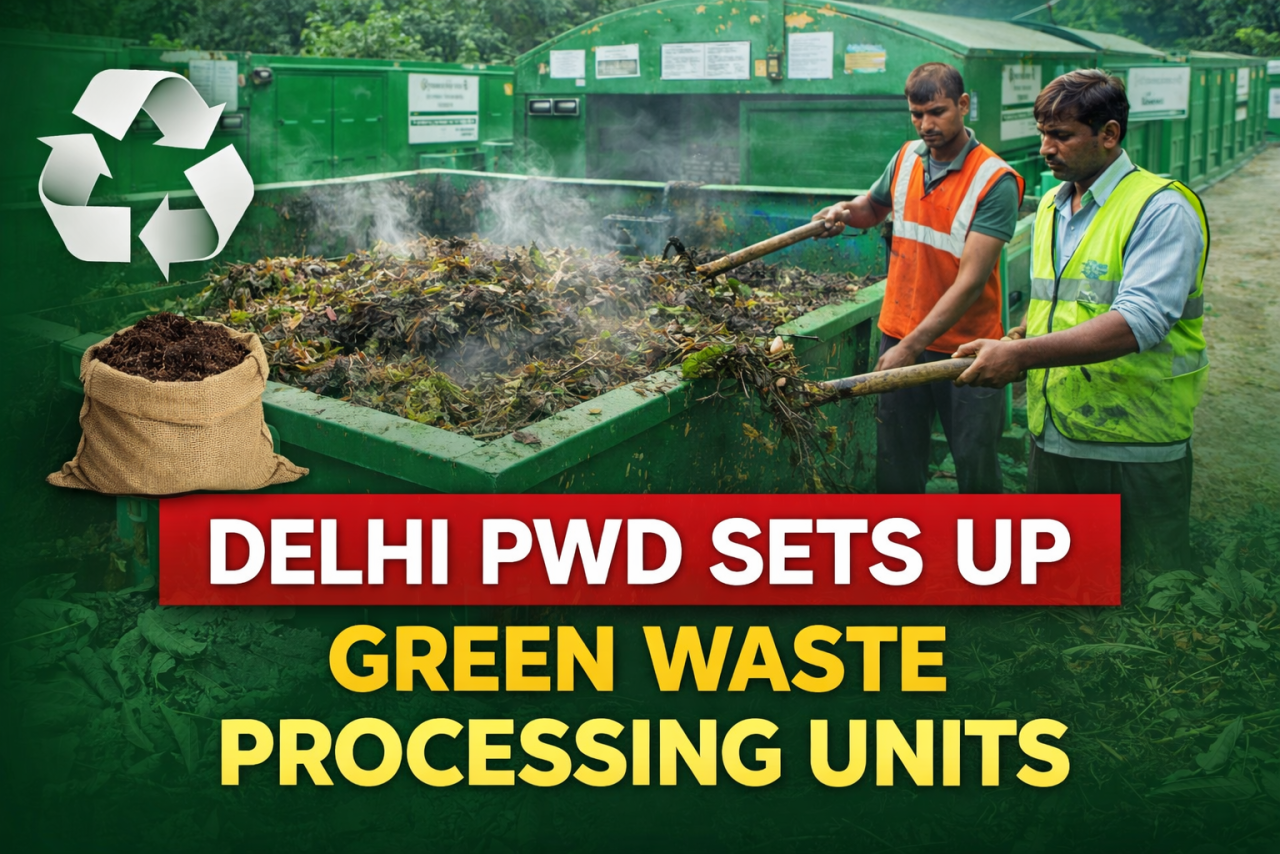
What was once rotting on Delhi’s roadsides will now return to the soil as compost—PWD’s first green waste processing plant signals a cleaner, smarter way to manage the city’s green footprint.
In a significant step toward sustainable urban management, the Public Works Department (PWD) of Delhi has inaugurated its first green waste processing plant, marking a shift in how the city handles horticultural waste generated along its vast road network and public spaces.
The facility, inaugurated by PWD Minister Parvesh Verma at the Secretariat nursery, is designed to process green waste such as branches, shrubs, leaves, and tree trimmings collected from roadsides and landscaped areas maintained by the department. Instead of being left to decay in open spaces or dumped along roadsides, this organic waste will now be converted into compost for reuse in landscaping and plantation activities.
For years, the absence of a dedicated processing system meant that trimmed branches and other plant waste often remained piled up for extended periods, particularly after storms or routine pruning drives. Such heaps not only created an eyesore but also raised sanitation concerns as the organic matter decomposed in public spaces. Residents’ welfare associations and schools had repeatedly flagged the issue, demanding a structured and permanent solution for green waste disposal.
With the launch of this plant, officials say that the department has taken a decisive step toward addressing those long-standing concerns. The compost produced at the facility will be used by the horticulture department, creating a closed-loop system where waste generated from maintenance activities is recycled back into the city’s green infrastructure.
Importantly, the initiative is not limited to a single site. Alongside the Secretariat nursery plant, five additional green waste processing facilities have become operational at key locations across the capital — Patparganj Industrial Area, Mukarba Chowk nursery, Lajwanti nursery in West Delhi, Sukhdev Vihar, and RK Puram. This distributed network is expected to significantly improve the department’s ability to handle horticultural waste generated across thousands of kilometres of roads under its jurisdiction.
Officials acknowledged that despite managing large-scale horticulture maintenance across the city, the department previously lacked a dedicated green waste processing mechanism. The new infrastructure fills that gap and signals a broader shift in urban waste management priorities.
The move comes at a time when Indian cities are under increasing pressure to adopt environmentally responsible practices. Open dumping of green waste not only contributes to localised pollution but can also encourage the burning of dry leaves and branches — a practice that worsens air quality, particularly during the winter months. By institutionalising composting, the PWD aims to reduce such risks while promoting sustainable reuse.
Environmental experts have long argued that organic waste, when managed properly, can become a valuable resource rather than a disposal problem. Composting enriches soil health, reduces dependence on chemical fertilizers, and supports urban biodiversity. In a city like Delhi, where maintaining green cover is critical to countering pollution and heat, the availability of locally produced compost could provide both ecological and economic benefits.
The success of the initiative, however, will depend on efficient collection systems, regular monitoring, and public cooperation. If managed effectively, the green waste processing plants could serve as a model for other municipal bodies in the National Capital Region and beyond.
As Delhi continues to grapple with the challenges of rapid urbanisation and environmental stress, the PWD’s new composting facilities represent a practical step toward cleaner streets, healthier public spaces, and a more circular approach to managing the city’s green resources.
























Leave a Comment