
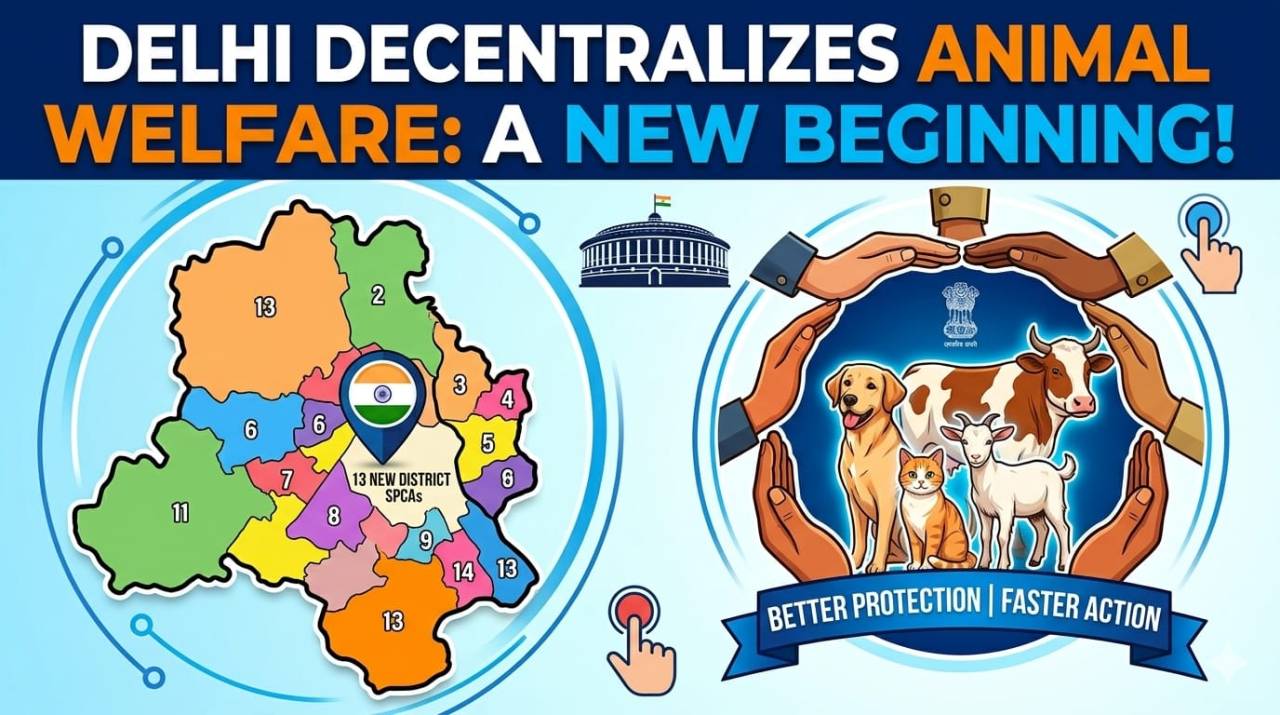
Delhi’s new 13-district SPCA model aims to fix delays in animal rescue and crack down on cruelty—here’s how the system will work.
The Delhi government has introduced a 13-district animal welfare framework that replaces the centralized Delhi Society for Prevention of Cruelty to Animals model with localized Societies for Prevention of Cruelty to Animals (SPCAs). The policy aims to strengthen enforcement of the Prevention of Cruelty to Animals Act, 1960, improve response time in animal rescue cases, and decentralize animal protection services across the capital. By placing district authorities at the center of implementation, the reform is expected to enhance accountability, streamline legal action against animal cruelty, and address region-specific challenges such as stray animal management, pet neglect, and urban wildlife care.
A Shift from Centralization to Grassroots Action
For decades, the Delhi Society for Prevention of Cruelty to Animals functioned as the primary agency responsible for animal welfare across the city. Operating from its well-known Tis Hazari infirmary, the DSPCA played a critical role in rescuing and treating injured animals. However, the growing size and complexity of Delhi exposed the limitations of a single centralized body, often leading to delays in response and uneven coverage.
Under the leadership of Rekha Gupta, the government has decided to dissolve the DSPCA and replace it with 13 independent Societies for Prevention of Cruelty to Animals (SPCAs), each aligned with one of Delhi’s revenue districts. The restructuring follows recent administrative changes in district boundaries and is intended to bring governance closer to communities.
The New Framework: Power to the Districts
The redesigned model places responsibility directly in the hands of district authorities. Each SPCA will be chaired by the respective District Magistrate (DM), a move expected to strengthen coordination between enforcement agencies and administrative offices.
This shift carries several practical implications:
- Faster Legal Action: With DMs overseeing operations, cases registered under the Prevention of Cruelty to Animals Act, 1960, are likely to move more quickly through administrative and legal channels.
- Context-Specific Solutions: Animal welfare challenges vary widely across Delhi. Outer districts often grapple with stray cattle and abandoned livestock, while urban pockets deal more with pet neglect and illegal breeding. District-level bodies are better positioned to respond to these localized issues.
- Inclusion of Expertise: Each SPCA is expected to include veterinarians, animal welfare activists, and subject experts, ensuring decisions are informed by both administrative authority and field knowledge.
The Role of the Apex Body
Even as operational authority shifts to districts, oversight will remain centralized through the Animal Welfare Board of India. The Board will act as the coordinating authority, ensuring consistency across all 13 SPCAs while maintaining alignment with national animal welfare standards.
Its role will include financial allocation, technical guidance, and policy monitoring. Standardization of veterinary care, shelter management practices, and reporting systems is expected to reduce disparities between districts and create a more uniform welfare framework.
Why This Matters for Delhi
The restructuring places animal welfare within the core responsibilities of district administration rather than treating it as a peripheral civic issue. By embedding enforcement and response mechanisms at the local level, the government is attempting to close the gap between complaint and action.
Statements from Rekha Gupta emphasize the broader intent behind the reform—linking animal protection to civic responsibility and urban governance standards. The proposal is currently awaiting final approval from Taranjit Singh Sandhu, whose nod will formalize the transition.
Implementation Challenges
Execution will determine whether the policy achieves its intended impact. The transfer of infrastructure, personnel, and ongoing cases from the DSPCA to the new SPCAs will require careful coordination. Any disruption during this transition phase could temporarily affect rescue and treatment services.
Equally important is the role of local animal welfare groups and NGOs, whose cooperation will be essential for on-ground effectiveness. Without sustained engagement from these stakeholders, the administrative shift may struggle to translate into real-world improvements.
For residents, the change promises a more accessible system. Complaints related to cruelty, injury, or neglect are expected to be handled within the district, reducing dependency on a distant central authority.
The 13-district model reflects a broader governance approach—one that prioritizes decentralization, faster response, and accountability. Its success will depend not just on policy design, but on consistent implementation across all districts.



























Leave a Comment