
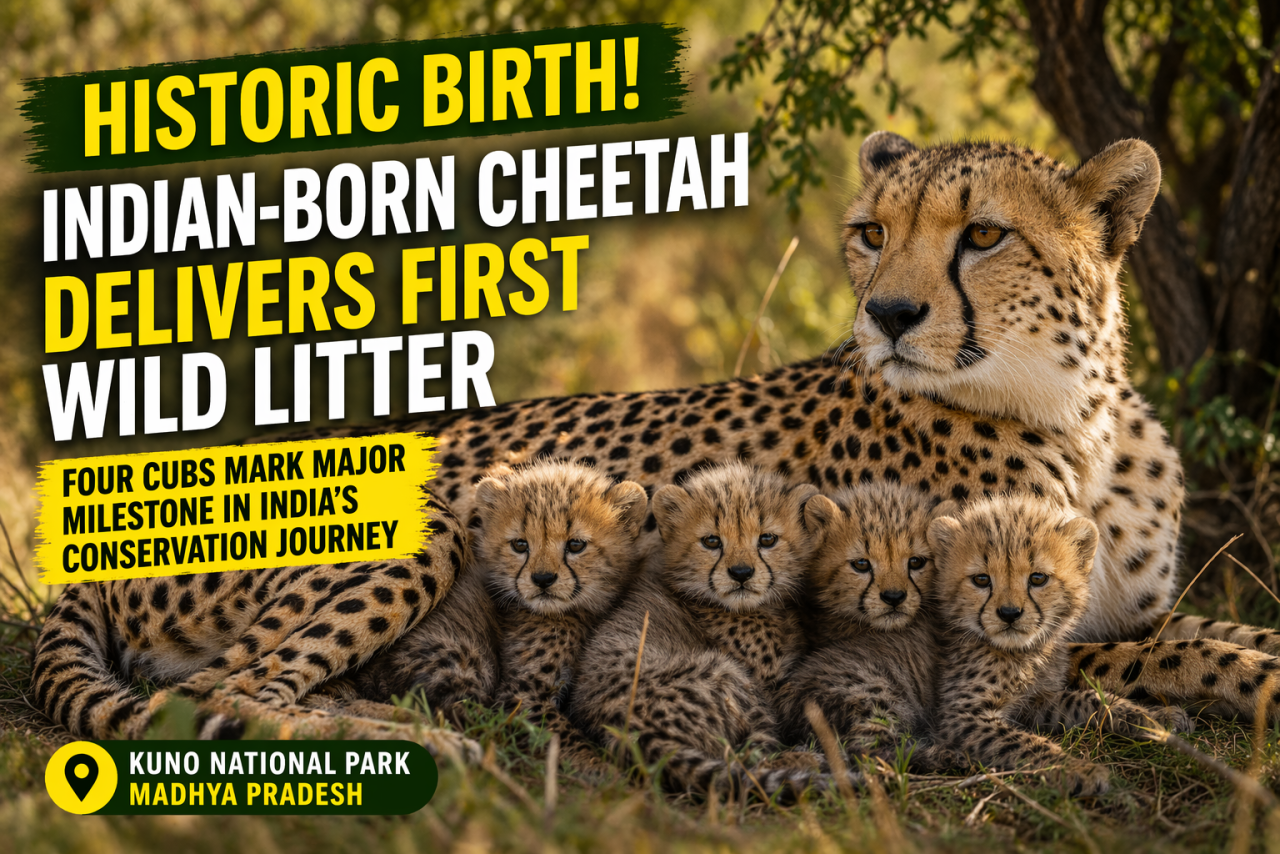
A historic moment unfolds in India’s wildlife as the first wild-born cheetah cubs signal new hope for a species once lost forever
In a significant moment for Indian wildlife, an Indian-born female cheetah has given birth to four cubs in the wild at Kuno National Park. This is the first such event since cheetahs were reintroduced to India in 2022. The development is being seen as a major step forward in the country’s efforts to restore a species that had gone extinct within its borders decades ago.
The cheetah, once widely found across India, was declared extinct in 1952 due to hunting, habitat loss, and decline in prey. For many years, efforts were discussed to bring the species back. The plan finally took shape under an ambitious conservation program that aimed to reintroduce cheetahs from Africa into suitable Indian habitats.
Under this project, several cheetahs were brought from Namibia and South Africa and released into Kuno National Park. The goal was to create a stable and growing population that could adapt to Indian conditions. Wildlife experts closely monitored the animals after their release. They studied their movement, hunting patterns, and health.
The birth of four cubs in the wild is an important sign that the cheetahs are adapting to their new environment. It also shows that the habitat is suitable for breeding. This is crucial for the long-term survival of the species in India. Without successful breeding, the population would depend only on imported animals.
Union Environment Minister Bhupender Yadav described the event as a major milestone in India’s conservation journey. Officials believe that this success reflects careful planning and continuous monitoring by wildlife authorities.
The mother cheetah was born in India. Her own mother had been translocated from South Africa. This makes the new litter even more important. It shows that the second generation is now capable of surviving and reproducing in the wild. This is a key goal of any wildlife reintroduction program.
Experts say that raising cubs in the wild is not easy. Cheetah cubs face many dangers. These include predators, disease, and lack of food. In Africa, survival rates of cheetah cubs are often low. For this reason, wildlife teams in Kuno are keeping a close watch. However, they are also ensuring minimal human interference so that the animals behave naturally.
Kuno National Park has been selected carefully for this project. It has grasslands and open forests that suit the cheetah’s hunting style. It also has prey animals such as deer and antelope. These conditions are important for the cheetah’s survival. Still, experts point out that more work is needed to improve prey density and reduce human disturbance in nearby areas.
The success of this birth also brings attention to the broader importance of wildlife conservation in India. Restoring a top predator like the cheetah can help maintain ecological balance. It can control herbivore populations and support healthy grassland ecosystems. This, in turn, benefits many other species.
At the same time, challenges remain. Some cheetahs have died since the project began. There have been concerns about disease, climate conditions, and adaptation issues. Critics have questioned whether India is fully ready for such a project. Authorities have responded by improving veterinary care and habitat management.
Local communities also play an important role. People living near Kuno need to be involved in conservation efforts. Their support can help reduce conflict and ensure the safety of wildlife. Awareness programs and compensation schemes are being used to build trust.
The birth of these cubs is a positive sign, but it is only one step in a long process. Conservation is a slow and continuous effort. It requires patience, scientific planning, and cooperation between many groups.
For now, the sight of a cheetah family in the wild of India offers hope. It shows that lost species can return with the right effort. It also reminds us of the responsibility to protect nature for future generations.
If the cubs survive and grow, they will become symbols of a successful conservation story. Their journey will be closely watched by experts and nature lovers across the country.
In a significant moment for Indian wildlife, an Indian-born female cheetah has given birth to four cubs in the wild at Kuno National Park. This is the first such event since cheetahs were reintroduced to India in 2022. The development is being seen as a major step forward in the country’s efforts to restore a species that had gone extinct within its borders decades ago.
The cheetah, once widely found across India, was declared extinct in 1952 due to hunting, habitat loss, and decline in prey. For many years, efforts were discussed to bring the species back. The plan finally took shape under an ambitious conservation program that aimed to reintroduce cheetahs from Africa into suitable Indian habitats.
Under this project, several cheetahs were brought from Namibia and South Africa and released into Kuno National Park. The goal was to create a stable and growing population that could adapt to Indian conditions. Wildlife experts closely monitored the animals after their release. They studied their movement, hunting patterns, and health.
The birth of four cubs in the wild is an important sign that the cheetahs are adapting to their new environment. It also shows that the habitat is suitable for breeding. This is crucial for the long-term survival of the species in India. Without successful breeding, the population would depend only on imported animals.
Union Environment Minister Bhupender Yadav described the event as a major milestone in India’s conservation journey. Officials believe that this success reflects careful planning and continuous monitoring by wildlife authorities.
The mother cheetah was born in India. Her own mother had been translocated from South Africa. This makes the new litter even more important. It shows that the second generation is now capable of surviving and reproducing in the wild. This is a key goal of any wildlife reintroduction program.
Experts say that raising cubs in the wild is not easy. Cheetah cubs face many dangers. These include predators, disease, and lack of food. In Africa, survival rates of cheetah cubs are often low. For this reason, wildlife teams in Kuno are keeping a close watch. However, they are also ensuring minimal human interference so that the animals behave naturally.
Kuno National Park has been selected carefully for this project. It has grasslands and open forests that suit the cheetah’s hunting style. It also has prey animals such as deer and antelope. These conditions are important for the cheetah’s survival. Still, experts point out that more work is needed to improve prey density and reduce human disturbance in nearby areas.
The success of this birth also brings attention to the broader importance of wildlife conservation in India. Restoring a top predator like the cheetah can help maintain ecological balance. It can control herbivore populations and support healthy grassland ecosystems. This, in turn, benefits many other species.
At the same time, challenges remain. Some cheetahs have died since the project began. There have been concerns about disease, climate conditions, and adaptation issues. Critics have questioned whether India is fully ready for such a project. Authorities have responded by improving veterinary care and habitat management.
Local communities also play an important role. People living near Kuno need to be involved in conservation efforts. Their support can help reduce conflict and ensure the safety of wildlife. Awareness programs and compensation schemes are being used to build trust.
The birth of these cubs is a positive sign, but it is only one step in a long process. Conservation is a slow and continuous effort. It requires patience, scientific planning, and cooperation between many groups.
For now, the sight of a cheetah family in the wild of India offers hope. It shows that lost species can return with the right effort. It also reminds us of the responsibility to protect nature for future generations.
If the cubs survive and grow, they will become symbols of a successful conservation story. Their journey will be closely watched by experts and nature lovers across the country.























Leave a Comment