
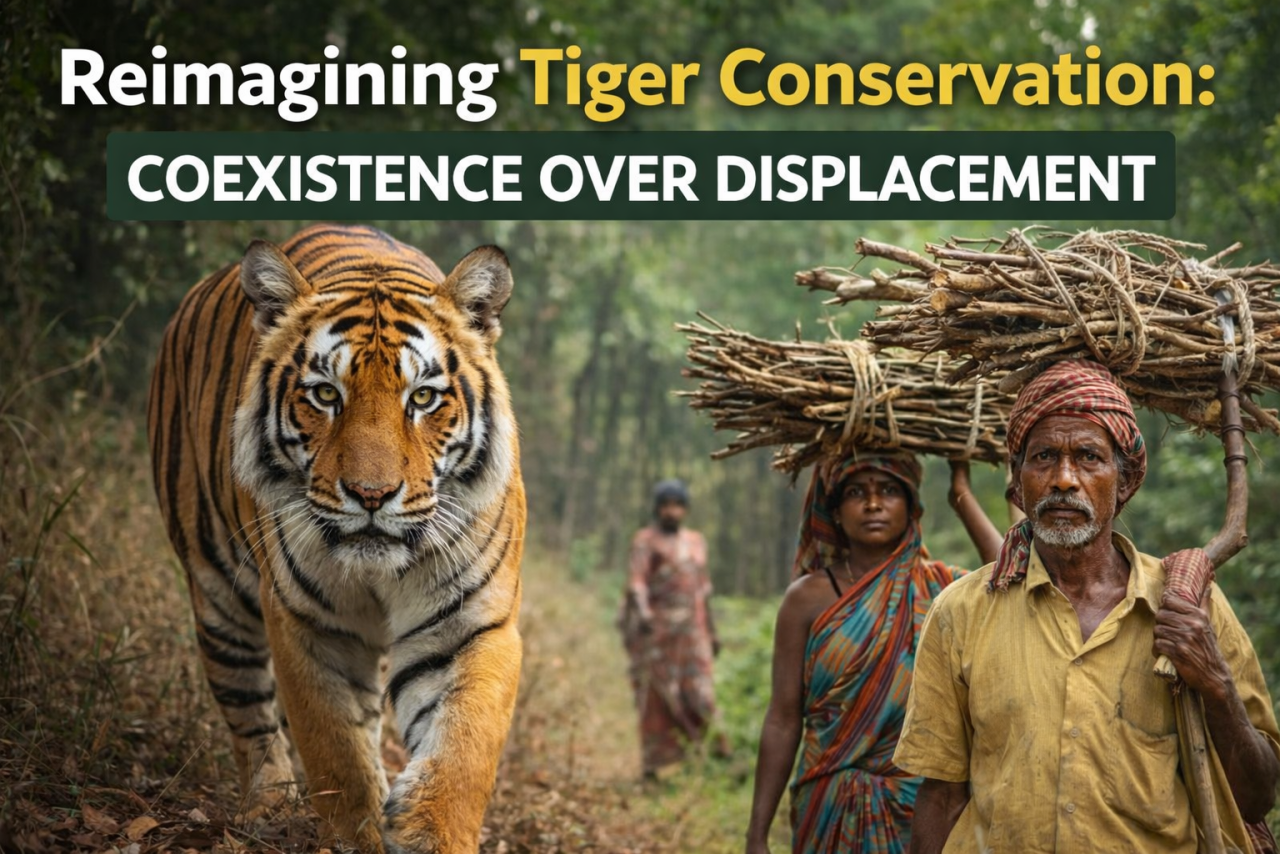
India is rewriting its tiger conservation story—moving from eviction to coexistence, where forests are no longer just for wildlife, but shared with those who call them home.
India’s approach to wildlife conservation—particularly in its famed tiger reserves—is undergoing a quiet but significant shift. A recent recommendation by the Standing Committee of the National Board for Wildlife (NBWL) signals a move away from a long-standing “relocation-first” strategy toward a more nuanced model that prioritises coexistence between forest-dwelling communities and wildlife.
For decades, conservation policy in India, guided largely by the National Tiger Conservation Authority (NTCA), has emphasised the relocation of human settlements from core areas of tiger reserves. The underlying logic was straightforward: reduce human interference to create inviolate spaces for wildlife to thrive. However, this approach has often led to social tensions, prolonged legal battles, and ethical questions about the rights of indigenous communities who have lived in these forests for generations.
The NBWL committee’s latest position reflects a growing recognition that conservation cannot be pursued in isolation from human realities. According to the committee’s observations, coexistence between forest dwellers and wildlife should be actively promoted in core areas wherever feasible. At the same time, voluntary relocation remains an option—but only when communities are willing and adequately informed.
This marks a notable departure from the NTCA’s earlier stance. In 2007, the authority had directed states to notify core Critical Tiger Habitats (CTHs) within a fixed timeframe. Many states, under pressure to comply, expanded core areas rapidly, often merging them with buffer zones without sufficient site-specific assessments. This process inadvertently placed a large number of villages within designated core zones, intensifying the challenge of relocation.
The scale of the issue is significant. Data presented to the committee indicates that while tens of thousands of families have been relocated from core areas over the years, a substantial number still reside within these critical habitats. The pace of relocation has been slow, not only due to administrative and financial constraints but also because of resistance from communities deeply rooted in these landscapes.
Experts argue that such resistance is not merely logistical but cultural and existential. Ecologist Raman Sukumar, who participated in the discussions, highlighted that many forest-dwelling communities have lived in these regions for centuries. In places like the Biligiri Ranganathaswamy Temple Tiger Reserve in Karnataka or the Sathyamangalam Tiger Reserve in Tamil Nadu, relocation is particularly complex due to deep social, cultural, and economic ties to the land.
The committee also underscored the importance of evidence-based policymaking. It has called for socio-economic and ecological studies, to be conducted with the support of institutions such as the Wildlife Institute of India, to better identify core areas, buffer zones, and the feasibility of coexistence. The aim is to enable communities to make informed decisions about relocation, rather than being compelled by top-down directives.
Importantly, the findings suggest that coexistence is not merely an idealistic concept but has yielded tangible conservation outcomes in certain contexts. In some reserves, tiger populations have shown significant growth even in landscapes where human presence continues. This challenges the long-held assumption that human activity and wildlife conservation are inherently incompatible.
However, the shift toward coexistence is not without its critics. Some conservationists caution that diluted protection measures could compromise the long-term survival of endangered species like the tiger. They argue that inviolate spaces remain essential, particularly in areas with high ecological sensitivity.
At the same time, the legal landscape adds another layer of complexity. The relocation of forest dwellers remains a contentious issue, currently under scrutiny in the Supreme Court. The debate intersects with the Forest Rights Act, 2006, which recognises the rights of Scheduled Tribes and other traditional forest dwellers over land and resources. Critics of forced relocation argue that bypassing these rights not only violates the law but also undermines the legitimacy of conservation efforts.
The committee appears to be advocating a middle path—one that balances ecological priorities with social justice. It emphasises a “balanced approach” that recognises both the need to protect biodiversity and the socio-economic aspirations of local communities.
Another emerging concern flagged during the discussions is the rise in human-leopard conflict outside protected areas. As leopards increasingly adapt to scrub forests and peri-urban landscapes, conservation challenges are no longer confined to designated reserves. This underscores the need for broader landscape-level planning that integrates wildlife conservation with human development.
Ultimately, the evolving policy discourse reflects a deeper shift in conservation thinking in India. It acknowledges that forests are not empty wildernesses but living landscapes shaped by human presence. The future of tiger conservation, therefore, may depend less on exclusion and more on coexistence—on finding ways for humans and wildlife to share space without undermining each other’s survival.
As India continues to balance its global leadership in tiger conservation with its constitutional commitment to social justice, the path forward will require careful negotiation, robust data, and, above all, a willingness to listen to those who call the forest home.



























Leave a Comment