
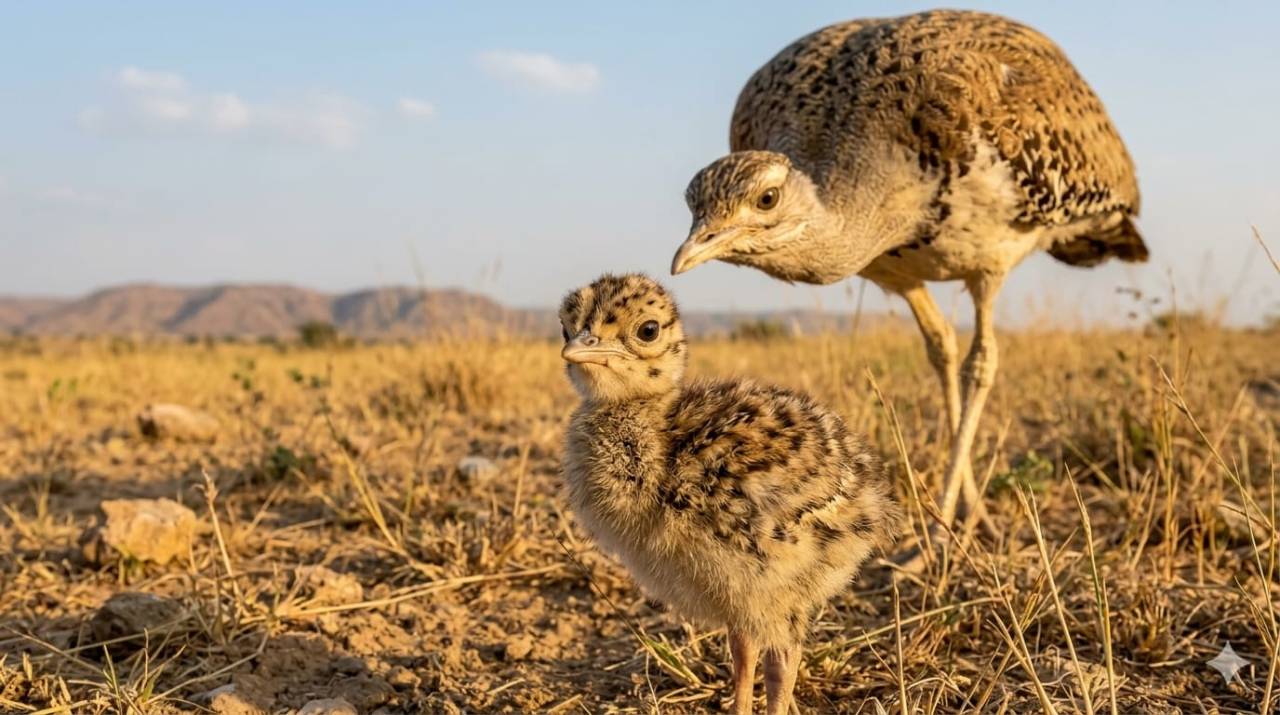
A decade later, a single hatchling in Gujarat’s grasslands is rewriting the survival story of one of India’s most endangered birds.
In a landmark achievement for wildlife conservation, the arid grasslands of Kutch have witnessed a sight not seen in ten years—the birth of a Great Indian Bustard (GIB) chick in the wild. This historic development, announced by Union Environment Minister Bhupender Yadav, could mark a turning point for a species teetering on the brink of extinction.
The arrival of the hatchling is not a matter of chance, but the outcome of a carefully executed scientific intervention known as the “jumpstart” method. This inter-state collaboration between Rajasthan and Gujarat represents a significant step forward in avian conservation, overcoming biological barriers that had made natural breeding in Gujarat nearly impossible.
The Crisis in the Grasslands
The significance of this breakthrough becomes clearer against the backdrop of the GIB’s declining population. Once widespread across India, the species has suffered a dramatic fall due to habitat loss, human activity, and predation.
In Gujarat, the situation has been particularly severe. Experts estimate that only three females remain in the wild, with no surviving males—making natural reproduction virtually impossible.
The broader national picture is equally alarming. According to a 2018 census conducted by the Wildlife Institute of India, the population of the Great Indian Bustard declined from 745 in 1978 to around 128 in 2018. Recent estimates suggest that fewer than 100 GIB’s may now remain in the wildlife across India.
The Anatomy of a ‘Jumpstart’
The “jumpstart” method is a sophisticated conservation strategy designed to give captive-bred birds a natural upbringing in the wild. The process involves precision, coordination, and timing:
- Sourcing and Transport: A fertile egg was obtained from a conservation breeding centre in Sam, Rajasthan.
- The 770-km Corridor: The egg was transported over 770 kilometers to Kutch in a portable incubator during a 19-hour non-stop journey, supported by a specially arranged halt-free corridor.
- The Substitution: Conservationists identified a wild female in the Naliya region that had laid an infertile egg. This egg was carefully replaced with the fertile one.
- Wild Rearing: Unaware of the swap, the wild female incubated the egg. It hatched on March 26, just days after placement on March 22.
This method ensures that the chick is raised in its natural habitat, learning critical survival skills such as foraging and predator awareness from its foster mother. Such “rewilding” from birth significantly improves its chances of surviving in the harsh grassland ecosystem.
Challenges and Hope
While the successful hatching is a milestone, conservationists stress that the journey ahead remains complex. The success of Project GIB, launched in 2016, depends not only on breeding but also on sustainable habitat restoration.
Currently, around 73 captive-bred birds are housed in breeding centres in Rajasthan. However, the number of suitable release sites remains limited. Experts warn that without protecting grasslands from encroachment and mitigating threats like overhead power lines, long-term recovery may remain elusive.
For now, the lone chick in Kutch stands as a powerful symbol of hope. It reflects the potential of scientific innovation and inter-state collaboration in reversing ecological decline. As it grows under the care of its foster mother, this young bird carries the fragile promise of survival for an entire species.























Leave a Comment