
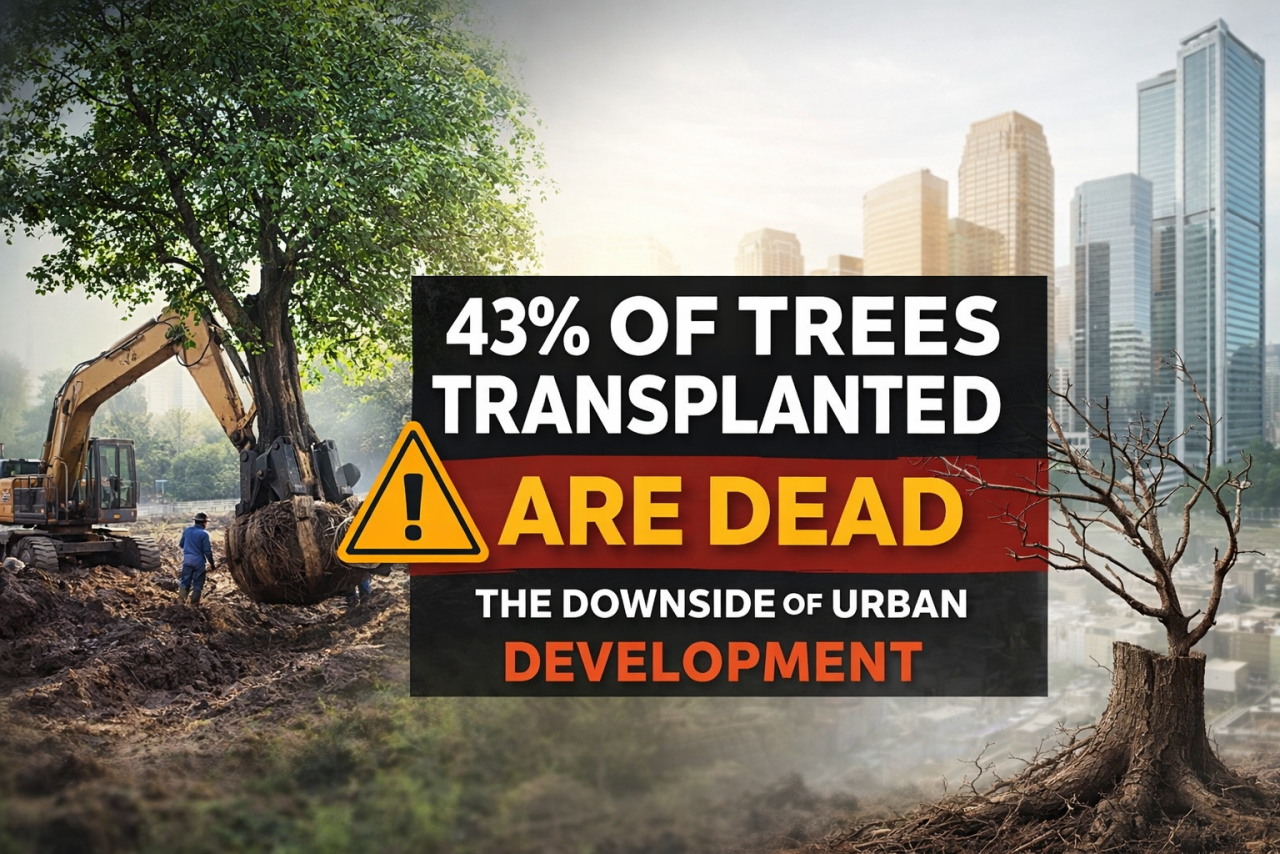
Can development truly be called progress when nearly half the trees meant to be ‘saved’ end up dying?
A recent news report has revealed a deeply concerning statistic that nearly 43% of trees transplanted for the Central Vista redevelopment project in New Delhi have died. This figure raises serious questions about the environmental cost of large-scale infrastructure projects and the effectiveness of tree transplantation as a conservation strategy.
Tree transplantation is often presented as a solution that balances development with environmental protection. When mature trees stand in the path of construction, authorities frequently promise to uproot and replant them elsewhere rather than cutting them down. On paper, this appears to be a responsible compromise. However, the ground reality, as highlighted in this case, suggests otherwise.
The report indicates that thousands of trees were transplanted as part of the Central Vista project, which aims to redesign and redevelop the administrative heart of the country. Despite significant financial investment and logistical efforts, a large portion of these trees did not survive. This high mortality rate points to systemic issues in the planning and execution of transplantation efforts.
One of the key reasons behind such failures is the biological sensitivity of mature trees. Unlike saplings, fully grown trees have extensive root systems that are deeply embedded in the soil. Uprooting them inevitably damages these roots, making it difficult for the trees to adapt to new environments. Even with advanced machinery and techniques, the stress of transplantation can be too much for many trees to handle.
Another important factor is the choice of location and post-transplant care. Trees require specific soil conditions, adequate water supply, and proper maintenance to survive. If these conditions are not met consistently, the chances of survival decrease significantly. The report suggests that post-transplant monitoring and care may not have been sufficient in many cases, contributing to the high death rate.
The financial implications are also worth noting. Large sums of public money are spent on transplantation projects, including transportation, labor, and maintenance. When nearly half of the transplanted trees fail to survive, it raises concerns about the efficient use of resources. This money could potentially be better utilized in planting new trees and ensuring their long-term growth.
Beyond economics, the ecological impact is even more serious. Mature trees play a crucial role in maintaining urban ecosystems. They provide shade, reduce air pollution, support biodiversity, and help regulate temperatures. Losing such a significant number of trees means a direct loss of these benefits, which cannot be quickly replaced. Newly planted saplings take years, if not decades, to reach the ecological value of mature trees.
This situation also highlights a broader issue in urban planning: the tendency to prioritize development over sustainability. While infrastructure projects are essential for growth, they should not come at the cost of environmental degradation. The high mortality rate of transplanted trees suggests that current approaches may be more symbolic than effective.
To address this issue, authorities need to rethink their strategies. First, there should be stricter assessment before deciding to transplant trees. Not all trees are suitable candidates for transplantation, and decisions should be based on scientific evaluation rather than convenience. Second, greater emphasis should be placed on preserving trees in their original locations whenever possible.
Additionally, transparency and accountability are crucial. Regular public reports on the survival rates of transplanted trees can help ensure that agencies remain responsible for their actions. Independent audits and expert involvement can further improve the process.
Finally, the death of 43% of transplanted trees in the Central Vista project serves as a wake-up call. It underscores the gap between policy promises and actual outcomes. If India is to pursue sustainable development, it must move beyond symbolic gestures and adopt practices that genuinely protect its natural resources.




















Leave a Comment