
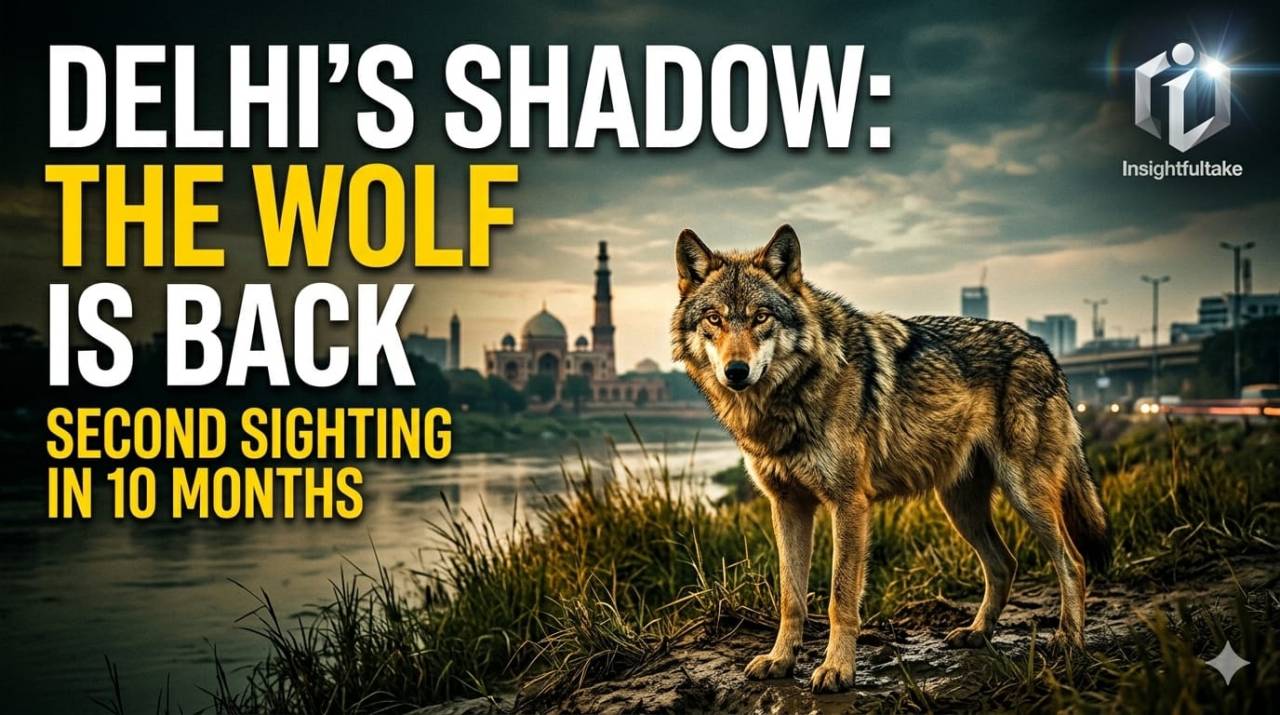
A ghost of the wild has returned to Delhi—after decades of absence, the Indian grey wolf’s second sighting in 10 months is raising a bigger question: is the capital quietly becoming a corridor for one of India’s most elusive predators?
A second sighting of the Indian grey wolf in the Yamuna floodplains of North Delhi has rekindled interest among wildlife experts and conservationists, marking a rare reappearance of the elusive predator in the national capital within a span of less than a year.
The latest sighting occurred in the Palla area on a Saturday morning, nearly ten months after a similar observation was reported from the same region in May last year. The animal was spotted by wildlife enthusiast Hemant Garg, who observed it for approximately seven to eight minutes before it retreated into the dense riverine grasses.
According to Mr. Garg, the wolf appeared to be in good physical condition and was covered in a thick winter coat. Its presence in close proximity to the earlier sighting has prompted speculation among experts that the Yamuna floodplains may function as a natural movement corridor for the species.
Identification and expert views
Photographs of the animal have been examined by wildlife researchers, lending credibility to the sighting. Dr. Bilal Habib of the Wildlife Institute of India confirmed that the animal in the images is consistent with a wolf. However, he cautioned that without genetic analysis, it remains difficult to conclusively determine whether the animal is a pure Indian grey wolf or a hybrid.
Another leading expert, Y.V. Jhala, also reviewed the images and concurred with the identification. While noting that the tail appeared slightly bushier than usual, he attributed this to the winter coat, which can alter the animal’s appearance. Based on its size, he assessed the animal to be an adult, though its sex could not be determined from the available visuals.
A rare return to the capital
The reappearance of the Indian grey wolf in Delhi is considered a significant development. Prior to the sighting reported last year, there had been no official records of wolves in the city since the 1940s. Over the decades, rapid urbanisation and habitat fragmentation were believed to have driven the species out of the region.
The Indian grey wolf, one of the oldest wolf lineages globally, is currently classified as “Vulnerable” by the International Union for Conservation of Nature (IUCN). Estimates suggest that the global population comprises between 2,877 and 3,310 mature individuals in the wild, underlining the ecological importance of each confirmed sighting.
Local reactions and official response
While the scientific community has welcomed the development, local responses have been mixed. Similar sightings last year had triggered scepticism among some residents, with claims that the animal could be a stray or feral dog. However, wildlife experts had firmly validated the earlier reports as those of a wolf.
The Delhi Forest Department has not yet issued an official statement on the latest sighting.
For now, the reappearance of the species offers a reminder that fragments of wild habitats continue to persist within the expanding urban landscape. The Yamuna floodplains, despite increasing anthropogenic pressures, appear to retain ecological characteristics capable of supporting even one of India’s most elusive predators.


























Leave a Comment